Emergency communication is not simply a backup phone system used when routine channels fail. In real incidents, it becomes the operational backbone that connects command centers, field responders, public warning channels, mobile teams, remote experts, and affected communities into one continuous information chain. A workable emergency response communication solution must therefore support more than voice. It must support dispatch, coordination, alerts, video, data exchange, location visibility, and cross-agency collaboration under unstable and fast-changing conditions.
That requirement becomes clear in earthquakes, floods, industrial accidents, wildfires, port incidents, transport disruptions, and large public events. In such scenarios, the first challenge is rarely the absence of devices. The real problem is fragmentation: radio systems are isolated, public cellular networks become congested, field teams cannot share data with command platforms, and warning information fails to reach the right people at the right time. A mature emergency communication solution is designed to reduce this fragmentation by creating a layered and interoperable communication framework.
From a project perspective, the goal is not to replace every existing communication tool with a single new platform. The more practical approach is to integrate multiple access methods, transport networks, and dispatch interfaces, then define clear operating logic for failover, escalation, and information synchronization. This is why modern emergency communication projects increasingly adopt hybrid architecture rather than relying on a single network or a single terminal type.
An emergency communication solution should be judged not by whether it works in normal conditions, but by whether it remains usable when power is unstable, infrastructure is damaged, traffic surges, and multiple departments need to coordinate at the same time.
An emergency response communication solution usually combines field terminals, radio systems, IP networks, satellite links, dispatch software, GIS mapping, public alerting interfaces, and command center applications. These components do not all operate in the same way or on the same protocol. The solution layer is what connects them into a usable operational framework.
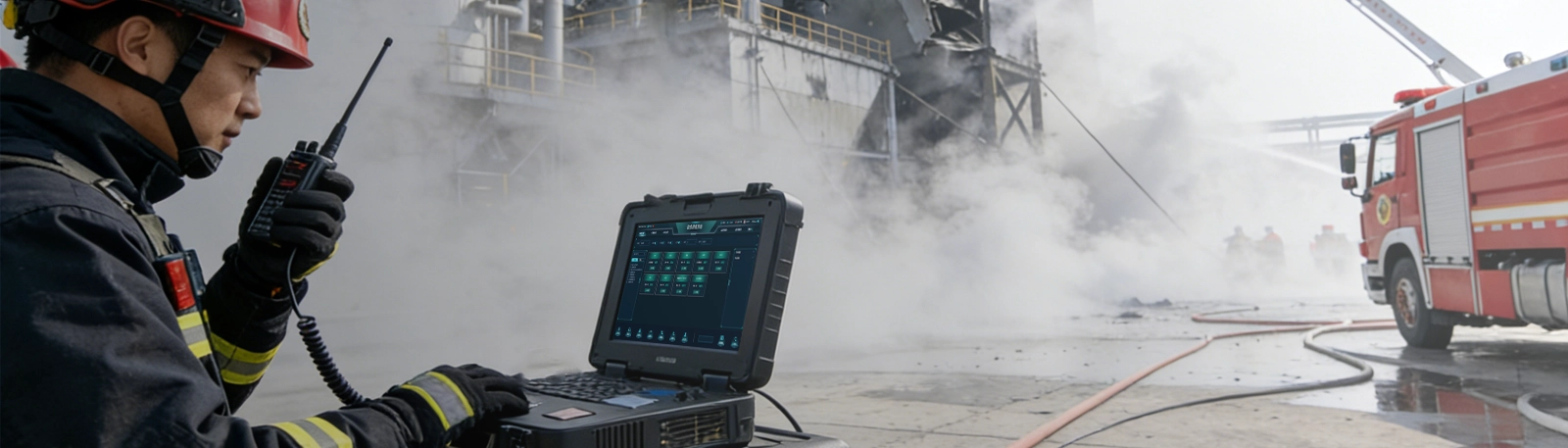
For example, firefighters may communicate over UHF or VHF radios on the scene, command staff may rely on IP dispatch consoles, mobile teams may upload video through 4G or 5G routers, and remote coordination may depend on satellite backhaul when terrestrial infrastructure is unavailable. If these channels remain isolated, information flow is delayed. If they are unified through gateways, dispatch logic, and shared situational awareness tools, the response becomes faster and more coherent.
This is why emergency communication planning should always begin with service flows rather than device lists. The first design question is not which handset, radio, or software to buy. The first question is how information should move between alert origin, command, dispatch, field execution, and status feedback.
During a major emergency, the communication environment changes rapidly. Public networks may still exist but become overloaded. Local fiber may remain intact in one district but fail in another. Indoor coverage may be poor, outdoor command vehicles may need instant connectivity, and temporary shelters may require public address and notification functions. The solution must therefore provide continuity, not just connectivity.
Continuity means the communication chain can survive degradation. When broadband weakens, mission-critical voice must still pass. When the main route fails, the backup route must take over. When one department cannot directly access another department’s network, an interoperability layer must bridge the gap. This principle often matters more than theoretical peak bandwidth.
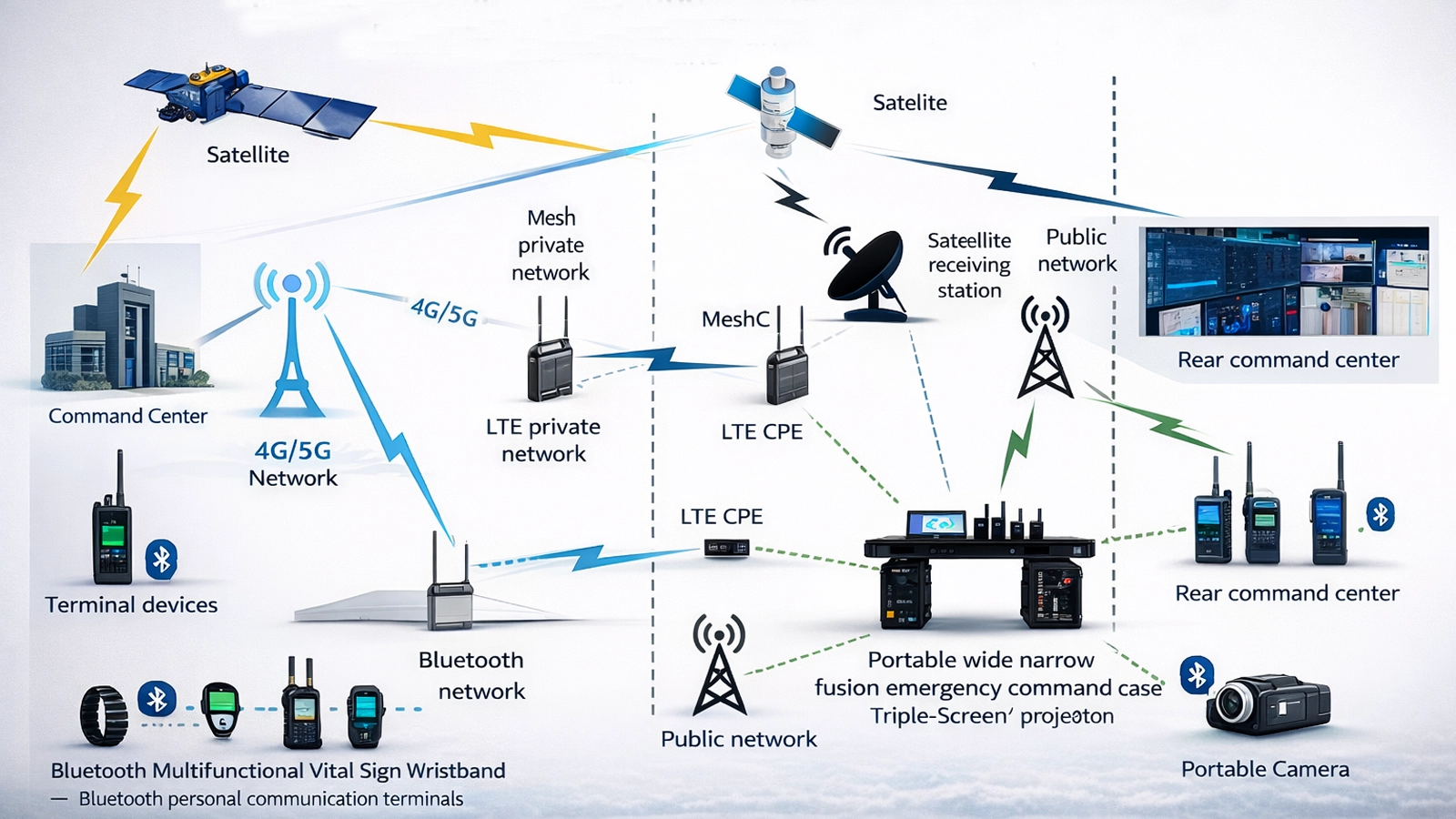
In practical deployment, continuity usually comes from layered communication design, such as radio for immediate on-site voice, cellular for mobile broadband, satellite for remote or damaged regions, and local IP or mesh networking for temporary site expansion. Each layer covers a different risk.
Resilience means the system must remain available when normal infrastructure is impaired. This includes redundant links, backup power, protected edge devices, failover routing, and decentralized operation modes. A command platform that depends entirely on one data center or one access network is vulnerable in real incidents.
Coverage means more than geographic reach. In emergency planning, coverage must be considered across terrain, building types, underground spaces, coastal areas, tunnels, industrial sites, and mobile command zones. Wide-area coverage may come from public networks or satellite systems, while local dead zones may require repeaters, portable base units, or temporary wireless mesh nodes.
Interoperability is equally critical because incident response rarely belongs to one team alone. Fire, police, medical services, municipal departments, utilities, industrial safety teams, and transport operators may all participate. If their systems cannot exchange voice, alerts, or status information, command effectiveness drops quickly.
Emergency communication often carries sensitive content, including casualty details, infrastructure status, incident locations, and internal coordination instructions. Encryption, secure authentication, access control, and audit logs are therefore important. Secure SIP signaling, encrypted radio traffic, VPN tunnels, and role-based command access are all relevant in modern system design.
However, security cannot be implemented in a way that makes the system too slow or complex to use in the field. Responders under stress need simple interfaces, predictable workflows, and fast access to core functions. A technically secure system that is difficult to operate may fail in practice. This is why field usability testing is as important as technical compliance.
In well-designed projects, security is embedded into the communication path without overburdening the operator. The user sees clear priority calling, group coordination, alarm reporting, and dispatch actions, while encryption and identity management remain largely transparent in the background.
Resilience through redundancy, backup power, and multi-path communication
Coverage through layered access networks and portable extension nodes
Interoperability through gateways, standards, and shared dispatch interfaces
Security through encryption, authentication, and controlled permissions
Usability through clear workflows, rugged terminals, and familiar operations
UHF and VHF radio remain essential because they provide immediate low-latency voice without relying on the public internet. In dense response operations, push-to-talk group communication is still one of the fastest ways to coordinate teams on the ground. Digital standards such as DMR or P25 further improve manageability, encryption support, and structured group calling.
Cellular networks, especially 4G and 5G, provide the broadband layer of emergency communication. They are useful for live video, image transmission, mobile access to incident databases, remote consultation, and GPS-based team visibility. Their weakness is congestion and infrastructure dependence, which means they are valuable but should not be the only communication backbone in emergency planning.
Satellite communication provides independence from damaged local infrastructure. It is especially important in remote, offshore, mountainous, or disaster-hit areas where terrestrial backhaul is no longer reliable. Satellite is often used as a strategic backup or as the primary WAN path for temporary command posts when restoration is still underway.
Wireless mesh networking is useful when responders need fast local connectivity without waiting for traditional infrastructure recovery. Portable mesh nodes can create a temporary data network across a disaster site, field camp, or damaged urban zone. This is particularly effective for short-term data exchange, localized sensor integration, and field coordination where infrastructure is incomplete.
At the same time, local IP networks remain important inside shelters, command vehicles, temporary control rooms, industrial emergency stations, and municipal coordination centers. SIP telephony, intercom, IP paging, alarm endpoints, and video devices can all operate over the same local network, provided prioritization and security policies are properly configured.
The most effective solution is therefore not a competition between technologies. It is a layered model in which each technology supports a specific operational role and can hand over traffic when another path degrades.
Use radio for immediate tactical voice on the incident scene.
Use 4G or 5G for mobile broadband, video, and application access.
Use satellite for remote areas, infrastructure failure, or command backup.
Use mesh networking for fast temporary local connectivity.
Use IP-based platforms to unify dispatch, alerting, logging, and coordination.
No single network is enough for emergency response. Reliability comes from combining low-latency voice, broadband data, backup backhaul, and field-level interoperability into one operational framework.
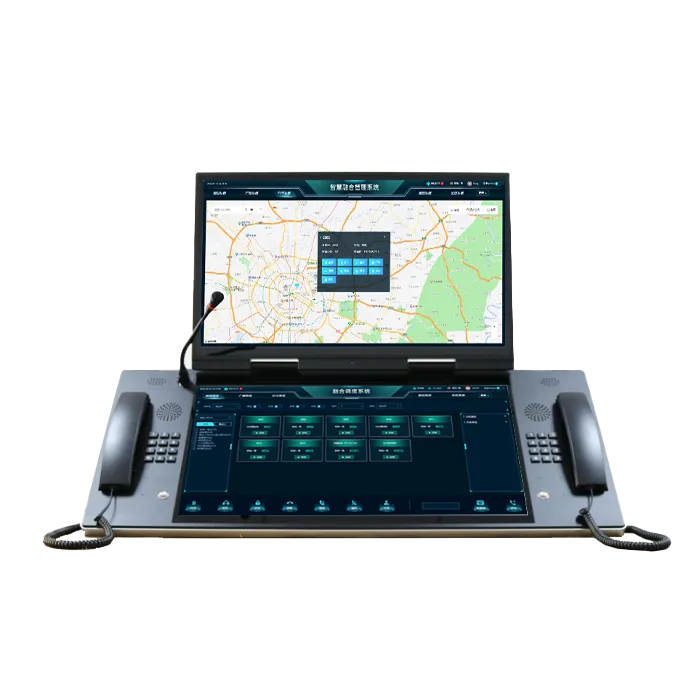
Hardware links are only one part of the solution. The command layer is where incoming information is aggregated, visualized, prioritized, and converted into dispatch decisions. A modern emergency communication platform often includes incident dashboards, GIS maps, call handling, alarm records, unit status tracking, media streams, and workflow logs in a single interface.
This command layer is valuable because emergency operations are not linear. Teams need to see who is available, where they are, what has already been done, what alarms remain active, and which communication paths are still stable. Without a common operating picture, communication becomes fragmented even if the underlying networks are technically functional.
For this reason, emergency communication software should not be evaluated only by messaging or voice features. It should also be evaluated by its ability to support command logic, event escalation, recording, auditability, and cross-department coordination.
GIS and real-time location functions allow command staff to understand incident geography rather than relying only on verbal updates. This matters in flood zones, wildfire perimeters, tunnels, industrial parks, ports, and dispersed municipal areas where physical context directly affects dispatch decisions. Location-linked communication can show which team is closest, which route is blocked, and where support resources should be staged.
Integration also plays a major role. Alarm inputs from industrial systems, public address triggers, CCTV feeds, environmental sensors, and access control events can all be connected into the communication environment. When these data streams are linked with dispatch actions, the system becomes more than a voice network. It becomes a decision support platform.
AI and automation may also help in specific tasks, such as message prioritization, transcription, multilingual support, anomaly detection, and event summarization. Their role should be practical and well bounded. In emergency systems, automation should assist the operator, not remove human control from critical decisions.
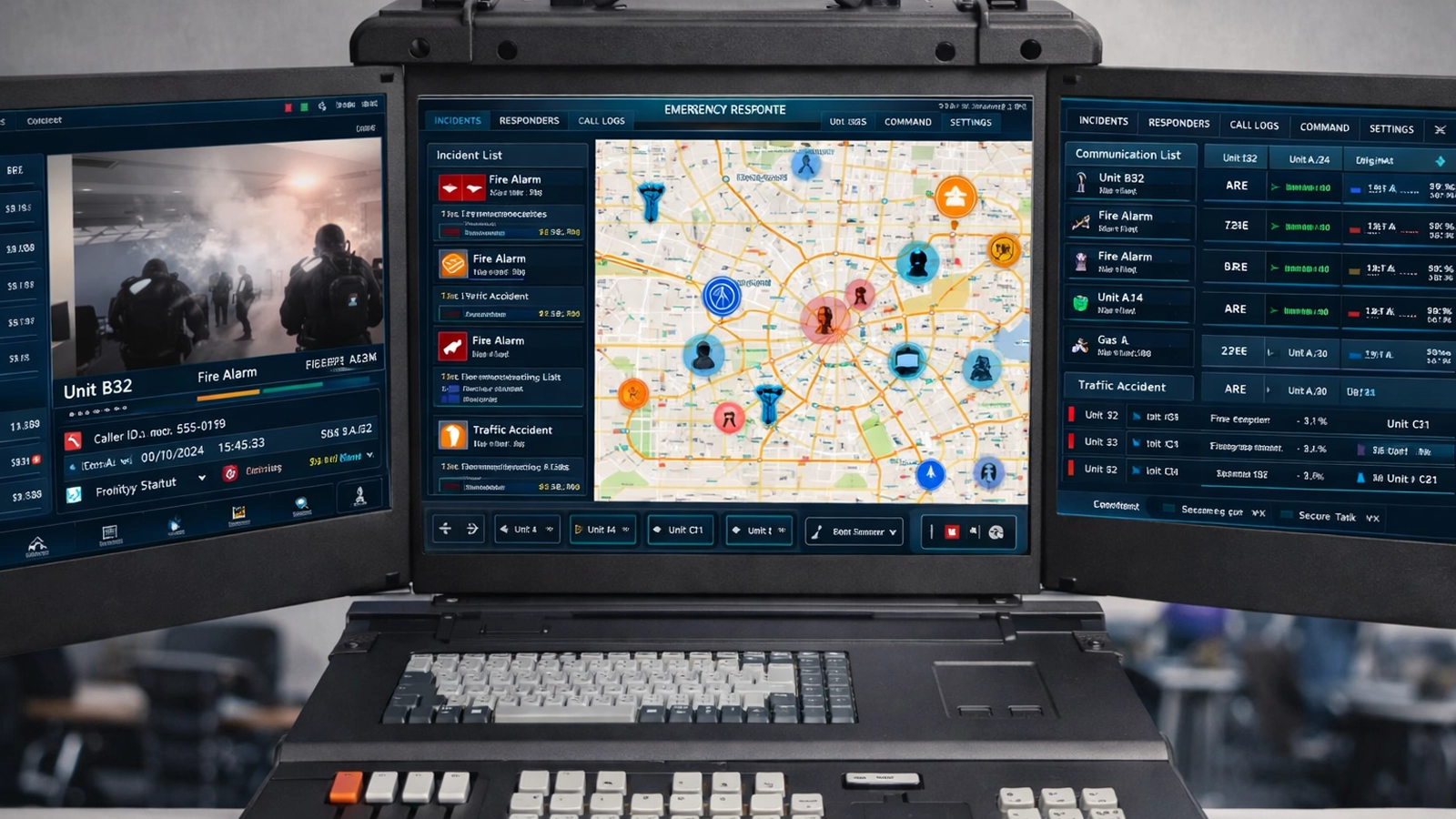
In actual deployments, pure centralized or pure mesh architecture is rarely sufficient on its own. Most emergency communication projects adopt a hybrid model: a core dispatch and management platform at one or more command centers, multiple field access methods, and backup connectivity options for continuity. This model allows stable daily use while preserving flexibility for incident escalation.
For example, a municipal emergency network may use fixed IP infrastructure in normal conditions, connect radio systems through interoperability gateways, extend mobile teams through 4G or 5G routers, and enable satellite uplink for command vehicles or affected districts. When a local segment fails, the overall command structure can still function through alternative routes.
This architecture should also define clear failover logic. Backup communication is only useful if switching rules, operator responsibilities, and service priorities are preconfigured and tested. Otherwise, redundancy exists on paper but not in operations.
Emergency communication design must reflect the physical environment in which it will operate. Industrial facilities may require ruggedized terminals, hazardous-area considerations, and high-noise communication endpoints. Tunnels and underground assets need distributed coverage planning and careful backhaul design. Flood-prone zones require power resilience, elevated equipment placement, and waterproof protection. Mobile command scenarios need fast deployment, compact equipment, and straightforward cabling.
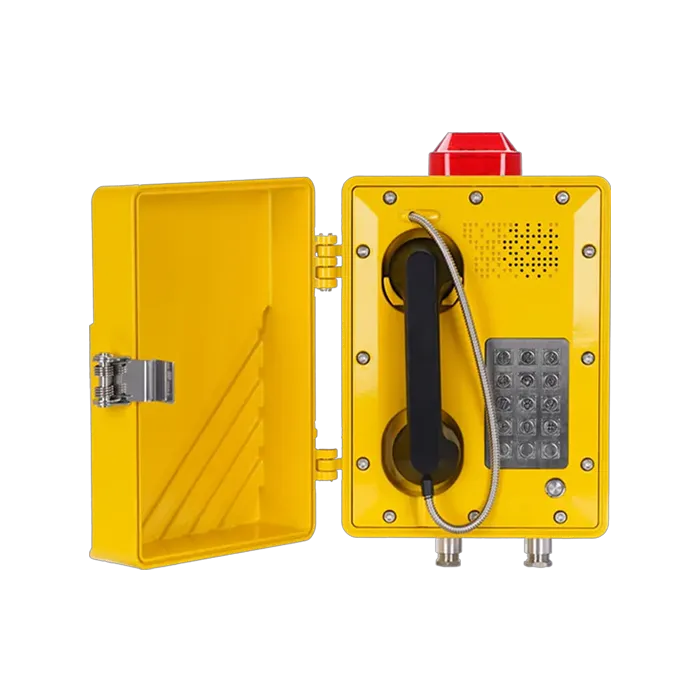
Environmental constraints also influence terminal selection. A dispatcher in a command room, a responder in protective gear, a driver inside a vehicle, and a technician in a chemical plant all use communication devices differently. The solution should support multiple endpoint forms such as handheld radios, desk dispatch consoles, industrial telephones, mobile gateways, intercom terminals, and public address devices.
Testing is therefore indispensable. A communication solution that looks complete in drawings may still fail if radio coverage, power endurance, interoperability timing, audio intelligibility, and link recovery behavior are not verified under realistic conditions.
| Deployment Area | Main Requirement | Typical Communication Focus |
|---|---|---|
| Urban emergency command | Cross-agency coordination | Dispatch platform, radio interconnect, broadband access |
| Industrial incident site | Rugged and safe field communication | Radio, industrial terminals, alarm linkage, resilient local IP |
| Remote or damaged region | Infrastructure-independent connectivity | Satellite backhaul, portable mesh, temporary command nodes |
| Large event or temporary operation | Fast deployment and mobility | Portable gateways, mobile broadband, shared command view |
Earthquakes, hurricanes, floods, and wildfires create a communication environment in which infrastructure status changes by the hour. In these scenarios, the communication solution must support rapid assessment, zone-based deployment, public warning, and progressive restoration. Satellite and portable wireless access often become essential in the first phase, while public cellular and fixed IP networks may gradually rejoin the architecture later.
The communication burden is also distributed across many roles. Field responders need tactical voice and local coordination. Command teams need dashboards and incident visibility. Public communication channels need alerting and information dissemination. Logistics teams need route and resource coordination. A strong solution connects these needs without forcing every role into the same device or workflow.
One common mistake in disaster planning is to focus too heavily on backbone connectivity while underestimating local communication continuity. Both layers matter. A command center may still be online, but if teams in the field cannot report clearly or receive instructions promptly, operational efficiency remains limited.
Industrial accidents, hazardous material leaks, power facility faults, tunnel emergencies, and transport incidents often demand closer integration with alarms, sensors, paging, CCTV, and operational control systems. Here the emergency communication solution must not only transmit voice; it must also support event linkage and structured response workflows.
For example, a hazardous-area incident may trigger alarms, require zone-based evacuation messaging, initiate direct communication with response teams, and escalate to a city command center. The communication platform should support this chain in a controlled way, including incident logging, group dispatch, priority routing, and status feedback. In many cases, integration quality determines system value more than raw communication capacity.
From a long-term project perspective, this is where technical support and interface assessment become important. Emergency communication systems must coexist with existing radio assets, IP infrastructure, alarm systems, and dispatch procedures. Practical deployment recommendations should therefore consider protocol compatibility, gateway design, endpoint roles, backup policies, and future expansion paths. In that context, solution planning can reasonably extend toward interface evaluation, deployment optimization, and technical support discussions involving platforms such as Becke Telcom where integrated communication scenarios are part of the project scope.
The most reliable emergency communication project is usually the one that respects existing operational habits, integrates the systems already in use, and adds resilience step by step instead of forcing an unrealistic all-at-once replacement.
An emergency response communication solution is best understood as a layered operational architecture built for uncertainty. Its purpose is to preserve command continuity, field coordination, and public information flow when routine communication paths become unstable or overloaded. That is why resilient emergency communication depends on more than one network, more than one terminal type, and more than one software tool.
The most effective solutions combine radio, broadband, satellite, local IP networking, dispatch software, location awareness, and interoperability mechanisms into one manageable framework. They are planned around workflows, tested under realistic conditions, and adapted to the physical and organizational environment in which they will be used.
For technical teams, project owners, and industry users, the real design task is not choosing a single communication technology, but defining how multiple technologies should cooperate during disruption, escalation, recovery, and cross-agency response. That is where interface evaluation, deployment planning, redundancy strategy, and long-term technical support become central to solution quality, including in integrated communication project discussions related to Becke Telcom.
A normal enterprise system is designed primarily for routine efficiency, while an emergency communication solution is designed for continuity under disruption. It must continue working when power, infrastructure, or network conditions are unstable, and it must support coordination across multiple teams and communication methods.
Because different communication technologies solve different operational problems. Radio supports fast on-site voice, cellular supports broadband mobility, satellite supports infrastructure-independent backhaul, and IP platforms unify dispatch and data. A hybrid design reduces the risk of single-point failure.
Not entirely. Public cellular networks are valuable for data, video, and mobile applications, but they can become congested or unavailable during major incidents. Radios still provide immediate tactical voice with lower dependence on public infrastructure, so both layers are typically needed.
Key checks include coverage conditions, interoperability needs, failover logic, power backup, environmental protection, endpoint roles, software integration, and user workflows. Field testing under realistic conditions is essential before the system can be considered operationally reliable.
They should prioritize open interfaces, scalable architecture, modular deployment, and compatibility with existing systems. Expansion works best when the platform can gradually integrate new terminals, networks, applications, and dispatch requirements without disrupting current operations.