


Paging has evolved far beyond the traditional ceiling speaker connected to a local amplifier rack. In modern business, industrial, education, healthcare, transportation, and public safety environments, voice communication must be faster, easier to manage, and more tightly integrated with the wider communication network. That is why IP paging speakers have become an increasingly important part of today’s audio and notification infrastructure.
An IP paging speaker is not simply a speaker with better sound quality. It is a network-connected communication endpoint designed to deliver live announcements, scheduled messages, safety instructions, operational alerts, and emergency notifications over an IP-based system. Instead of relying on legacy analog wiring and fixed hardware zones, IP paging speakers make it possible to distribute audio through an Ethernet network, manage zones by software, and connect paging to SIP telephony, security systems, intercom devices, dispatch platforms, and centralized control interfaces.
For organizations that operate across multiple buildings, large campuses, industrial sites, warehouses, parking facilities, transport terminals, or critical infrastructure, this shift offers clear advantages. IP paging speakers can improve flexibility, reduce infrastructure complexity, support remote management, and help organizations respond more effectively when routine communication or emergency broadcasting is required.
They are also highly relevant in environments where voice communication is tied to operational efficiency and safety. A warehouse may use IP paging speakers for workflow coordination and shift announcements. A hospital may use them for public guidance and localized alerts. A school may rely on them for campus-wide announcements and emergency messaging. A factory may combine them with intercoms, call stations, visual beacons, and control room platforms to support both daily operations and incident response.
In this article, we explore what IP paging speakers are, how they work, the features that define them, the benefits they offer, and the common applications where they bring the most value. We also look at how they fit into broader unified communication and emergency communication solutions, especially in organizations that need more than a standalone public address product.
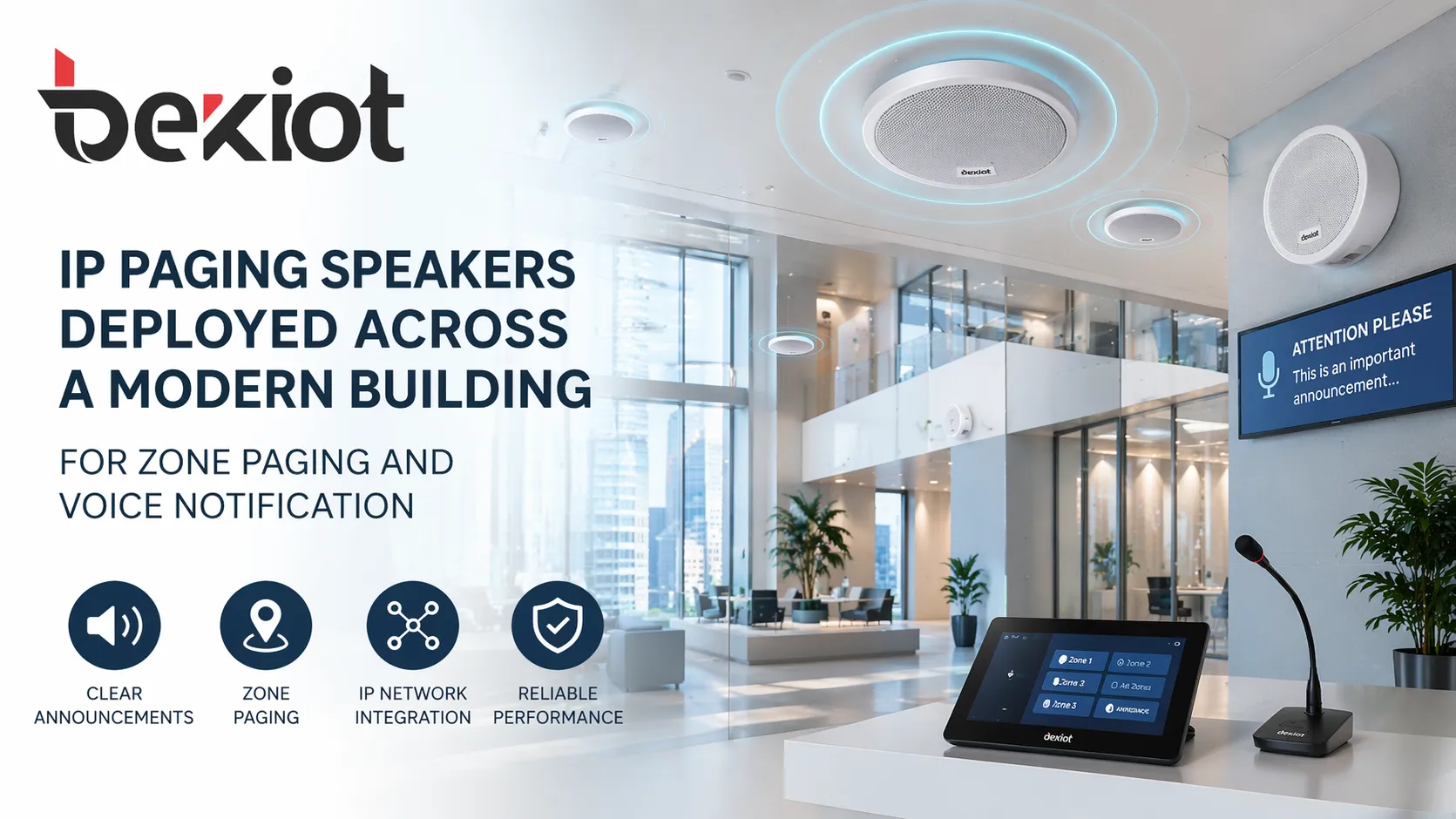
What Are IP Paging Speakers?
IP paging speakers are audio devices that receive voice and audio streams through an IP network rather than through traditional analog audio cabling. In practical terms, they are part of a networked audio system that can be addressed individually, grouped into logical zones, managed remotely, and integrated with other communication platforms.
Unlike conventional analog speakers, which usually depend on a centralized amplifier and physically defined speaker circuits, IP paging speakers operate as intelligent endpoints. Each device typically has its own network identity, can be configured over the network, and may include built-in amplification, SIP support, multicast reception, scheduling functions, and status monitoring. This transforms the speaker from a passive output device into an active node within the communication system.
In many deployments, IP paging speakers are used to deliver routine business communication such as general announcements, shift changes, paging calls, visitor messages, and scheduled reminders. In more advanced systems, they are also used for mass notification, evacuation messaging, incident broadcasting, lockdown instructions, and coordinated emergency response communication.
Depending on the environment, IP paging speakers may appear in different forms. Ceiling speakers are common in offices, schools, hospitals, and retail environments where even audio coverage is needed indoors. Horn speakers are widely used in outdoor areas and noisy industrial spaces because they provide stronger projection and better intelligibility over longer distances. Wall-mounted speakers, column speakers, and specialized ruggedized units may be selected for tunnels, transport facilities, warehouses, ports, or industrial plants.
Because they are network-based, IP paging speakers can also be deployed in a more scalable and distributed way. An organization no longer has to treat paging as an isolated subsystem. Instead, voice announcements can become part of a larger architecture that includes SIP telephony, intercom devices, emergency call boxes, dispatch consoles, access control, CCTV linkage, and alarm management.
How IP Paging Speakers Work
At a basic level, IP paging speakers receive digital audio over the network and convert it into audible output. However, the system behind that process can vary depending on the design of the communication platform and the operational needs of the site.
In a standard enterprise or industrial deployment, the speaker is connected to the Ethernet network, often with Power over Ethernet, which allows both power and data to travel through a single cable. Once connected, the device may be assigned an IP address, provisioned through a management platform, and associated with a paging group, location, or operational zone.
Audio can reach the speaker in several ways. In SIP-based systems, a user may initiate a page from an IP phone, softphone, dispatch console, or control application. The paging server or IP PBX then routes the audio stream to one speaker, a selected group, or a defined zone. In multicast-based systems, the speaker subscribes to one or more audio streams so that live or pre-recorded messages can be delivered efficiently to many endpoints at once. In integrated emergency systems, audio may also be triggered automatically by an alarm platform, panic button event, fire panel interface, or security management workflow.
This is one of the major strengths of IP paging architecture. It is not limited to one method of communication. A control room operator can broadcast live instructions. A facility manager can schedule routine announcements. An incident management platform can trigger a priority evacuation message. A SIP intercom call can be escalated to a public area broadcast. A dispatch system can direct targeted instructions to a specific zone without affecting the rest of the site.
Some systems also support two-way coordination when IP paging speakers are deployed together with SIP intercoms, emergency telephones, or call stations. In those cases, speakers form part of a broader communication loop in which alarms, live calls, public announcements, and control room coordination work together rather than as disconnected subsystems.
IP paging speakers are most valuable when they are treated as part of a connected communication platform, not as isolated audio hardware.
Key Features of IP Paging Speakers
Network-Based Audio Distribution
One of the defining features of IP paging speakers is that they use the existing IP network to distribute audio. This reduces dependence on legacy audio cabling and gives organizations more flexibility in how they design, expand, or restructure their paging infrastructure. It also allows paging to extend across multiple floors, buildings, or remote sites using the same network framework that supports other IP communication services.
For many organizations, this network-based model is a major operational advantage. A site can add new paging points without redesigning the entire system. Existing zones can be reconfigured by software. Temporary spaces, expansion areas, or newly built sections of a facility can be added more easily than in a rigid analog architecture.
SIP Integration
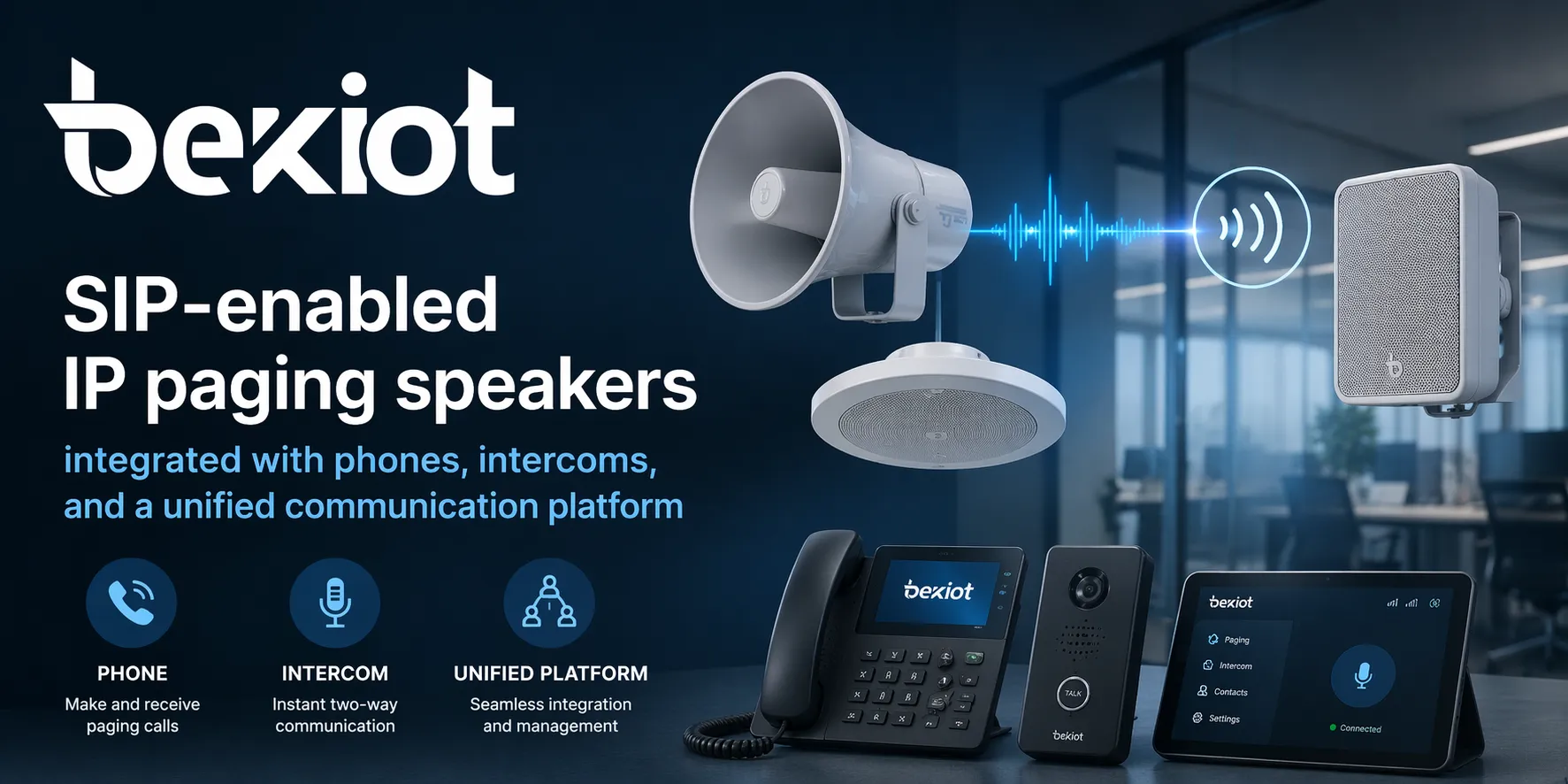
SIP support is one of the most important features to consider when evaluating IP paging speakers. A SIP-enabled speaker can register to a SIP server, IP PBX, or unified communication platform in much the same way as a SIP phone or SIP intercom. This makes it possible for users to initiate paging from familiar telephony devices and workflows.
In practical terms, a receptionist might page the lobby from a desk phone, a supervisor might make a live announcement to a warehouse zone, or a control room operator might broadcast to a selected area through a dispatch console connected to the same communication environment. SIP also helps improve interoperability, which is especially important for organizations that want to avoid locking themselves into a closed paging ecosystem.
Zone Paging and Group Broadcasting
Traditional paging systems often rely on hardware-defined zones that are difficult to modify once installed. IP paging speakers support software-defined zoning, allowing users to create zones based on floors, buildings, operational departments, parking levels, outdoor areas, production lines, or safety sectors.
This flexibility matters in daily operations and in emergency situations. Routine announcements may be relevant only to a single zone, while urgent safety messages may need to reach multiple areas at once. IP paging systems can also support priorities, ensuring that critical messages override normal background announcements when necessary.
Power over Ethernet
PoE support simplifies deployment by allowing both power and network communication to run through a single Ethernet cable. This reduces installation complexity, lowers the need for separate local power sources, and helps speed up rollout across large facilities. For building owners and integrators, PoE also improves project planning because endpoint placement can align more easily with network infrastructure.
In many enterprise and commercial projects, PoE is a deciding factor because it enables cleaner installation and easier maintenance. In distributed environments such as schools, parking facilities, office buildings, and retail branches, the operational benefit becomes even more obvious.
Remote Configuration and Monitoring
Modern IP paging speakers are often provisioned and managed through a central platform. This allows administrators to configure endpoints, assign zones, update parameters, push firmware, check device status, and troubleshoot remotely. Compared with traditional systems that require more localized intervention, this central management capability can reduce maintenance effort and improve system visibility.
Remote management is especially important in multi-site organizations and in facilities where uptime matters. When an endpoint fails, is disconnected, or requires reconfiguration, the support team can respond faster and with less disruption.
Priority Paging and Emergency Notification
Many IP paging speakers are designed not only for convenience but also for critical messaging. They may support emergency tones, pre-recorded warning messages, scheduled alert playback, and high-priority live paging. In integrated solutions, they can be linked with fire alarms, panic alert systems, emergency call boxes, security workflows, or centralized dispatch operations.
This makes them suitable for more than ordinary public address use. In the right system design, they become part of the site’s readiness strategy, enabling organizations to communicate clearly during evacuations, restricted access events, safety incidents, severe weather alerts, or operational disruptions.
Core Benefits of IP Paging Speakers
Greater Flexibility
One of the most immediate benefits of IP paging speakers is flexibility. Organizations can define paging groups by software, adapt them to changing building usage, and extend the system without major rewiring. This is particularly useful in growing businesses, campuses, logistics facilities, and industrial sites where the physical and operational layout changes over time.
Instead of treating the paging system as fixed infrastructure, organizations can manage it as an adaptable communication service. That improves both long-term usability and return on investment.
Easier Scalability
Scalability is another major advantage. Because IP paging speakers use network infrastructure, adding new speakers usually aligns with broader IT and communication expansion practices. A company can start with a single building and later expand to multiple floors, connected branches, warehouses, or outdoor operational zones without rebuilding the entire audio system from the ground up.
This is especially valuable in distributed organizations or in sites that need phased deployment. The system can grow in a structured way while preserving consistent management and user experience.
Improved System Integration
IP paging speakers fit naturally into integrated communication environments. They can work alongside IP PBX systems, SIP intercoms, emergency phones, control room consoles, video surveillance platforms, access control systems, and incident response workflows. This integration improves coordination because communication is not split across disconnected technologies.
For example, an emergency call from a help point may be handled by the control room while a related public instruction is broadcast to a nearby area. A parking facility alarm may trigger both a console alert and an area-wide spoken notification. A transport terminal may combine paging, intercom, visual information, and dispatch control within one architecture.
Lower Infrastructure Complexity
Although system design still needs proper planning, IP paging speakers often reduce complexity compared with traditional analog public address systems. Built-in amplification, PoE support, central management, and software-based zoning can reduce the amount of dedicated hardware and specialized cabling required at the field level.
This does not mean every project becomes simple, especially in large industrial or critical communication environments. But it does mean organizations can achieve more functionality with a more modern and manageable architecture.
Faster and More Effective Emergency Communication
In many environments, the real value of IP paging speakers becomes most visible during abnormal events. When an incident occurs, communication must be immediate, intelligible, and targeted. IP paging speakers support this by enabling rapid live announcements, automated emergency playback, area-specific messaging, and integration with centralized command workflows.
Whether the scenario involves evacuation, shelter instructions, restricted area warnings, operational shutdown, or crowd guidance, the ability to deliver spoken information quickly can make a significant difference in response quality.
The strongest business case for IP paging speakers is not only convenience in daily communication, but also readiness when clear and timely instructions matter most.
Common Applications of IP Paging Speakers
Office Buildings and Corporate Campuses
In office environments, IP paging speakers are commonly used for general announcements, visitor communication, facility notifications, scheduled reminders, and emergency instructions. Because many office sites already rely on IP telephony and structured cabling, IP paging speakers fit naturally into the communication ecosystem.
On larger campuses, they can also help unify communication across multiple buildings, entrances, public lobbies, cafeterias, meeting areas, and outdoor walkways. Instead of maintaining separate systems for telephony and audio notification, organizations can move toward a more integrated model.
Schools and Universities
Educational institutions need dependable communication for both routine operations and safety management. IP paging speakers can be used for class change tones, campus announcements, weather alerts, lockdown notifications, and emergency guidance. Software-defined zoning is especially useful in schools because not every message should be heard everywhere.
A school may need to page one building, a sports field, a parking area, or an entire campus depending on the situation. The ability to handle those scenarios from a centralized platform improves communication efficiency and supports clearer emergency procedures.
Hospitals and Healthcare Facilities
Healthcare environments require communication that is clear, controlled, and often localized. IP paging speakers can support public area announcements, visitor guidance, staff coordination, and emergency instructions without relying entirely on isolated legacy infrastructure. In larger healthcare facilities, they can complement nurse call workflows, security response, and building management coordination.
Because hospitals often have different acoustic and operational needs across wards, corridors, waiting areas, entrances, and service zones, flexible zone-based paging is particularly valuable.
Warehouses and Logistics Centers
Warehouses and distribution centers are busy, fast-moving environments where spoken communication helps coordinate workflow, safety, and personnel movement. IP paging speakers can be used for loading zone announcements, shift coordination, dock instructions, safety reminders, and emergency messaging. In sites with multiple storage sections or loading bays, zone paging prevents unnecessary disruption while ensuring the right message reaches the right team.
Integration with broader communication platforms is also useful in logistics settings where phones, radios, control room systems, and visual management tools may all be involved in operations.
Manufacturing and Industrial Facilities
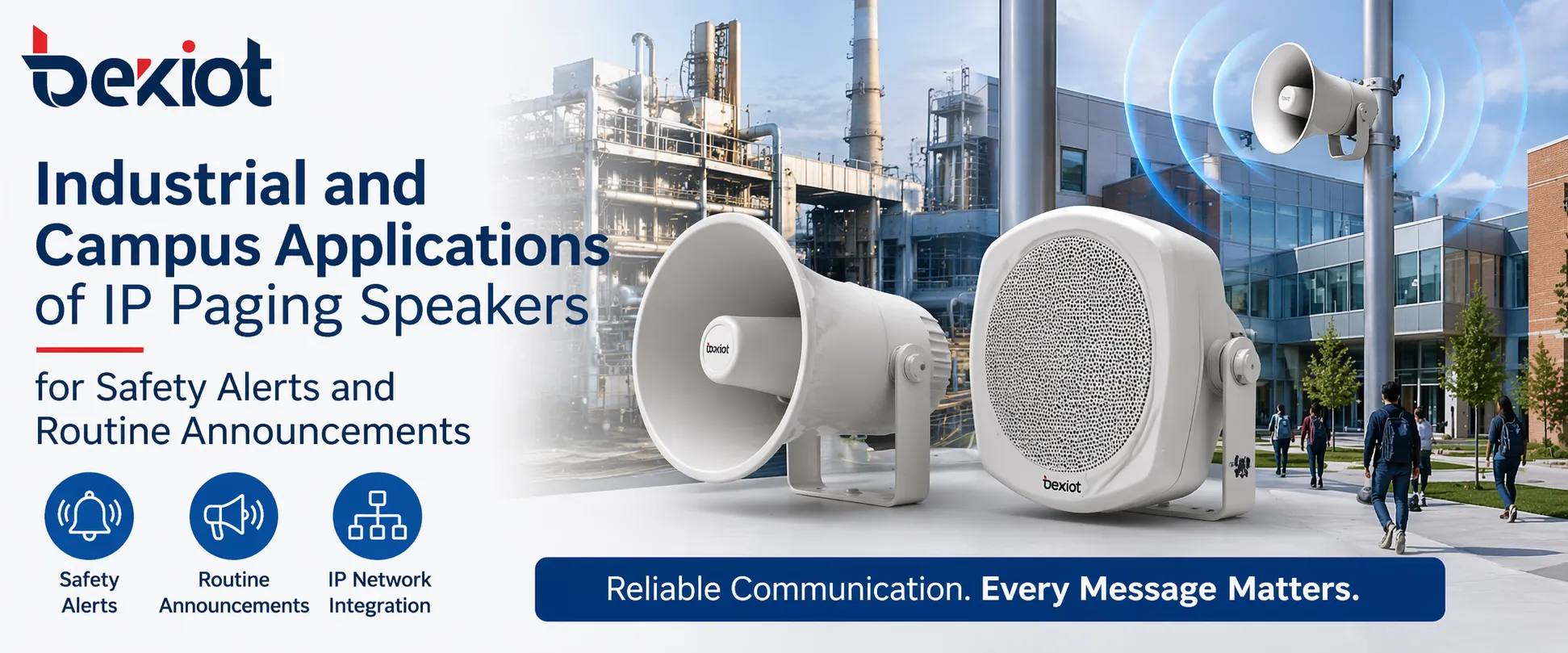
Industrial environments often present high noise levels, large coverage areas, and strict safety requirements. In these sites, horn-style IP paging speakers and ruggedized speaker solutions can play a major role in delivering operational communication and emergency alerts. They may be deployed across workshops, process zones, utility areas, production lines, outdoor yards, loading points, and control interfaces.
When integrated with SIP intercoms, industrial telephones, alarm systems, and dispatch platforms, IP paging speakers can become part of a more comprehensive industrial communication solution. This is particularly relevant in sectors such as energy, petrochemical, ports, mining, metallurgy, transport infrastructure, and large manufacturing campuses.
Transportation Hubs and Parking Facilities
Airports, railway stations, metro facilities, bus terminals, and parking structures all depend on public communication to guide movement and manage incidents. IP paging speakers support passenger information, operational announcements, emergency alerts, and site coordination across indoor and outdoor zones.
In parking environments, they may also work with emergency call boxes, barrier systems, CCTV-linked monitoring, and control room dispatch operations. This is important because parking facilities often need both public instruction and direct incident response capability.
Critical Infrastructure and Public Safety Sites
Utilities, tunnels, substations, port facilities, remote operational compounds, and other critical sites require communication systems that are dependable, scalable, and easy to coordinate centrally. IP paging speakers can support both routine operational messaging and emergency communication in these environments, especially when linked with control centers and multi-system dispatch workflows.
For these projects, paging is rarely a standalone requirement. It is usually one layer within a wider emergency communication and operational coordination framework.
IP Paging Speakers vs Traditional Analog Speakers
Comparing IP paging speakers with traditional analog speakers helps explain why many organizations are modernizing their systems. Analog speakers still have a place in some projects, particularly where legacy infrastructure already exists or where a basic local public address function is sufficient. However, modern operational demands often go beyond what analog systems were originally designed to support.
Traditional analog speaker systems are usually built around amplifiers, hardwired speaker circuits, and fixed zones. Expanding the system can require additional hardware, zone controllers, and more structured audio wiring. Reconfiguring the site often means physical changes. Management and monitoring may also be more limited.
IP paging speakers, by contrast, support network-based distribution, central provisioning, logical zoning, endpoint-level management, and stronger integration with modern communication platforms. They are better suited to organizations that want paging to be part of a wider unified communication, security, or emergency notification strategy.
The decision is not always about replacing every analog component immediately. In some projects, hybrid approaches are used during migration. But from a long-term infrastructure perspective, IP paging speakers typically offer a more scalable and operationally adaptable direction.
How IP Paging Speakers Fit into Integrated Communication Solutions
For many organizations, the real value of IP paging speakers is unlocked when they are integrated into a complete communication solution rather than deployed as isolated audio endpoints. In that broader role, they help bridge routine communication, emergency notification, and incident response.
A modern integrated architecture may combine IP paging speakers with SIP phones, SIP intercoms, emergency call stations, industrial telephones, broadcast gateways, dispatch consoles, video surveillance systems, access control, and alarm platforms. In such a design, the speaker becomes part of a coordinated communication workflow. Operators can make live announcements, trigger pre-recorded alerts, page selected zones, and coordinate with field personnel through one operational environment.
This approach is particularly relevant for solution providers and organizations that need layered communication capability across large sites. A warehouse may link paging speakers with SIP help points and a monitoring platform. A smart campus may combine paging, intercom, and access control. An industrial site may connect rugged telephones, zone paging, emergency call workflows, and dispatch consoles for faster incident handling.
In these scenarios, IP paging speakers are not just a convenience feature. They are one of the voice endpoints that help turn a group of technologies into a unified communication and emergency response system.
The most effective deployments treat IP paging speakers as part of a larger operational communication strategy that connects people, spaces, and response workflows.
What to Consider When Choosing IP Paging Speakers
Selecting the right IP paging speaker involves more than choosing a form factor. The environment, communication workflow, integration requirements, and operational priorities all matter. Indoor office areas may need discreet ceiling speakers with clear speech performance. Outdoor or noisy industrial areas may require horn speakers with stronger projection and rugged protection.
SIP compatibility is an important consideration for organizations that want integration with IP PBX systems, SIP intercoms, or telephony-based paging workflows. PoE support is valuable for easier installation. Centralized management capability becomes more important as the number of endpoints grows. In critical environments, organizations should also assess reliability expectations, environmental protection level, and how the speakers will interact with alarm, dispatch, and security systems.
It is also important to consider the wider solution architecture. A speaker should not be selected in isolation from the platform that will manage it, the zones it will serve, or the emergency procedures it may need to support. In many cases, the best results come from treating paging as part of an integrated site communication design from the beginning.
Conclusion
IP paging speakers have become an essential part of modern paging and notification systems because they combine network-based flexibility, easier scalability, and stronger integration with broader communication infrastructure. They support routine announcements, operational coordination, targeted zone paging, and emergency voice notification across a wide range of environments.
For offices, campuses, hospitals, warehouses, transport facilities, industrial plants, and critical sites, they offer a more adaptable alternative to rigid legacy audio systems. More importantly, they help organizations move toward a communication architecture in which paging, telephony, intercom, dispatch, and emergency response can work together instead of separately.
As communication demands continue to grow, organizations are no longer looking only for devices that make sound. They are looking for endpoints that fit into a connected, manageable, and future-ready communication system. IP paging speakers meet that need by turning public audio into a smarter and more responsive part of business and operational communication.
Talk to Becke Telcom About Your IP Paging Project
From business paging and campus announcements to industrial broadcasting and emergency communication, Becke Telcom delivers IP-based voice solutions designed for demanding environments. Our portfolio includes IP paging speakers, SIP intercoms, emergency phones, broadcast gateways, and dispatch platforms that can be integrated into a unified communication system.
Contact Becke Telcom today to explore the right IP paging solution for your site, improve zone-based communication, and build a more responsive paging and mass notification system.
FAQ
What is an IP paging speaker?
An IP paging speaker is a network-connected speaker used to deliver voice announcements, alerts, and notifications over an IP-based communication system. It typically supports centralized management, zone paging, and integration with other communication platforms.
What is the difference between an IP paging speaker and a traditional analog speaker?
A traditional analog speaker usually depends on centralized amplifiers and fixed wiring zones. An IP paging speaker connects to the network, can often be managed individually, supports software-defined zones, and is better suited for integration with SIP, IP PBX, and modern communication systems.
Do IP paging speakers support SIP?
Many IP paging speakers do support SIP, but not all of them. SIP-enabled models can register to a SIP server or IP PBX, which allows paging to be initiated from IP phones, software clients, intercom systems, or dispatch platforms.
Where are IP paging speakers commonly used?
They are widely used in office buildings, schools, universities, hospitals, warehouses, manufacturing plants, parking facilities, transportation hubs, campuses, and industrial or critical infrastructure sites.
Are IP paging speakers suitable for emergency notification?
Yes. In many systems, IP paging speakers are used for emergency alerts, evacuation messaging, safety announcements, and incident response communication. Their effectiveness depends on proper system design, speaker selection, zoning strategy, and integration with the wider emergency communication platform.
Why is PoE important for IP paging speakers?
Power over Ethernet allows the speaker to receive both power and network communication through one cable. This simplifies deployment, reduces installation complexity, and is especially useful in distributed business and commercial environments.
Can IP paging speakers be integrated with other systems?
Yes. They can often be integrated with IP PBX platforms, SIP intercoms, emergency call boxes, control room dispatch consoles, access control systems, CCTV-linked workflows, and alarm or incident management platforms.
How do organizations choose the right IP paging speaker?
The choice depends on the environment, coverage needs, noise level, indoor or outdoor use, SIP requirements, PoE support, environmental protection, management platform compatibility, and the role the speaker will play in the overall communication solution.







