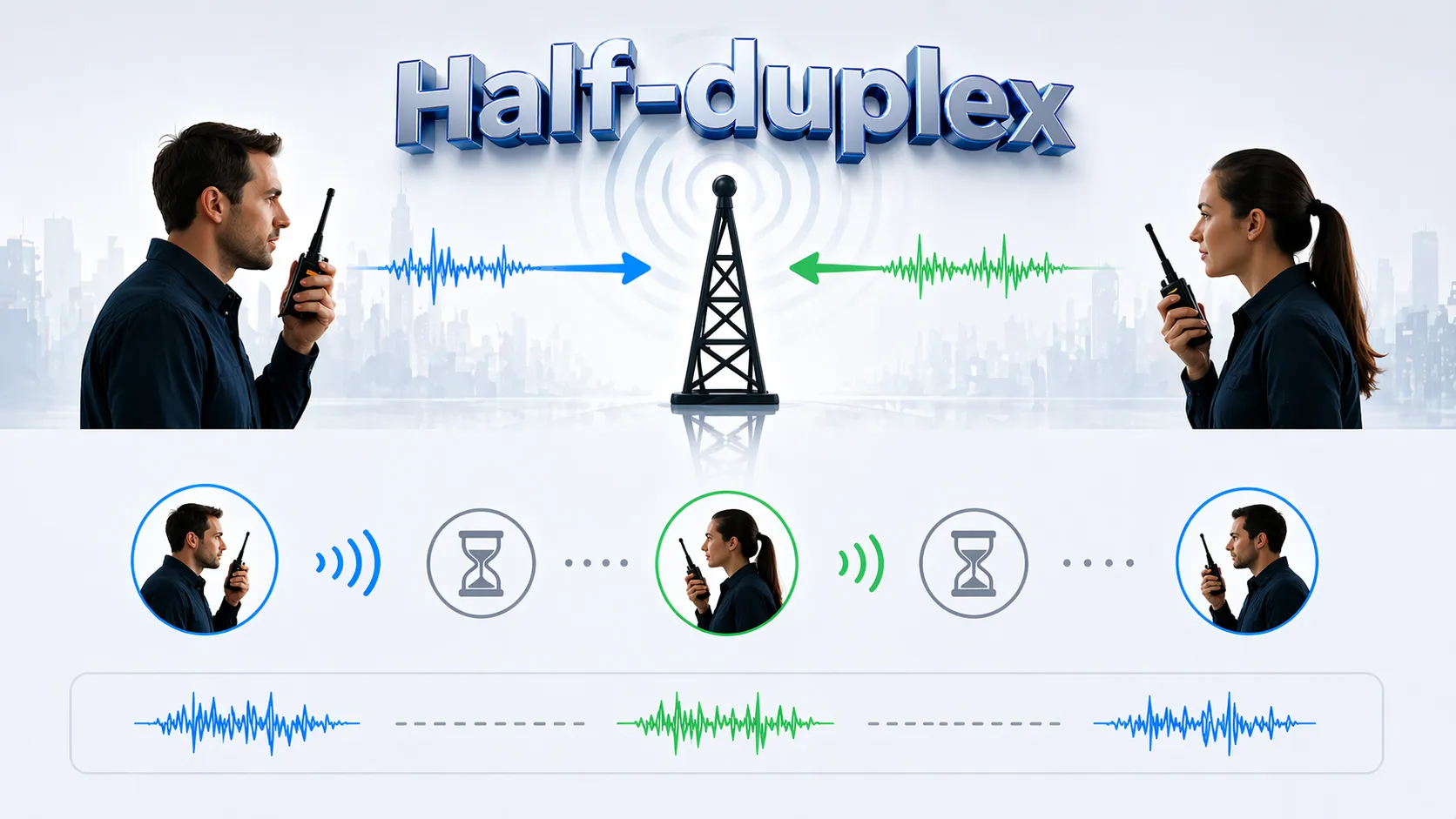
Half-duplex communication is a transmission method in which both ends of a communication link can send and receive information, but not at the same time. In other words, communication can move in both directions, yet only one side transmits at any given moment. When one party is speaking or sending data, the other party must wait until the channel is free before replying. This makes half-duplex different from full-duplex communication, where both sides can transmit simultaneously.
Although half-duplex may sound less advanced than full-duplex, it remains highly practical in many real-world systems. It is widely used in two-way radios, push-to-talk platforms, intercom systems, dispatch networks, industrial communication links, and control environments where structured turn-taking is acceptable or even desirable. In these situations, the goal is not always natural simultaneous conversation. Instead, the priority may be channel efficiency, controlled access, lower complexity, or reliable communication across shared media.
Because of this, half-duplex communication continues to be an important concept in telecommunications, networking, industrial systems, and operational voice environments. Understanding how it works helps explain why some systems feel conversational while others feel more like turn-based communication. It also helps organizations choose the right communication model for their actual operational needs.
What Is Half-Duplex Communication?
Definition and Core Principle
Half-duplex communication is a bidirectional communication method in which two connected parties can both transmit and receive, but they cannot do so at the same time over the same communication path. The channel supports traffic in both directions, yet access is sequential rather than simultaneous. One side talks, sends, or transmits first, and the other side responds only after that transmission ends.
The core principle is shared directional use. The channel is not permanently limited to one direction, as in simplex communication, but it is also not open for overlapping speech or data transfer in both directions at once, as in full duplex. Instead, the direction of use alternates. This is why half-duplex communication often feels organized around turns rather than continuous mutual exchange.
In practical use, half duplex can be manual or automatic. In a radio system, the user may press a push-to-talk button to take control of the channel. In a data system, link control rules may determine when each side can transmit. The underlying idea remains the same: both sides can communicate, but only one at a time.
Half-duplex communication allows two-way exchange, but it requires turn-taking instead of simultaneous transmission.
Why the Concept Matters
The concept matters because communication systems are designed around different operational priorities. Some environments need natural, uninterrupted conversation. Others need controlled channel access, simple field operation, or efficient use of limited spectrum or shared media. Half-duplex supports the second group especially well.
In many operational settings, simultaneous talking is not the primary requirement. Clarity, range, coordination, and disciplined message exchange are often more important. A dispatcher giving instructions to field personnel, a security officer using a radio, or a plant operator communicating over an industrial intercom may benefit from a clear one-speaker-at-a-time communication style.
This is why half duplex is still common in mission-oriented environments. It may feel less conversational than full duplex, but it often matches the workflow of the people using it.
How Half-Duplex Communication Works
One Channel, Alternating Direction
Half-duplex works by allowing a shared communication path to be used in both directions, but not simultaneously. At any given moment, the system is effectively operating in only one direction. When one side is transmitting, the receiving side listens. When the first transmission stops, the direction can reverse and the other side can reply.
In some systems, this change in direction is controlled explicitly by the user. Push-to-talk radios are the best-known example. The user presses the talk button, transmits a message, releases the button, and then waits for a reply. In other systems, the switching may happen through protocol timing, link control, or media-access rules without direct user awareness.
This alternating-direction model is what gives half duplex its recognizable communication rhythm. It prevents simultaneous overlap, but it also creates a clear structure for message exchange, especially where orderly communication is preferred.
Channel Access and Turn Control
A half-duplex system must control who has the right to transmit at a given moment. Without that control, both sides might attempt to use the shared channel at once, which would create interference, collision, or confusion. Different technologies solve this problem in different ways.
In voice systems, channel access is often user-driven. A person speaks only after taking the channel, and others wait. In data links, protocols may use timing rules, arbitration, or carrier-sense mechanisms to decide when a device can send. The result is still half-duplex because the medium is shared in alternating turns rather than in parallel operation.
This need for control is one reason half-duplex systems are often associated with disciplined communication practice. Users need to understand that transmitting and listening are separate moments, not simultaneous actions.
Half duplex depends not only on two-way capability, but also on a clear rule for whose turn it is to use the channel.
Main Features of Half-Duplex Communication
Bidirectional but Not Simultaneous
The most important feature of half-duplex communication is that it supports both transmission and reception, but not at the same time. This distinguishes it from simplex systems, where information moves only one way, and from full-duplex systems, where both directions remain active simultaneously.
This feature makes half duplex more flexible than one-way communication while still keeping the system simpler than many full-duplex designs. It supports response, confirmation, and two-way interaction, but in a more structured format. That structure often works well in environments where messages are short, deliberate, and operationally focused.
In practice, this means the user experience feels more like taking turns than holding a natural overlapping conversation. That can be a limitation in some settings, but it is also part of the feature set that makes half duplex useful elsewhere.
Shared Media Efficiency and Controlled Communication
Another key feature is efficient use of a shared channel. Because the same path is reused for both directions, the system can be simpler in architecture or more efficient in spectrum use, depending on the technology involved. This is especially relevant in wireless environments where spectrum is limited or where field devices need practical, robust communication methods.
Controlled communication is also a defining feature. Half duplex naturally limits simultaneous interruption. This can make operational exchanges cleaner in dispatch, security, emergency response, and industrial coordination scenarios, where users often need concise turn-based messaging rather than overlapping discussion.
These features help explain why half duplex remains common in two-way radios, intercom systems, and certain industrial or networked control environments even though full duplex exists.
Half-Duplex Versus Full-Duplex Communication
The Main Difference
The main difference between half duplex and full duplex is simultaneous transmission. In a half-duplex system, only one side can transmit at a time. In a full-duplex system, both sides can send and receive at the same time. This gives full duplex a more natural conversational feel because users do not need to wait for the channel to become free before responding.
Full duplex is common in standard telephone calls, many SIP voice systems, and other communication environments where real-time two-way interaction is expected. Half duplex, by contrast, is more common where communication is turn-based, controlled, or optimized for shared channel use.
Neither method is universally better. The better choice depends on use case. Full duplex is generally better for natural conversation, while half duplex can be better for managed access, radio-style operation, or simpler shared-medium systems.
Why Half Duplex Is Still Used
Half duplex is still used because simultaneous communication is not always necessary and sometimes is not even desirable. In dispatch and field operations, users often exchange short, clear messages rather than hold free-flowing conversations. In such environments, turn-based communication can improve discipline and reduce confusion.
It also remains useful because it can fit systems where hardware simplicity, channel efficiency, rugged field use, or controlled priority handling matter more than conversational fluidity. Many users are already familiar with the push-to-talk style of operation, especially in safety, transport, logistics, construction, and industrial environments.
For these reasons, half duplex continues to be an intentional design choice rather than just an older technical limitation.
Full duplex supports simultaneous conversation. Half duplex supports structured exchange over a shared path.
Benefits of Half-Duplex Communication
Simpler Operation in Many Field Environments
One benefit of half-duplex communication is operational simplicity. In many radio and intercom-style systems, the user only needs to know when to take the channel and when to listen. That straightforward pattern works well in field conditions where devices must be easy to use, fast to understand, and dependable under pressure.
This is especially valuable in outdoor operations, industrial facilities, transport networks, and security teams, where communication devices may be used by people who need immediate, practical voice exchange rather than feature-rich conversational audio systems. A clear talk-listen pattern can be easier to manage in noisy or urgent environments.
The benefit is not only technical simplicity. It is also procedural simplicity, which can matter just as much in real operations.
Efficient Use of Shared Channels
Half duplex can also make efficient use of shared communication resources. Because one path is reused in both directions, the system may require less simultaneous channel separation than a full-duplex design. In wireless systems especially, this can support practical operation over shared spectrum or limited radio resources.
The efficiency is not about sending more information at once. It is about making a shared channel usable for two-way communication without needing continuous parallel transmission in both directions. This is one reason half duplex has remained practical in radio systems and other shared-medium technologies.
In environments where messages are short and response timing is structured, this efficiency can outweigh the disadvantages of not having simultaneous speech.
Limitations of Half-Duplex Communication
No Simultaneous Talking or Listening
The most obvious limitation of half duplex is that users cannot speak and listen at the same time. That makes conversation less natural than full-duplex calling. It can also slow down interaction if users have to wait frequently for the other side to finish before responding.
In some situations, this can reduce communication fluidity. Fast collaborative discussion, nuanced problem-solving, or emotionally sensitive conversation often works better in full duplex because interruptions, confirmations, and immediate responses can happen more naturally.
This limitation is why half duplex is not the best fit for every communication task, even though it remains highly useful in many operational roles.
Possible Delays and User Discipline Requirements
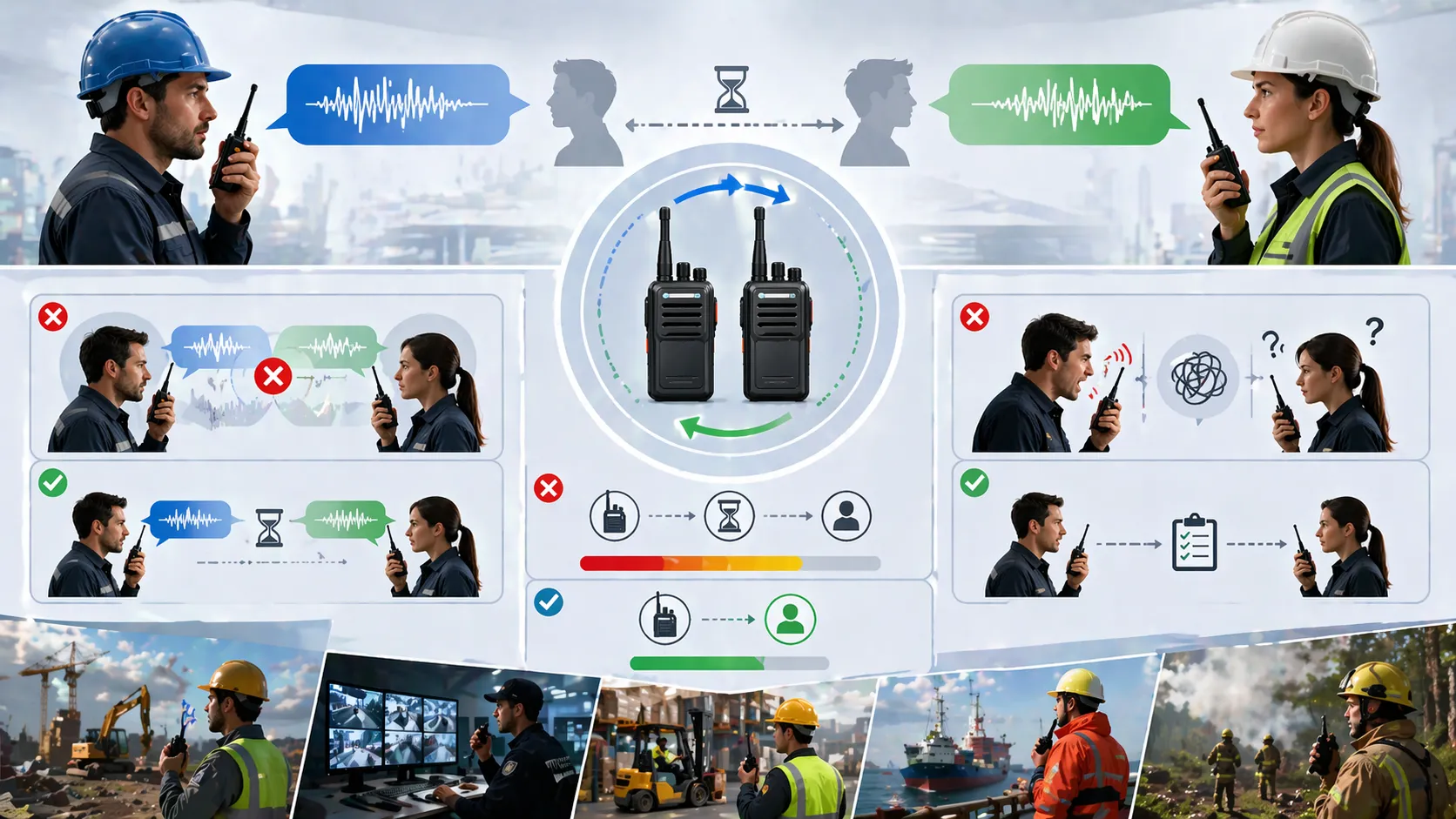
Another limitation is that half-duplex systems depend on timing and discipline. Users must avoid talking over each other, forgetting to release the channel, or failing to wait for a response moment. In poorly managed usage, this can cause clipped messages, missed responses, or inefficient exchanges.
Some half-duplex environments also introduce small delays while channel control changes direction. While this is often acceptable in operational messaging, it can still affect conversational smoothness. In shared-channel systems with many users, access competition may also become a factor.
These limitations do not make half duplex ineffective. They simply mean that the method works best where turn-based communication fits the workflow.
Applications of Half-Duplex Communication
Two-Way Radios, Push-to-Talk, and Dispatch Systems
The most familiar applications of half duplex are two-way radios and push-to-talk systems. In these systems, users share a channel and speak one at a time. This model works well for security teams, transport operators, site supervisors, emergency response teams, and industrial staff who need fast and clear operational messaging.
Dispatch systems also commonly use half duplex because the communication style supports controlled instruction flow. A dispatcher can call field users, deliver an instruction, and wait for confirmation without the channel becoming cluttered with overlapping speech. This is especially useful in fleet coordination, campus safety, public service operations, and industrial control settings.
Even in modern IP-based voice systems, half-duplex logic still appears in push-to-talk over cellular, radio-over-IP, and dispatch integration environments because the operational model remains relevant.
Intercoms, Industrial Communications, and Control Links
Half duplex is also common in intercom-style systems, especially where one user initiates contact and the other replies after the first transmission ends. Certain door stations, help points, control-room links, and field communication terminals use this model where clear, structured exchange is acceptable.
In industrial environments, half duplex can appear in communication terminals, plant intercom systems, operational call points, and some shared-medium data or control scenarios. The method fits environments where ruggedness, clear procedure, and controlled access are often more important than conversational smoothness.
In communication projects involving intercoms, radio gateways, SIP-based PTT systems, or industrial voice networks, vendors such as Becke Telcom can be relevant when organizations need practical field communication designs that align with half-duplex operational workflows.
Half-Duplex Communication in Modern Networks
Use in IP and Hybrid Communication Platforms
Although half duplex is often associated with analog radios, it is still present in modern IP and hybrid communication systems. Push-to-talk applications, dispatch consoles, radio-over-IP platforms, and integrated intercom environments may all use half-duplex communication logic even when the underlying transport is digital or IP-based.
This shows that half duplex is not tied to one technology generation. It is a communication model that can be carried across different infrastructures. What matters is the operational behavior: one side speaks, the other listens, and direction alternates rather than overlapping.
This is especially useful in mixed environments where traditional radios, IP endpoints, and control-room platforms need to work together in a shared operational workflow.
Role in Mission-Oriented Communication Design
Half duplex remains important in mission-oriented communication because many such environments value message discipline, channel control, and practical field reliability. Transport, utilities, industrial plants, logistics operations, security networks, and emergency coordination often prioritize structured exchange over casual conversational flow.
In these environments, the ability to manage who transmits and when can actually improve clarity, especially when many users depend on a shared channel or when commands must be concise and acknowledged clearly. Half duplex therefore fits naturally into operational communication design.
This is why the concept still appears in modern discussions of PTT, intercom, dispatch, and industrial voice systems even in a world dominated by full-duplex consumer telephony.
Half duplex remains relevant because many real-world operations value controlled messaging more than simultaneous speech.
How to Choose Between Half Duplex and Full Duplex
When Half Duplex Is the Better Fit
Half duplex is the better fit when communication is short, structured, and operationally controlled. It works well when users share a channel, when spectrum or media efficiency matters, when field devices must be simple, or when dispatch-style turn-taking is part of the workflow. It is also appropriate where one user usually initiates and the other responds rather than both speaking continuously.
This is why half duplex is a strong choice for PTT systems, field intercoms, control-point communications, and industrial or transport communication scenarios. In these environments, clear procedure often matters more than conversational naturalness.
The question is not whether half duplex is more advanced. The question is whether its communication model matches the operational need.
When Full Duplex Is the Better Fit
Full duplex is the better fit when users need natural real-time conversation, interruption, rapid clarification, and simultaneous speaking and listening. Standard telephone service, most office SIP communications, customer support calls, and collaborative remote discussions are usually better served by full duplex.
If the task depends on fluid conversation, nuanced discussion, or immediate back-and-forth interaction, full duplex generally provides a better user experience. That is why it dominates mainstream enterprise calling and everyday personal communications.
In short, half duplex is best where structured exchange is acceptable, while full duplex is best where natural conversation is central.
Conclusion
Half-duplex communication is a two-way transmission method in which both sides can send and receive information, but not at the same time. Its defining feature is alternating direction: one side transmits, then the other responds after the channel becomes available. This creates a structured communication style that remains useful in many operational environments.
Although it differs from the more conversational nature of full duplex, half duplex offers clear advantages in radios, push-to-talk systems, intercoms, dispatch platforms, industrial communications, and mission-oriented voice networks. Its benefits include simple field operation, efficient shared-channel use, and communication discipline that can improve clarity in structured workflows.
For organizations choosing communication technologies, half duplex should not be seen as merely a limitation. It is a practical and often intentional communication model whose value depends on how well it matches the real demands of the environment.
FAQ
What is half-duplex communication in simple terms?
In simple terms, half-duplex communication means both sides can talk or send data, but only one side at a time. One party transmits first, then the other replies after the channel becomes free.
This is why half duplex often feels like turn-based communication rather than simultaneous conversation.
What is the difference between half duplex and full duplex?
Half duplex allows communication in both directions, but not simultaneously. Full duplex allows both sides to send and receive at the same time. Full duplex is usually more natural for conversation, while half duplex is often better for controlled operational messaging.
The right choice depends on the communication task and system design.
Where is half-duplex communication commonly used?
Half duplex is commonly used in two-way radios, push-to-talk systems, dispatch platforms, certain intercoms, industrial communication terminals, and operational voice environments where users share a channel and communicate in turns.
It remains especially useful in field, safety, transport, and industrial settings where structured communication is often preferred.