Escalation is the process of moving an issue, request, alert, or decision to a higher level of attention, authority, or technical support when the original response path is no longer sufficient. In simple terms, escalation happens when a problem cannot be resolved at the first level and must be passed to someone with greater expertise, responsibility, urgency, or decision-making power. This idea appears in many environments, including customer service, IT operations, healthcare, industrial safety, project management, emergency response, and internal communications.
In daily operations, escalation is rarely just about sending something “upward.” It is really about making sure that the right people become involved at the right time. A support ticket may be escalated because it requires advanced troubleshooting. A maintenance issue may be escalated because it affects production continuity. A clinical concern may be escalated because the patient’s condition changes unexpectedly. A voice, paging, or alarm event may be escalated because the first response point does not answer in time. In all of these cases, escalation is a control mechanism that helps organizations avoid delay, confusion, and missed responsibility.
Because of this, escalation is not merely a management term. It is a practical workflow concept. A good escalation design improves visibility, speeds up response, reduces risk, and helps teams handle events more consistently. A poor escalation design, by contrast, can cause problems to remain unresolved, drift between teams, or become more serious before the correct people are involved.
What Is Escalation?
Definition and Core Meaning
Escalation refers to the act of increasing the priority, visibility, or handling level of an issue so that it receives stronger attention or additional resources. The issue may be technical, operational, clinical, commercial, or safety-related. What matters is that the normal or initial handling path is no longer enough to achieve the required outcome. At that point, the issue is escalated to another person, team, supervisor, specialist, or command layer.
The core meaning of escalation is controlled progression. It creates a structured way for a problem to move from one stage of response to another instead of remaining stalled. This progression may involve a change in authority, such as routing a complaint from a frontline agent to a manager. It may involve a change in expertise, such as moving a system fault from general support to a senior engineer. It may also involve a change in urgency, such as upgrading an ordinary maintenance alert into an emergency operational event.
In well-managed systems, escalation is not treated as failure. It is treated as part of the response design. Not every issue should remain at the first line of handling, and not every situation can be solved where it begins. Escalation exists to make that transition orderly and timely.
Escalation is not only about moving a problem upward. It is about moving the problem to the level where it can actually be resolved.
Why Escalation Is Necessary
Escalation is necessary because organizations operate through layers of responsibility. Frontline teams handle many issues quickly and efficiently, but some situations demand broader authority, deeper expertise, or faster coordinated action. Without escalation, unresolved issues may remain trapped at the wrong level, where the people involved either lack the power to decide or the technical ability to fix the problem.
It is also necessary because conditions can change. A routine ticket may become urgent. A small equipment fault may start affecting a wider service area. A patient request may turn into an emergency. A missed response in a paging or call system may require secondary or supervisory notification. Escalation provides the logic that tells the organization when and how that change in response level should happen.
In this way, escalation supports both efficiency and safety. It keeps simple issues from consuming high-level resources unnecessarily, but it also prevents serious issues from being treated too casually for too long.

How Escalation Works
Trigger, Evaluation, and Routing
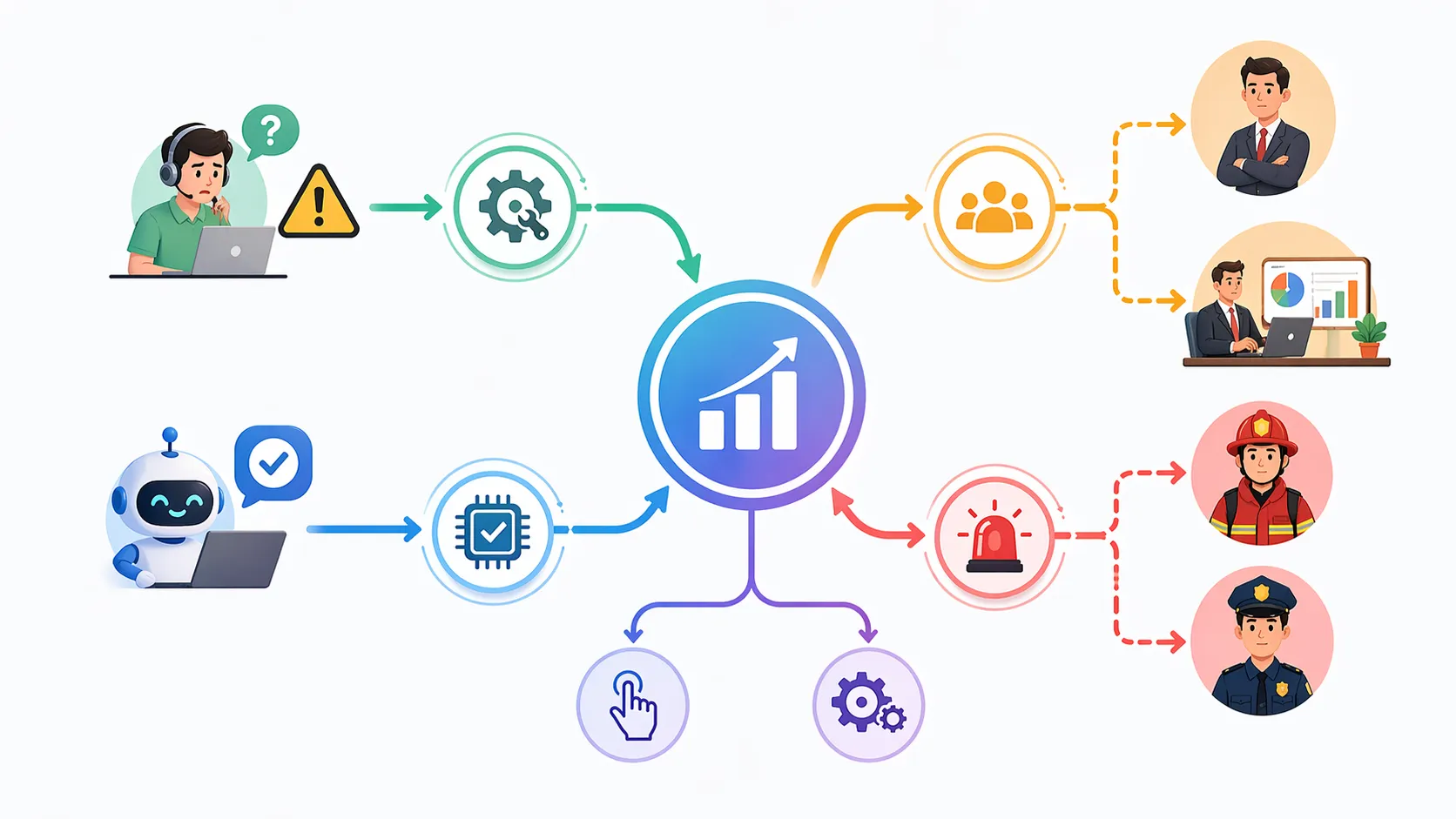
Escalation usually begins with a trigger. That trigger may be manual, such as a staff member deciding that a case needs supervisory review. It may also be automatic, such as a system rule that escalates an alert if no one acknowledges it within a defined time. In some environments, both human judgment and automated logic are used together so that the process remains both structured and flexible.
Once the trigger occurs, the issue is evaluated against escalation rules. These rules may consider severity, safety impact, time sensitivity, service level agreement deadlines, business impact, legal risk, or technical complexity. Based on that evaluation, the issue is routed to a new response level. That level may be a senior specialist, a department lead, an emergency team, an on-call engineer, or a duty manager.
The key point is that escalation should not happen randomly. It should follow defined logic so that everyone understands why the issue moved, who now owns it, and what response is expected next.
Levels, Time Thresholds, and Response Ownership
Many escalation models are built around levels. Level 1 may represent frontline handling. Level 2 may involve a specialist team. Level 3 may require engineering, management, or command-level attention. In customer service and IT, these levels often reflect skill depth. In safety, healthcare, or operations, they may reflect urgency and authority. In communication systems, they may reflect which endpoint or team is notified first, second, and third.
Time thresholds are also central to how escalation works. An issue may be escalated if it is not acknowledged within a short period, not resolved within a longer period, or not updated according to process rules. This helps prevent silent delays. If a task remains unanswered, the escalation design ensures that visibility increases rather than fades.
Response ownership matters just as much. When an issue is escalated, responsibility should become clear. A good escalation process does not simply send more notifications. It transfers accountability in a defined way so the next handler understands what must happen and by when.
Effective escalation is not only about sending alerts to more people. It is about changing ownership, urgency, or authority in a controlled way.
Main Types of Escalation
Functional Escalation and Hierarchical Escalation
One common way to understand escalation is to distinguish between functional escalation and hierarchical escalation. Functional escalation means passing an issue to someone with more specialized knowledge or technical skill. For example, a service desk may escalate a complex SIP registration issue to a network voice engineer, or a maintenance technician may escalate an unusual equipment fault to a manufacturer-level specialist.
Hierarchical escalation means moving the issue to a higher managerial or decision-making level. This may happen when a complaint becomes sensitive, when a response delay creates service risk, or when approval is needed for additional action. A frontline employee may not be allowed to make certain commitments, shut down a system, or mobilize a wider response team, so the matter is escalated to someone with the right authority.
In practice, many real situations involve both types at once. A serious issue may need both expert input and managerial decision-making. That is why escalation design often has to account for more than one path.
Automatic Escalation and Manual Escalation
Another useful distinction is between manual escalation and automatic escalation. Manual escalation depends on human judgment. A staff member recognizes that a case is more serious or more complex than expected and actively pushes it to the next level. This is valuable because not every real-world situation fits neatly inside a fixed rule set.
Automatic escalation depends on predefined conditions. If an alarm is not acknowledged, if a ticket exceeds time limits, if a nurse call is unanswered, or if a system event crosses a severity threshold, the system automatically notifies the next response layer. This helps reduce dependence on memory and reduces the risk that a serious issue will be overlooked.
In modern operations, the strongest approach is often a combination of both. Systems handle predictable escalation events automatically, while people still retain the ability to escalate based on judgment and context.
Benefits of Escalation
Faster Response to Important Issues
One of the clearest benefits of escalation is faster response to issues that matter most. Not every task deserves immediate high-level attention, but some problems become more harmful if they remain at the first stage too long. Escalation reduces that delay by making it easier for serious or unresolved matters to reach the people who can act more effectively.
This is important in customer operations, where unresolved complaints can damage trust. It is important in IT, where prolonged faults can affect service continuity. It is important in clinical care, where delayed recognition can affect outcomes. It is important in industrial sites, where alarm response and equipment faults can have safety consequences. Across all of these settings, escalation turns time sensitivity into a visible workflow rule.
The value is not just speed for its own sake. It is speed directed toward the appropriate level of action.
Better Accountability and Reduced Operational Risk
Escalation also improves accountability. When a process clearly defines who must respond after a trigger, problems are less likely to disappear into uncertainty. A case is not just “still open.” It has moved to a defined owner, and the next step is known. This helps teams avoid situations where everyone assumes someone else is handling the problem.
Risk is reduced because escalation exposes issues earlier. Instead of allowing a fault, complaint, or alert to remain hidden at a low-visibility level, the process raises its profile when necessary. Supervisors, specialists, or on-call teams see the issue before the consequences become more serious.
This makes escalation valuable not only in emergencies, but also in ordinary professional operations. It is a discipline that helps organizations respond more deliberately and with less ambiguity.
Applications of Escalation
Customer Service, IT Support, and Business Operations
In customer service, escalation is used when a complaint cannot be resolved by the first agent, when compensation approval is needed, or when a customer relationship issue becomes sensitive enough for management attention. The purpose is not only to “hand off” the customer, but to ensure that the case reaches someone with the ability to respond appropriately.
In IT support, escalation is a central operating principle. Basic incidents may be handled at the service desk, while network faults, SIP trunk problems, server outages, or security-related events are escalated to specialist engineers or incident managers. Time-based escalation is especially important when service level commitments are involved.
In broader business operations, escalation appears wherever workflow continuity matters. Contract exceptions, payment disputes, procurement delays, project blockers, compliance concerns, and executive approvals may all rely on escalation logic to keep work moving instead of stalling.
Healthcare, Safety Response, and Industrial Communications
In healthcare, escalation can mean moving a patient issue from routine nurse observation to urgent physician review, or raising a clinical concern when a patient’s condition changes. In hospital communication systems, an unanswered nurse call or emergency assistance request may be escalated from the room to the nurse station and then to a wider duty or supervisory layer.
In safety response and industrial environments, escalation is often tied to alarms, faults, and operational risk. A local alert may be escalated if the first responder does not acknowledge it, if the condition worsens, or if wider coordination becomes necessary. In these settings, escalation is directly related to response discipline and hazard control.
In modern industrial and enterprise communication systems, escalation may also be implemented through voice, paging, intercom, alarm integration, and dispatch workflows. A call, event, or alert can be routed from one endpoint or team to another based on response rules. This is why escalation is closely linked not only to management process, but also to communication infrastructure.
Escalation in Communication and Alerting Systems
Call Escalation, Alarm Escalation, and Notification Chains
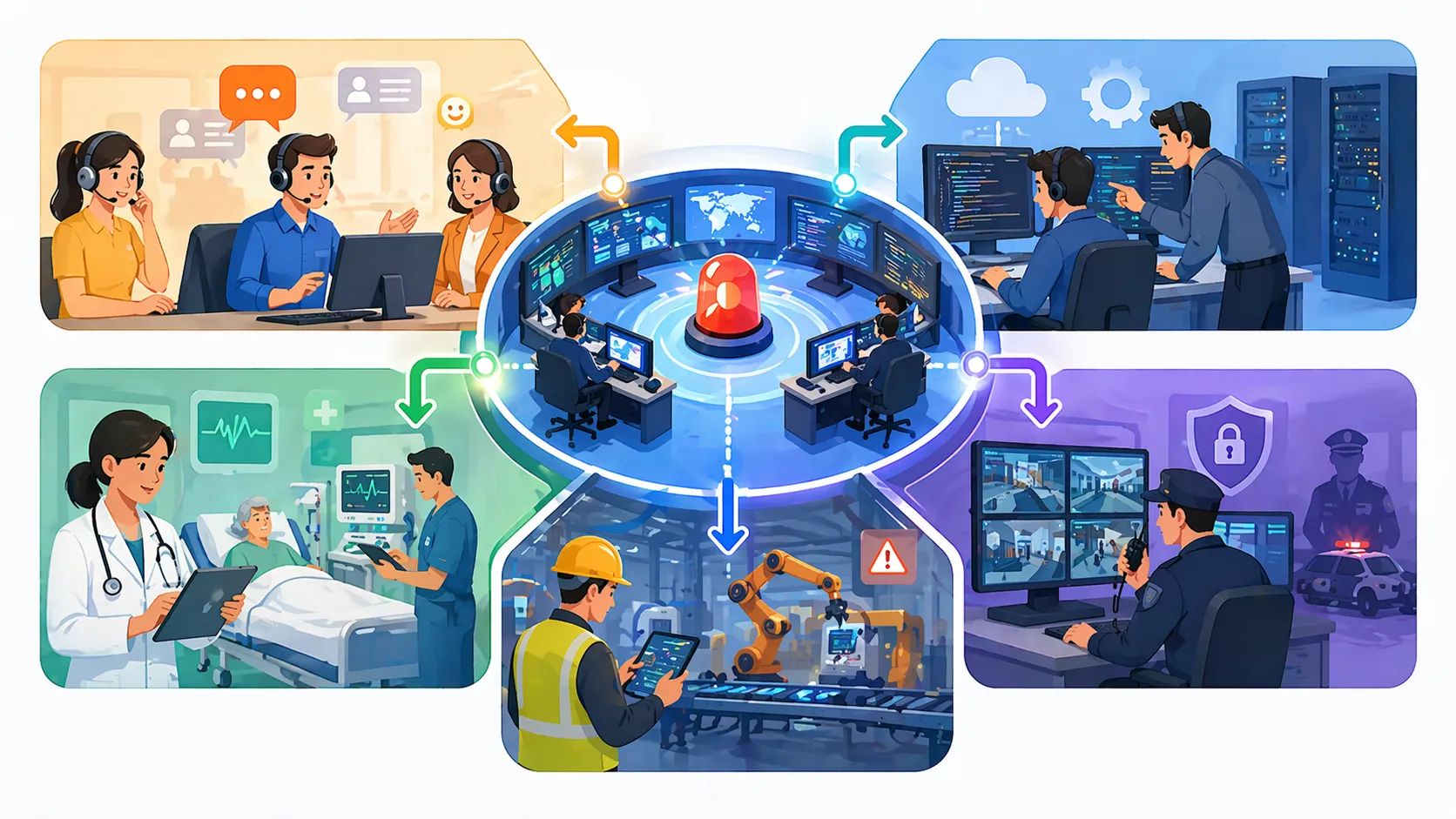
In communication systems, escalation often appears as a notification chain. A call, alert, or alarm is first sent to a primary contact or endpoint. If no one responds, the event is forwarded to a second line, a group, a supervisor, or an alternative communication path. This prevents the workflow from depending entirely on one person or one device.
Call escalation may be used in service desks, hospitals, duty rooms, security stations, and industrial response centers. Alarm escalation may be used in plant operations, emergency communications, maintenance platforms, and remote site monitoring. The escalation logic may include timeouts, acknowledgment rules, priority levels, or escalation trees that define the sequence of response.
This type of design makes communication more resilient. Instead of assuming that the first destination will always answer, the system builds a structured fallback path.
Role in SIP, Paging, and Integrated Response Platforms
In SIP and IP-based communication environments, escalation can be built into call routing rules, paging logic, intercom workflows, or centralized management platforms. A missed duty call may be sent to another extension, then a mobile endpoint, then a supervisory terminal. A help point call may be escalated if it is not answered within a defined interval. A broadcast or operational event may trigger secondary notification across teams.
This is particularly relevant in sites that rely on coordinated communications rather than isolated devices. Utilities, transport hubs, hospitals, campuses, factories, and control rooms often need response logic that connects people, endpoints, and priorities in a practical sequence. Escalation helps make that sequence reliable.
In that context, vendors such as Becke Telcom can fit naturally into escalation-oriented communication projects where SIP endpoints, intercoms, paging devices, gateways, or dispatch workflows need to support multi-level call handling and operational response logic.
In communication systems, escalation is often the difference between a missed alert and a managed response.
How to Design an Effective Escalation Process
Clear Rules, Timeframes, and Severity Criteria
An effective escalation process begins with clear criteria. Teams need to know what triggers escalation, how quickly it should happen, and who receives the issue next. Without these definitions, escalation becomes inconsistent. One person may escalate too early, another too late, and a third not at all.
Severity should also be defined carefully. Minor issues do not need the same path as high-impact ones. Good process design distinguishes between inconvenience, service degradation, compliance risk, safety concern, and emergency conditions. This keeps escalation proportionate and helps avoid alert fatigue at higher levels.
Timeframes matter because unresolved issues often become dangerous or expensive not only because of what they are, but because of how long they remain unaddressed. A strong escalation design therefore links severity with time expectations rather than treating all delays the same way.
Communication Clarity, Ownership, and Review
Clear communication is essential. When an issue is escalated, the next responder should understand what happened, what has already been tried, how urgent the matter is, and what action is expected. Poor escalation often fails not because the message was sent, but because the content was incomplete or unclear.
Ownership must also be explicit. The next team or individual should know whether they now fully own the issue, share responsibility, or are providing specialist input to another owner. This distinction matters because many escalation failures come from blurred accountability rather than lack of effort.
Regular review is equally important. Organizations should look back at escalated cases to see whether rules were appropriate, whether timing worked, and whether the right people were involved. Escalation should be treated as a process that can be improved, not a fixed rule set that is never examined again.
Common Escalation Problems
Escalating Too Late or Too Early
One common problem is escalation that happens too late. Teams may hold on to an issue for too long, hoping it will resolve, even when the signs show that higher-level support is already needed. This can delay resolution, increase frustration, and expand the impact of the problem.
Escalating too early can also be a problem. If every issue is pushed upward immediately, senior teams become overloaded, response quality may decline, and frontline capability may weaken over time. This is why escalation should be based on defined criteria rather than fear or habit.
Good process design helps balance these two risks. The goal is not maximum escalation. The goal is timely escalation at the correct threshold.
Poor Handover and Lack of Follow-Through
Another frequent problem is weak handover. An issue may be escalated, but the receiving team gets incomplete context, unclear ownership, or no actionable summary. This creates duplication and slows down the very process escalation was supposed to improve.
Lack of follow-through is equally damaging. If escalation occurs but no one checks whether the response was effective, the organization may assume that movement equals progress when it does not. Escalation only adds value when the new handling level produces clearer action, faster decision-making, or stronger resolution potential.
For that reason, escalation should always be connected to measurable response behavior rather than treated as a purely symbolic act.
Escalation should increase the chance of resolution, not just increase the number of people who know about the problem.
Conclusion
Escalation is the process of raising an issue to a higher level of attention, authority, expertise, or urgency when the original handling path is no longer enough. It is a core operating principle in customer service, IT, healthcare, industrial response, and communication systems because it helps ensure that serious or unresolved matters reach the level where they can be addressed properly.
Its value lies in structure. Escalation helps organizations respond faster, improve accountability, reduce hidden delays, and manage operational risk more effectively. Whether it is used in support tickets, alarm response, nurse call workflows, duty communications, or business decision paths, it creates a controlled way for the right people to become involved at the right time.
When designed well, escalation is not a sign that a process failed. It is part of the process itself. It helps organizations move from basic handling to effective resolution in a more disciplined and dependable way.
FAQ
What does escalation mean in business operations?
In business operations, escalation means moving an issue, request, or decision to a higher level of support, management, or authority when the current handling level cannot resolve it appropriately. This may happen because of urgency, complexity, risk, or policy limits.
The purpose is to ensure that problems do not remain stuck with the wrong owner or at the wrong priority level.
What is the difference between functional escalation and hierarchical escalation?
Functional escalation sends an issue to someone with greater technical or specialist expertise, while hierarchical escalation sends it to someone with greater managerial authority or decision-making power. A real situation may involve one or both, depending on what is needed for resolution.
This distinction helps organizations route issues more accurately instead of treating every escalation as the same kind of handoff.
Why is escalation important in communication and alert systems?
Escalation is important in communication and alert systems because a missed call, unanswered alert, or unresolved event should not simply stop at the first destination. Escalation creates a fallback path so the event can reach another endpoint, team, or supervisor if the initial response does not happen.
This helps improve reliability, visibility, and response discipline in operational environments where timing matters.