Full duplex is a communication mode that allows both sides of a connection to transmit and receive audio at the same time. In practical terms, this means two parties can speak naturally without waiting for the other side to stop. Unlike half duplex systems, which require users to take turns, full duplex supports continuous conversation that feels closer to face-to-face communication.
This capability is highly important in modern voice networks because communication today is expected to be immediate, natural, and efficient. In VoIP systems, SIP intercom platforms, dispatch consoles, industrial telephony, and unified communication environments, users often need to interrupt, confirm, coordinate, and respond in real time. Full duplex supports that behavior by removing the stop-and-start rhythm that limits simpler communication methods.
Although the idea sounds straightforward, full duplex depends on careful audio engineering. The system must manage simultaneous voice paths, control echo, reduce background noise, maintain low latency, and preserve speech intelligibility even when both parties speak at once. For this reason, full duplex is not just a talking feature. It is a technical foundation for professional-grade voice communication.

Full duplex enables both sides of a conversation to speak and hear simultaneously in real time.
What Full Duplex Means in Voice Communication
Simultaneous Two-Way Audio
At the core of full duplex is the ability to carry audio in both directions at the same time. Each side of the conversation has an active transmit path and an active receive path operating together rather than in sequence. This creates a natural conversational flow because users do not need to wait for a channel handover or a push-to-talk release before responding.
In real communication scenarios, this matters more than it may seem. Human conversation depends on timing, short acknowledgments, interruptions, and overlapping speech. People naturally say things like “yes,” “go ahead,” or “wait” while the other person is still speaking. A full duplex system supports those behaviors, making communication faster and more intuitive, especially when decisions must be made quickly.
This is why full duplex is widely preferred in telephony, intercom, conferencing, command centers, and collaborative work environments. It provides a speech experience that matches natural human interaction rather than forcing communication into a rigid exchange pattern.
How It Differs from Half Duplex
Full duplex is often best understood by comparing it with half duplex. In a half duplex system, communication can move in both directions, but not at the same time. One side speaks, then the other side responds after the channel is released. Classic walkie-talkie behavior is the best-known example. This method is useful in some radio environments, but it changes how people communicate and can slow interaction.
By contrast, full duplex removes the turn-taking requirement. The result is more natural discussion, fewer missed cues, and better conversational efficiency. In customer service, emergency coordination, industrial operations, and office telephony, that difference can strongly affect comprehension and speed. A user can clarify immediately, interrupt to prevent an error, or confirm details without waiting for a speaking turn.
That is also why full duplex is commonly associated with higher communication quality. It does not simply sound better because of codec performance or speaker design. It sounds better because the communication model itself is better aligned with how people actually talk.
Full duplex improves communication not only by allowing sound to pass in both directions, but by allowing human conversation to behave normally.
How Full Duplex Works
Separate Transmit and Receive Paths
A full duplex audio system works by maintaining simultaneous transmit and receive channels. In digital systems, this may be handled through network packet streams, DSP processing, codec management, and endpoint audio control. In practical deployments, the endpoint device captures local speech through a microphone while also reproducing incoming speech through a speaker or handset without forcing one path to stop the other.
In SIP and VoIP environments, full duplex typically operates over packet-based voice sessions where both media streams remain active throughout the call. The endpoint, media engine, and network all contribute to performance. The microphone path must capture usable speech, the speaker path must reproduce incoming audio clearly, and the device must prevent its own speaker output from feeding back into the microphone in a disruptive way.
This is why full duplex performance depends on more than call signaling. A SIP device may establish a call successfully, but achieving strong full duplex audio requires good acoustic design, proper gain control, echo cancellation, and stable network transport.
Echo Cancellation and Audio Processing
One of the key technical challenges in full duplex communication is echo. When a device plays incoming speech through a speaker, that sound can be picked up again by the microphone and sent back into the call. If this is not controlled, users may hear delayed reflections of their own voice, which can make conversation uncomfortable or unusable.
To solve this, full duplex devices often use acoustic echo cancellation, digital signal processing, automatic gain control, and noise reduction algorithms. Echo cancellation attempts to identify and remove the device’s own playback signal from the outgoing microphone path. Noise suppression helps reduce environmental sound, while gain control keeps levels balanced so one side does not overpower the other.
These mechanisms are especially important in speakerphone intercoms, industrial SIP terminals, dispatch microphones, and room-based communication devices. In such products, full duplex is only effective when simultaneous speech remains clear and stable under real acoustic conditions.
Network Performance and Low Latency
Full duplex conversation also depends on latency remaining low enough for natural interaction. If network delay becomes too high, users may begin interrupting one another unintentionally or hearing responses too late. In packet-based systems, latency can be influenced by codec selection, jitter buffering, packet loss, routing efficiency, and overall network congestion.
For this reason, full duplex audio quality is tied closely to VoIP network design. QoS policies, stable switching, adequate bandwidth, and properly configured SIP and RTP behavior all contribute to a better result. In critical communication systems, the difference between acceptable and excellent full duplex performance often comes down to how well the underlying network was engineered.
In other words, full duplex is not only an endpoint capability. It is a system capability supported by device design, media processing, and network quality together.
Audio Benefits of Full Duplex
More Natural Conversation
The most obvious benefit of full duplex is conversational naturalness. Users can speak, react, interrupt politely, and acknowledge information in real time. This reduces friction and makes communication feel immediate rather than procedural. In environments where people use voice communication all day, this improvement has a direct effect on comfort and productivity.
Natural interaction is especially valuable in team coordination, customer support, and field-to-control room communication. When users do not have to think about channel control, they can focus on the message itself. This makes full duplex particularly useful in complex environments where speed and understanding matter more than rigid speaking order.
That benefit also improves user adoption. Systems that feel easier to use are more likely to be used correctly and consistently, which is important in enterprise and safety-related deployments.
Better Clarity in Fast-Paced Communication
Full duplex improves clarity not only through audio processing but through timing. When both sides can respond immediately, misunderstandings can be corrected before they grow. A dispatcher can stop a mistaken instruction halfway through. A nurse can interrupt with urgent patient information. A technician can confirm a location while the other party is still describing it.
This is particularly important in situations where short delays create operational risk. In half duplex systems, users may need to wait for the other side to finish speaking before correcting an error. In full duplex systems, clarification happens faster and more naturally. The result is not just smoother conversation but better communication accuracy.
Because of this, full duplex is often considered essential in environments where communication supports live operations rather than casual discussion.
Reduced Communication Fatigue
Over time, half duplex or poorly processed audio can become mentally tiring. Users must pay extra attention to timing, avoid interruption, and compensate for missing conversational cues. Full duplex reduces that strain by letting speech flow normally. People spend less effort managing the channel and more effort understanding the content.
This matters in dispatch centers, help desks, security stations, and industrial operations where staff may handle repeated voice interactions over long shifts. Lower communication fatigue can improve concentration, shorten calls, and reduce the likelihood of repeated instructions.
In this sense, full duplex is not only an audio feature but a usability advantage that supports long-term operational performance.
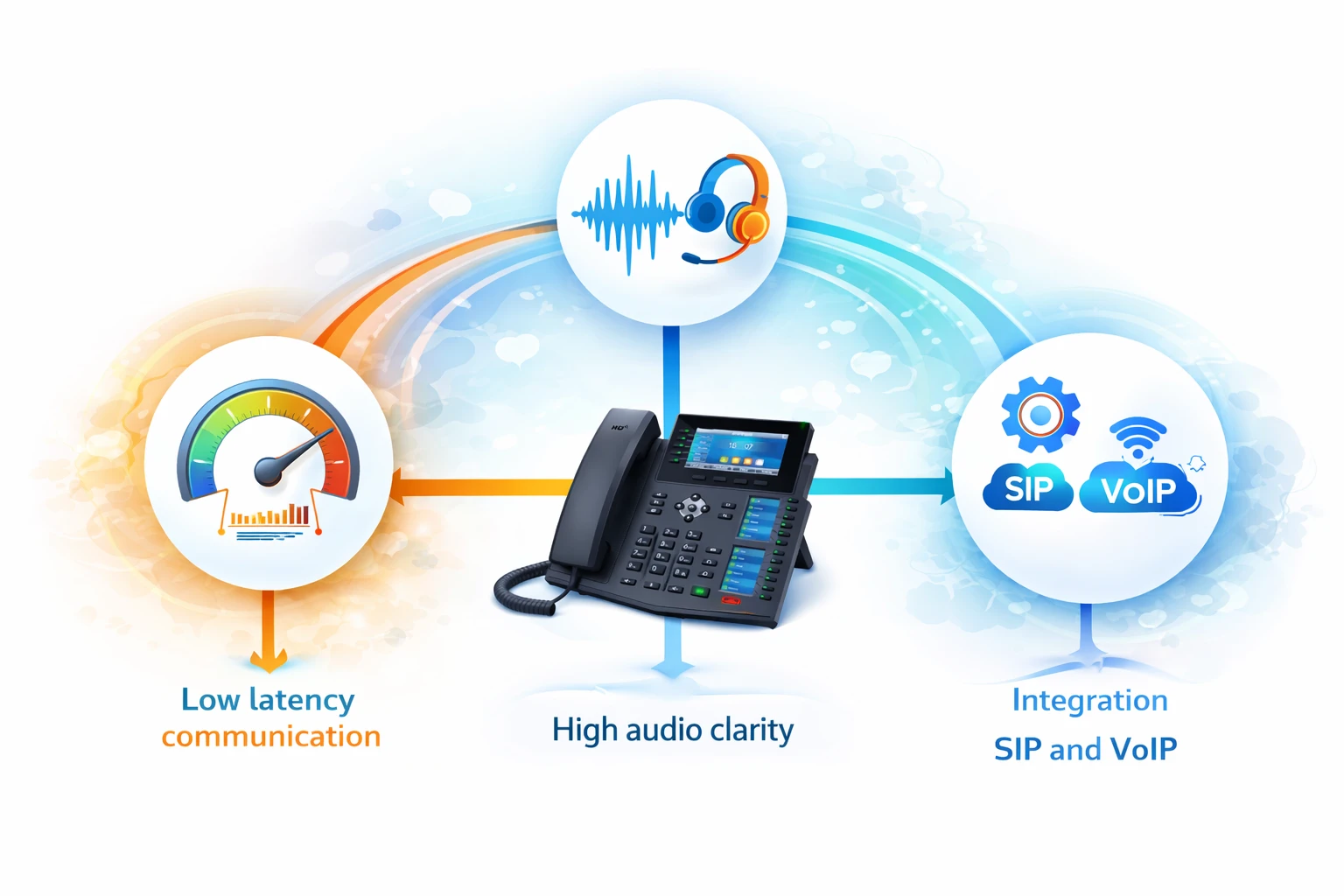
Effective full duplex audio combines simultaneous voice flow with echo control, low latency, and clear speech reproduction.
Technical Features of Full Duplex Systems
Echo Control, Noise Reduction, and DSP
Most modern full duplex devices depend on DSP-based audio enhancement. Echo cancellation is usually the most important function, but it is rarely the only one. Noise reduction, automatic gain adjustment, microphone optimization, and speaker tuning are also common. Together, these features help the device remain usable in real environments rather than only in ideal laboratory conditions.
In industrial and public-area communication products, DSP becomes even more important because the acoustic environment is often difficult. Machinery noise, reflective surfaces, wind, and distance from the speaker all affect performance. Full duplex devices for these settings must be designed to maintain understandable speech even when the environment is not quiet.
That is why product selection should consider more than whether “full duplex” appears on a specification sheet. The quality of the audio processing implementation strongly affects real-world results.
Wideband Audio and Codec Support
Another important technical feature is codec capability. Full duplex systems often perform better when they use wideband codecs that preserve more speech detail than narrowband legacy audio. Codecs such as G.722 or other HD voice options can improve intelligibility, especially in professional SIP and VoIP environments.
However, codec support alone does not guarantee a superior experience. The endpoint microphone, speaker design, enclosure acoustics, and network behavior must also support that capability. A wideband codec can preserve speech detail, but poor echo handling or unstable packet delivery can still reduce the communication quality.
For this reason, full duplex quality should be viewed as the result of the whole voice chain, from capture to transport to playback.
Integration with SIP and VoIP Systems
In modern deployments, full duplex is commonly integrated into SIP-based communication architecture. SIP handles session establishment and control, while RTP or related media transport carries the bidirectional audio streams. This allows full duplex endpoints to participate in enterprise telephony, intercom platforms, paging systems, unified communication environments, and dispatch networks.
The benefit of this integration is flexibility. A full duplex SIP intercom can call a desk phone, connect to a control room, join a paging workflow, or become part of a broader incident response system. In these cases, full duplex improves the local audio experience while SIP and VoIP provide the broader network reach and management framework.
As a result, full duplex is increasingly seen not as a standalone capability but as a standard expectation for professional IP voice endpoints.
Applications of Full Duplex
VoIP Telephony and Unified Communications
Traditional desk phones, softphones, conference devices, and business voice platforms rely heavily on full duplex audio because users expect natural conversation. In enterprise communication, simultaneous speech is necessary for meetings, rapid coordination, customer interaction, and everyday office collaboration.
Within unified communications, full duplex also supports a more seamless experience across devices and locations. Whether users are speaking from a desk endpoint, a mobile client, or a meeting room device, the expectation is the same: clear, low-latency conversation without turn-taking limitations.
This is one reason full duplex has become standard in modern IP telephony. It matches both user expectations and operational needs.
SIP Intercom, Paging, and Industrial Communication
Full duplex is also highly valuable in SIP intercom and industrial communication systems. In a factory, tunnel, utility corridor, campus entrance, or gate station, users often need hands-free or speakerphone-style interaction. In these cases, simultaneous audio helps conversations move quickly, especially when one side needs guidance, permission, or immediate confirmation.
For industrial and public-facing intercoms, full duplex becomes even more important when the device is part of an operational workflow. A field worker may need to report an issue while listening to instructions. A visitor may need assistance through an outdoor help point. A guard station may need to question and verify access in real time. These interactions are faster and clearer when the audio path is always open in both directions.
This is why many advanced SIP intercoms and emergency communication terminals promote full duplex as a key functional benefit.
Emergency Response and Dispatch Systems
In emergency and dispatch environments, full duplex can directly improve response efficiency. Dispatchers, operators, responders, and field personnel often need overlapping conversation, immediate correction, and dynamic coordination. Waiting for speaking turns can slow the exchange of critical information.
A full duplex environment supports more fluid command communication. The operator can issue instructions while hearing live feedback, and field users can interrupt with updates or warnings as conditions change. This makes full duplex especially useful in hospitals, transport control, security operations, industrial emergency systems, and public safety support environments.
Where communication quality affects situational awareness, full duplex is often the preferred mode because it supports both speed and clarity under pressure.

Full duplex is widely used in enterprise telephony, intercom, dispatch, and emergency communication systems.
In high-value communication environments, full duplex is not just about convenience. It supports faster decisions, clearer coordination, and more reliable human interaction.
Conclusion
Why Full Duplex Matters
Full duplex matters because professional communication depends on timing as much as sound. By allowing simultaneous two-way audio, it creates a more natural, efficient, and accurate interaction model. It improves the user experience, supports faster clarification, and reduces the friction that comes with turn-based communication.
From a technical perspective, strong full duplex performance requires more than enabling both media directions. It depends on echo cancellation, DSP quality, low latency networking, and solid endpoint design. From an application perspective, it plays a major role in VoIP telephony, SIP intercom, dispatch, paging, and emergency response systems.
As communication networks become more integrated and more real-time, full duplex continues to be one of the most important capabilities for clear and dependable voice interaction.
FAQ
Is full duplex better than half duplex?
For most natural voice conversations, yes. Full duplex allows both sides to speak and hear simultaneously, while half duplex requires turn-taking. That makes full duplex more suitable for telephony, intercom, conferencing, and dispatch communication.
Why is echo cancellation important in full duplex systems?
Because the device may play incoming speech through a speaker while also capturing local speech through a microphone. Without echo cancellation, the far-end user may hear their own voice reflected back, which reduces clarity and comfort.
Is full duplex only used in office phones?
No. It is also widely used in SIP intercoms, industrial communication terminals, dispatch consoles, emergency help points, and many other IP voice systems where natural two-way conversation is needed.
Does full duplex depend on network quality?
Yes. Low latency, stable packet delivery, proper QoS, and suitable codec handling all contribute to good full duplex performance in VoIP and SIP environments.