What Is Public Switched Telephone Network (PSTN)? Uses, How It Works, and Applications
The Public Switched Telephone Network (PSTN) is the traditional global circuit-switched telephone system enabling reliable voice communication and integration with VoIP and SIP-based modern networks.
Becke Telcom
Introduction to PSTN
Definition of PSTN
The Public Switched Telephone Network (PSTN), also widely known as the Plain Old Telephone Service (POTS) backbone, is the historic global public telecommunications system that has standardized circuit-switched network architecture to facilitate real-time analog and digital voice communication between fixed-line endpoints across cities, countries, and continents. This universal network infrastructure consists of twisted-pair copper wiring for last-mile local connections, high-capacity fiber-optic cables for long-haul backbone transmission, geographically distributed telecommunication switching centers that manage call routing and connection setup, and satellite communication links that bridge intercontinental voice traffic where terrestrial cabling is impractical or unavailable.
For more than a century, the PSTN has functioned as the irreplaceable core backbone of global telecommunications, supporting residential and commercial landline telephone services, enabling cross-border voice communication, and establishing the fundamental technical framework upon which numerous modern communication systems, including mobile telephony and enterprise telephony solutions, have been developed and integrated.
Evolution of PSTN
The PSTN originated in the late 19th century with entirely analog signal transmission, manual switchboard operations, and copper-line physical connections, but it has undergone decades of technological evolution to incorporate digital electronic switching systems, time-division multiplexing (TDM) technology, and automated call-control mechanisms to enhance capacity, voice clarity, and transmission efficiency. Despite the explosive global growth of IP-based communication technologies such as VoIP, UCaaS, and cloud telephony in recent decades, the PSTN continues to perform a vital and irreplaceable operational role in telecommunications networks across both developed and developing regions worldwide.
In contemporary communication deployments, the PSTN commonly operates in parallel and interoperability with VoIP platforms and SIP-based enterprise communication systems, acting as a transitional and complementary infrastructure that enables seamless voice communication, call handoff, and service compatibility between legacy analog telephony devices and modern IP-based communication endpoints, ensuring uninterrupted connectivity for users across different network generations.
The PSTN remains a critical bridging infrastructure that connects legacy analog telephony systems and modern IP-based communication networks, guaranteeing cross-platform service compatibility, stable call connectivity, and consistent transmission reliability across heterogeneous telecommunication environments.
How PSTN Works
Circuit Switching Mechanism
The PSTN operates on the fundamental principle of circuit-switched telecommunication, a connection-oriented technology that establishes a dedicated, continuous physical communication circuit between two calling and called endpoints for the entire duration of a voice call, reserving fixed bandwidth and transmission resources exclusively for that single conversation until the call is terminated by either party.
This dedicated-circuit transmission method ensures exceptionally stable, low-latency, and consistent voice quality with minimal packet loss or distortion, making it ideal for real-time voice communication; however, it is inherently less efficient in bandwidth utilization compared to packet-switched communication systems like VoIP, as the reserved circuit remains idle and unavailable for other users during silent periods within a call.
Key Network Components
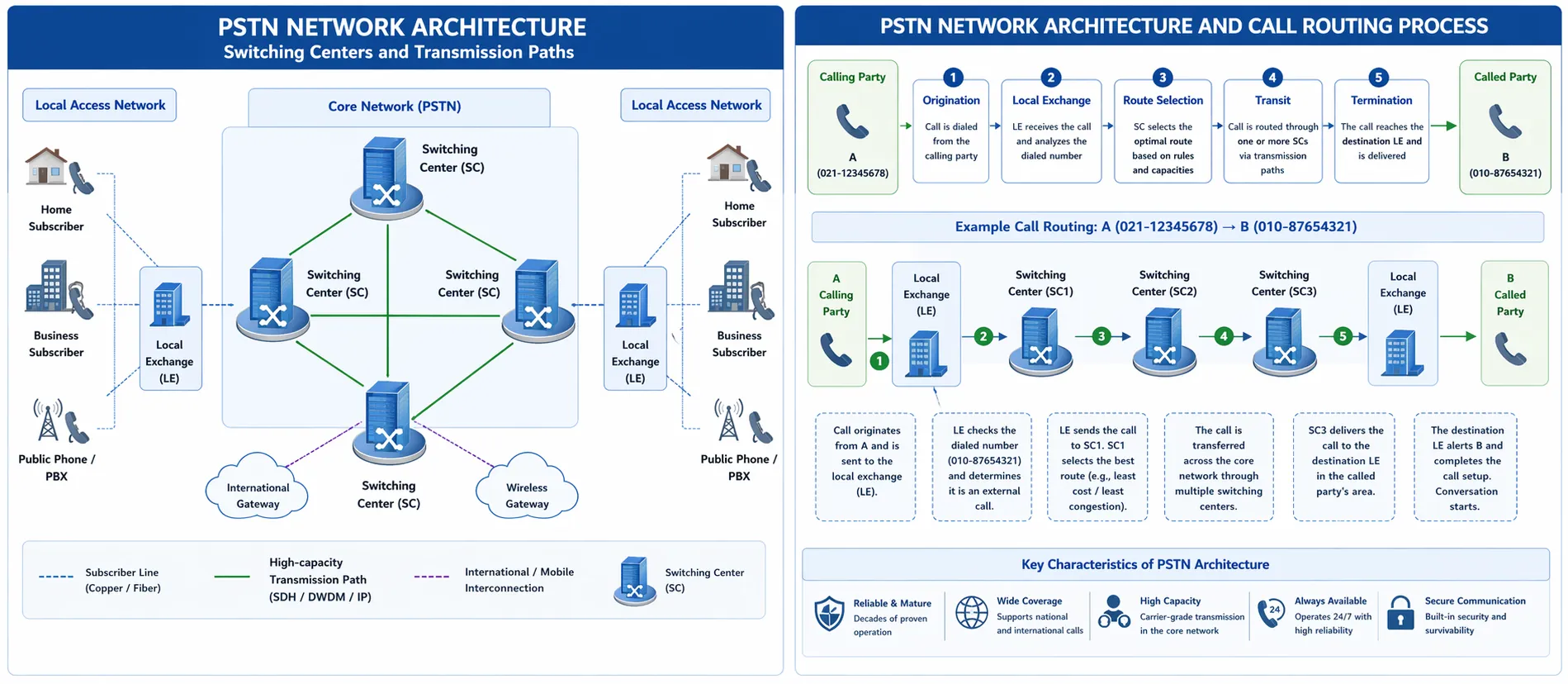
The complete PSTN infrastructure comprises four core interconnected components: local loops, the twisted-pair copper lines that connect end-user telephones to nearby telecommunication facilities; central offices (COs), the local switching nodes that manage subscriber connections and call routing within a regional area; trunk lines, high-bandwidth transmission links that carry aggregated voice traffic between multiple central offices and switching centers; and hierarchical switching systems, including Class 1 to Class 5 switches, that govern call routing across local, national, and international network segments.
Voice and control signals within the PSTN may be transmitted in either analog waveform format (primarily across local loop copper lines) or digital pulse-code modulation (PCM) format (primarily across backbone fiber and trunk lines), depending on the specific segment, distance, and technical configuration of the network path being used for call transmission.
Integration with VoIP and SIP
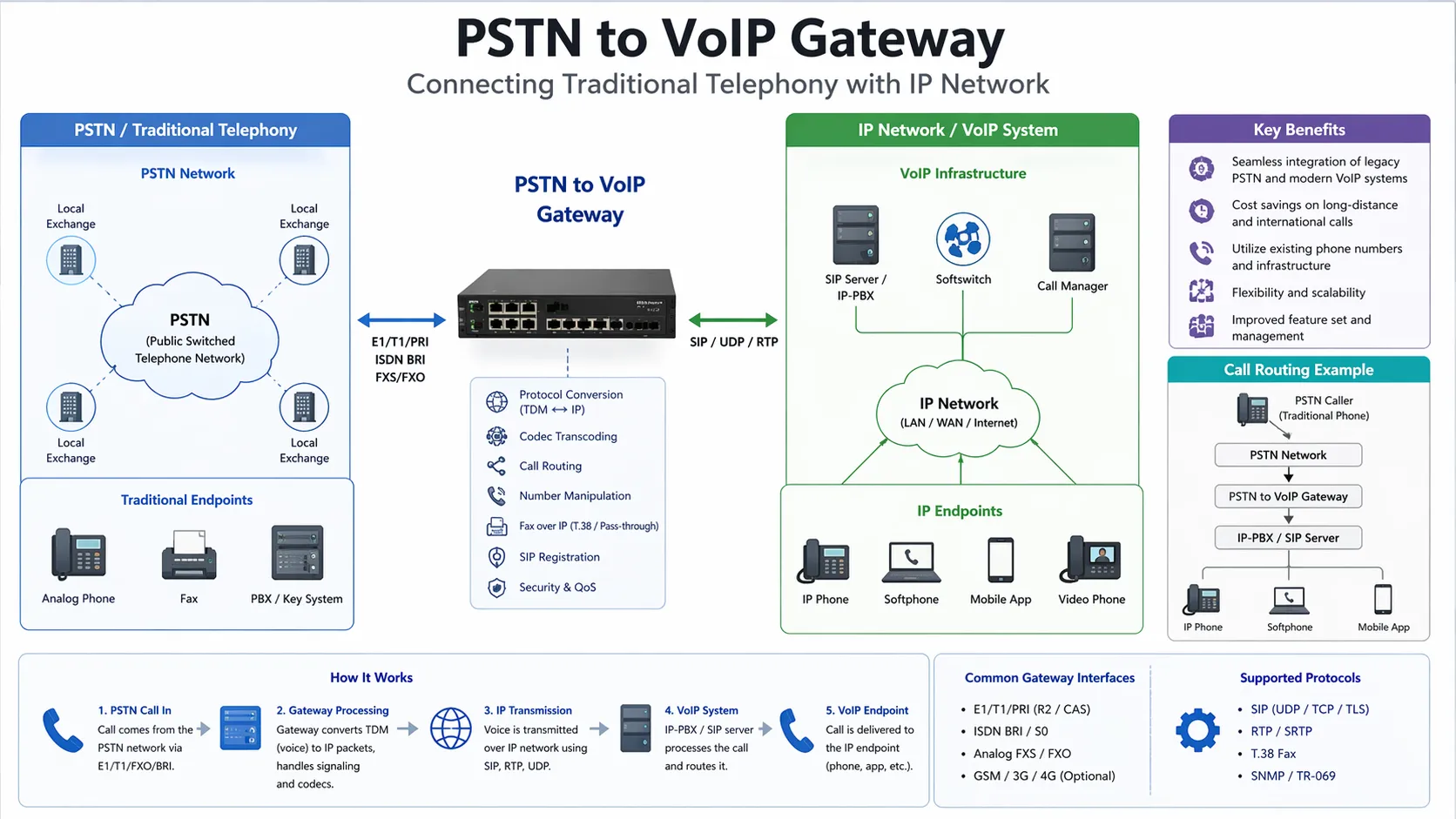
Modern enterprise and carrier-grade communication systems achieve seamless integration between the PSTN and IP-based VoIP networks through specialized media gateway and signaling gateway devices, which perform real-time conversion of analog voice signals from the PSTN into digital data packets suitable for IP network transmission, as well as packet-to-analog conversion for incoming IP voice traffic to the PSTN.
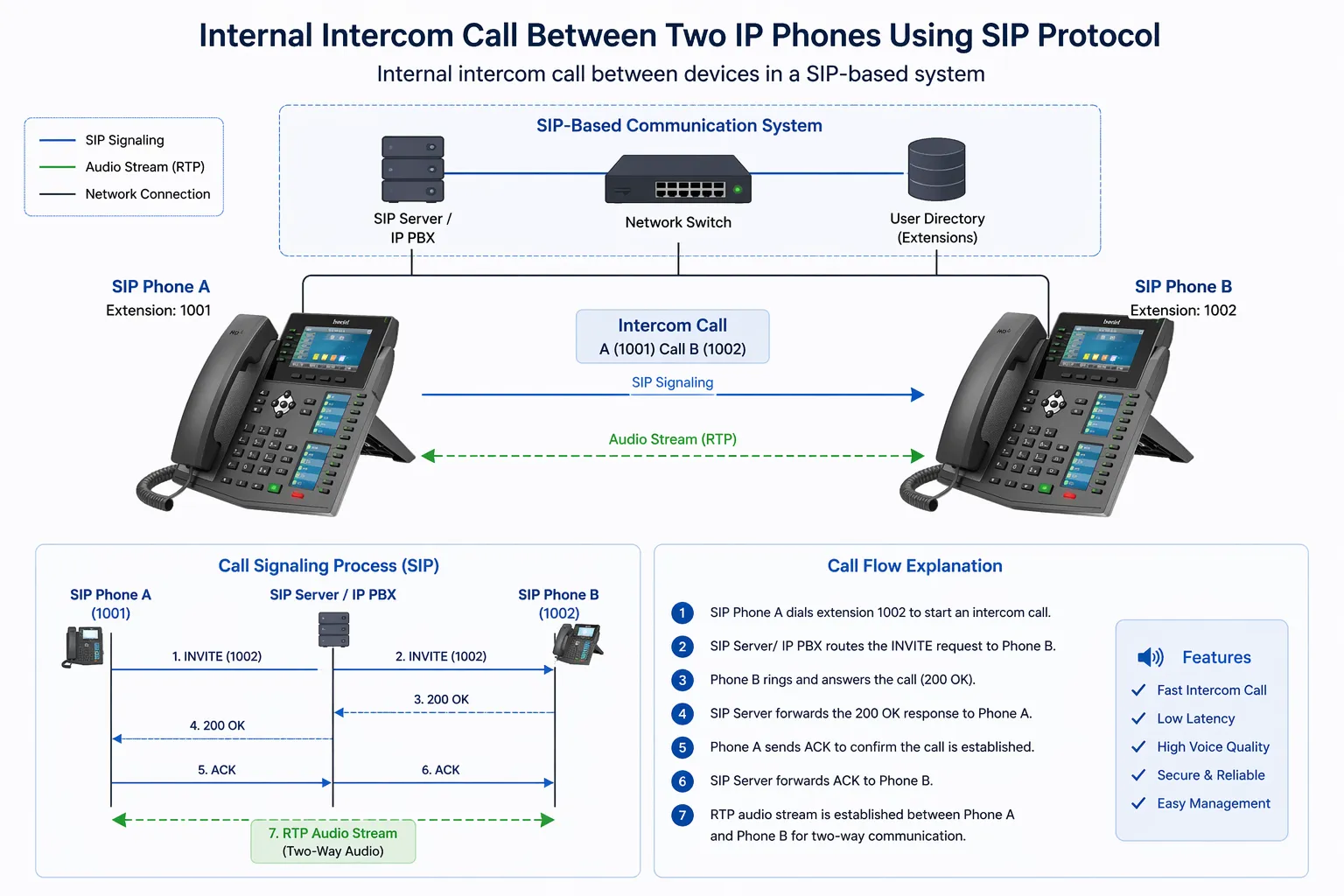
Industry-standard protocols such as the Session Initiation Protocol (SIP) enable full cross-network interoperability, signaling exchange, and call control between PSTN infrastructure and SIP-based communication systems, allowing organizations to combine the reliable legacy connectivity of traditional PSTN telephony with advanced IP-based communication features including unified communications, call recording, remote extension access, and multi-device call synchronization.
PSTN network architecture and call routing process
Uses of PSTN
Traditional Telephony
The PSTN is still extensively deployed for fixed-line landline telephone services in both residential household and commercial business environments worldwide, providing highly reliable, always-available voice communication that operates independently of internet connectivity, broadband access, or IP network infrastructure, making it particularly valuable in areas with limited digital network coverage or unstable internet service.
Backup Communication System
A large number of enterprises, government agencies, healthcare facilities, and industrial organizations utilize the PSTN as a mission-critical redundant backup communication system to maintain continuous voice connectivity in the event of complete IP network failures, fiber-optic cable outages, cyberattacks targeting IP communication platforms, or natural disasters that disrupt modern broadband and data network services.
Integration with Enterprise Systems
Businesses of all sizes frequently connect their on-premises or cloud-hosted IP PBX systems directly to the PSTN through trunk interfaces (such as PRI, BRI, or FXO trunks) to enable external public-network calling, retain official business telephone numbers, support local and long-distance dialing, and build hybrid communication environments that combine the flexibility of IP telephony with the stability and universal reach of the PSTN.
PSTN integration with VoIP systems through gateway devices
Applications of PSTN
Enterprise Communication
Organizations across industries rely on the PSTN to support stable external voice communication with customers, partners, and suppliers, providing consistent access to public telephone networks, supporting toll-free and local dialing services, and maintaining professional business communication channels that are recognized and accessible to all public telephone users globally.
Emergency and Public Services
The PSTN plays an irreplaceably crucial role in public emergency communication systems, including emergency call services (such as 911 in the United States, 112 in Europe, and other local emergency numbers), as it provides highly reliable location-indexed connectivity, operates independently of IP networks, and remains functional during power or data network outages, ensuring emergency services can always be reached by the public.
Industrial and Remote Environments
In geographically remote rural areas, mining sites, offshore facilities, transportation corridors, and industrial zones where broadband internet deployment is economically unfeasible or technically challenging, the PSTN frequently remains the primary, and sometimes the only, viable communication infrastructure for voice services, operational coordination, and basic telecommunication needs.
FAQ
Is PSTN still used today?
Yes, the PSTN remains widely used across the globe in modern telecommunication systems, especially serving as a highly dependable backup communication channel for enterprises, public services, and remote areas, and it continues to support basic voice services in regions where IP network infrastructure is not fully developed.
What is the difference between PSTN and VoIP?
The core technical difference is that PSTN uses circuit-switched transmission, which dedicates a fixed physical circuit for each call, while VoIP uses packet-switched transmission, which breaks voice into digital data packets and transmits them over IP networks; PSTN offers higher reliability without internet dependency, while VoIP provides greater flexibility and richer functional features at a lower operational cost.
Can PSTN integrate with modern systems?
Yes, the PSTN can fully integrate with modern IP-based communication, VoIP, and SIP systems through specialized media gateways, signaling converters, and SIP trunking services, enabling hybrid communication architectures that leverage the strengths of both legacy PSTN stability and modern IP telephony functionality.
We use cookie to improve your online experience. By continuing to browse this website, you agree to our use of cookie.
Cookies
This Cookie Policy explains how we use cookies and similar technologies when you access or use our website and related services. Please read this Policy together with our Terms and Conditions and Privacy Policy so that you understand how we collect, use, and protect information.
By continuing to access or use our Services, you acknowledge that cookies and similar technologies may be used as described in this Policy, subject to applicable law and your available choices.
Updates to This Cookie Policy
We may revise this Cookie Policy from time to time to reflect changes in legal requirements, technology, or our business practices. When we make updates, the revised version will be posted on this page and will become effective from the date of publication unless otherwise required by law.
Where required, we will provide additional notice or request your consent before applying material changes that affect your rights or choices.
What Are Cookies?
Cookies are small text files placed on your device when you visit a website or interact with certain online content. They help websites recognize your browser or device, remember your preferences, support essential functionality, and improve the overall user experience.
In this Cookie Policy, the term “cookies” also includes similar technologies such as pixels, tags, web beacons, and other tracking tools that perform comparable functions.
Why We Use Cookies
We use cookies to help our website function properly, remember user preferences, enhance website performance, understand how visitors interact with our pages, and support security, analytics, and marketing activities where permitted by law.
We use cookies to keep our website functional, secure, efficient, and more relevant to your browsing experience.
Categories of Cookies We Use
Strictly Necessary Cookies
These cookies are essential for the operation of the website and cannot be disabled in our systems where they are required to provide the service you request. They are typically set in response to actions such as setting privacy preferences, signing in, or submitting forms.
Without these cookies, certain parts of the website may not function correctly.
Functional Cookies
Functional cookies enable enhanced features and personalization, such as remembering your preferences, language settings, or previously selected options. These cookies may be set by us or by third-party providers whose services are integrated into our website.
If you disable these cookies, some services or features may not work as intended.
Performance and Analytics Cookies
These cookies help us understand how visitors use our website by collecting information such as traffic sources, page visits, navigation behavior, and general interaction patterns. In many cases, this information is aggregated and does not directly identify individual users.
We use this information to improve website performance, usability, and content relevance.
Targeting and Advertising Cookies
These cookies may be placed by our advertising or marketing partners to help deliver more relevant ads and measure the effectiveness of campaigns. They may use information about your browsing activity across different websites and services to build a profile of your interests.
These cookies generally do not store directly identifying personal information, but they may identify your browser or device.
First-Party and Third-Party Cookies
Some cookies are set directly by our website and are referred to as first-party cookies. Other cookies are set by third-party services, such as analytics providers, embedded content providers, or advertising partners, and are referred to as third-party cookies.
Third-party providers may use their own cookies in accordance with their own privacy and cookie policies.
Information Collected Through Cookies
Depending on the type of cookie used, the information collected may include browser type, device type, IP address, referring website, pages viewed, time spent on pages, clickstream behavior, and general usage patterns.
This information helps us maintain the website, improve performance, enhance security, and provide a better user experience.
Your Cookie Choices
You can control or disable cookies through your browser settings and, where available, through our cookie consent or preference management tools. Depending on your location, you may also have the right to accept or reject certain categories of cookies, especially those used for analytics, personalization, or advertising purposes.
Please note that blocking or deleting certain cookies may affect the availability, functionality, or performance of some parts of the website.
Restricting cookies may limit certain features and reduce the quality of your experience on the website.
Cookies in Mobile Applications
Where our mobile applications use cookie-like technologies, they are generally limited to those required for core functionality, security, and service delivery. Disabling these essential technologies may affect the normal operation of the application.
We do not use essential mobile application cookies to store unnecessary personal information.
How to Manage Cookies
Most web browsers allow you to manage cookies through browser settings. You can usually choose to block, delete, or receive alerts before cookies are stored. Because browser controls vary, please refer to your browser provider’s support documentation for details on how to manage cookie settings.
Contact Us
If you have any questions about this Cookie Policy or our use of cookies and similar technologies, please contact us at support@becke.cc .