All-weather protection refers to the ability of a device, enclosure, or communication terminal to continue operating reliably in changing outdoor or harsh environmental conditions. In practical engineering terms, it means the equipment is designed to resist the effects of rain, dust, wind, sunlight, humidity, temperature variation, and in some cases salt spray, corrosion, ice, vibration, or mechanical impact. The concept is widely used in industrial communications, outdoor telephony, public safety systems, transportation infrastructure, utility networks, marine installations, and emergency help points.
Although the phrase sounds simple, all-weather protection is not just a marketing expression. In serious technical use, it usually implies that the product has been designed with a defined environmental target and backed by measurable protection levels such as IP ratings, IK ratings, material selection, sealing methods, coating treatment, and compliance with recognized standards. For buyers and system designers, understanding this concept is important because outdoor equipment failure is often caused not by core electronics, but by water ingress, corrosion, UV aging, cable entry leakage, gasket deterioration, or poor enclosure strength.
In communication systems, all-weather protection is especially important because field devices are often deployed far from controlled indoor spaces. A weatherproof emergency telephone in a tunnel, a SIP paging speaker in a port, a roadside help point, or an outdoor intercom in a campus environment must all remain available when weather conditions are at their worst. In many cases, the need is not merely convenience but operational continuity, safety response, and emergency communication readiness.
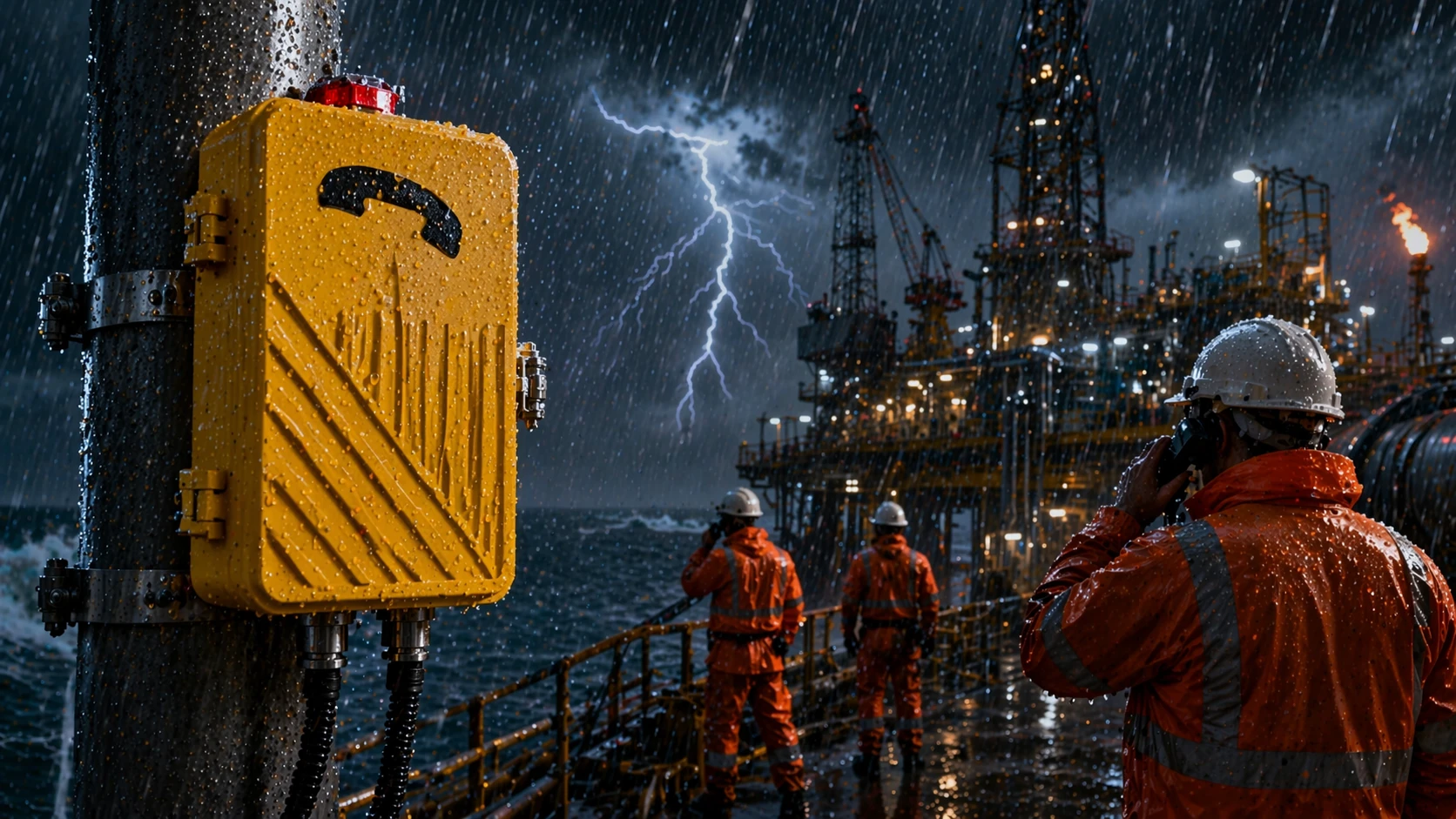
All-weather protection helps outdoor communication equipment maintain reliable operation in exposed and demanding environments.
What All-Weather Protection Means in Practice
More Than Resistance to Rain
Many people first associate all-weather protection with rain resistance, but the real meaning is broader. A properly protected outdoor device must handle multiple environmental stress factors at the same time. A rainy coastal site, for example, may expose equipment not only to water but also to salt-laden air, humidity, temperature cycling, metal corrosion, and long-term UV radiation. A desert or mining location may create different problems, including fine dust ingress, thermal loading, mechanical shock, and exposure to direct sunlight over long periods.
That is why all-weather protection should be understood as a system-level environmental design approach rather than a single feature. The enclosure, seals, cable glands, drainage strategy, surface coating, microphone and speaker openings, fasteners, connectors, and mounting method all contribute to the final performance. A product can have a rugged metal body yet still fail outdoors if its cable entry is weak or its sealing structure is poorly designed.
For this reason, professional buyers normally look beyond appearance and ask how the equipment behaves over time. The key question is not whether a device can survive a brief exposure, but whether it can continue functioning through years of seasonal change, maintenance cycles, contamination, and repeated environmental stress in a real operating environment.
Environmental Reliability as a Design Goal
When manufacturers describe a product as all-weather protected, they are usually saying that the product is intended for service where the environment cannot be tightly controlled. That includes exposed roadside installations, outdoor industrial plants, rail corridors, airports, ports, utility substations, campuses, parking areas, and petrochemical facilities. In these applications, equipment must keep working during storms, heat, cold, and airborne contamination without constant manual intervention.
Environmental reliability depends on design discipline. Engineers must think about how water flows over the enclosure, where condensation may form, how seals age, whether metal parts can corrode, whether plastics can become brittle, and whether audio openings can remain protected without blocking speech or broadcast quality. This is particularly important in intercoms, emergency telephones, loudspeakers, and paging stations because the device must not only remain powered on but also keep delivering understandable audio.
In other words, all-weather protection is closely tied to service availability. If a field communication endpoint becomes unusable during heavy rain, winter freezing, or severe dust conditions, the cost is often much higher than equipment replacement alone. It can affect site safety, emergency response time, coordination efficiency, and even regulatory compliance in critical sectors.
All-weather protection is not simply about surviving the outdoors. It is about maintaining dependable communication performance when the outdoor environment is actively working against the equipment.
Key Standards and Measurement Concepts
Why Standards Matter
Without standards, terms such as weatherproof, outdoor-grade, rugged, or heavy-duty can easily become vague. Standards provide a common technical language that allows manufacturers, consultants, contractors, and end users to compare products more objectively. They do not automatically guarantee that one product is perfect for every environment, but they make it possible to understand what kind of exposure a device was designed to resist.
For all-weather protected products, the most widely referenced concepts usually include ingress protection ratings, impact resistance ratings, corrosion-related testing, environmental endurance testing, and material-level design characteristics. In some industries, additional certification may be required depending on the site, such as marine requirements, hazardous area requirements, transportation specifications, or military-style environmental testing methods.
That is why a serious product selection process often combines standardized ratings with application-specific engineering judgment. A product rated for dust and water ingress may still require extra review if it will be installed offshore, in a chemical plant, or in a region with severe winter freeze-thaw cycles. Standards help define the baseline, but the final deployment decision must still reflect the actual environment.
IP Ratings and Ingress Protection
One of the most important frameworks for all-weather protection is the IP rating, commonly written as IP65, IP66, IP67, or similar. IP stands for ingress protection and indicates how well an enclosure resists the entry of solid particles and water. The first digit relates to protection against solids such as dust, while the second digit relates to protection against water exposure. This system is widely used because it gives an immediate technical shorthand for enclosure sealing performance.
For outdoor communication equipment, IP65 usually means the enclosure is dust-tight and protected against water jets. IP66 typically indicates dust-tight protection plus stronger resistance to powerful water jets. IP67 normally adds temporary immersion resistance under defined test conditions. In practice, these ratings are often highly relevant for outdoor telephones, SIP speakers, call boxes, intercom stations, and network enclosures because moisture and dust ingress are among the most common causes of field failure.
However, IP ratings should be interpreted carefully. A higher number does not automatically mean the product is ideal for every situation. IP testing is based on defined test methods, not every real-world combination of weather, pressure, contamination, or installation error. For example, improper mounting, damaged gaskets, poor cable sealing, or aging maintenance conditions can reduce real-life performance even if the enclosure itself carries a high rating.
IK Ratings and Mechanical Strength
Weather is not the only challenge for outdoor equipment. Many exposed installations also face mechanical risks such as accidental impact, vandalism, tool strikes, maintenance collisions, or moving object contact. This is where IK ratings become important. IK ratings indicate resistance to mechanical impact, helping buyers understand how durable an enclosure is when exposed to force.
In real deployments, mechanical durability often matters just as much as water resistance. A roadside help point, a prison intercom, a transport platform emergency phone, or a public campus call station may be exposed not only to rain and dust but also to human contact, tampering, or rough treatment. If the enclosure cracks under impact, the weather seal can fail soon after. That means IK performance indirectly supports all-weather reliability as well.
For this reason, outdoor and public-facing equipment is often assessed through both IP and IK thinking. A device that is sealed against water but physically fragile may not remain weatherproof after a relatively minor strike. Strong enclosure construction, metal housings, protected fasteners, and reinforced front panels all contribute to keeping environmental protection intact over the product life cycle.
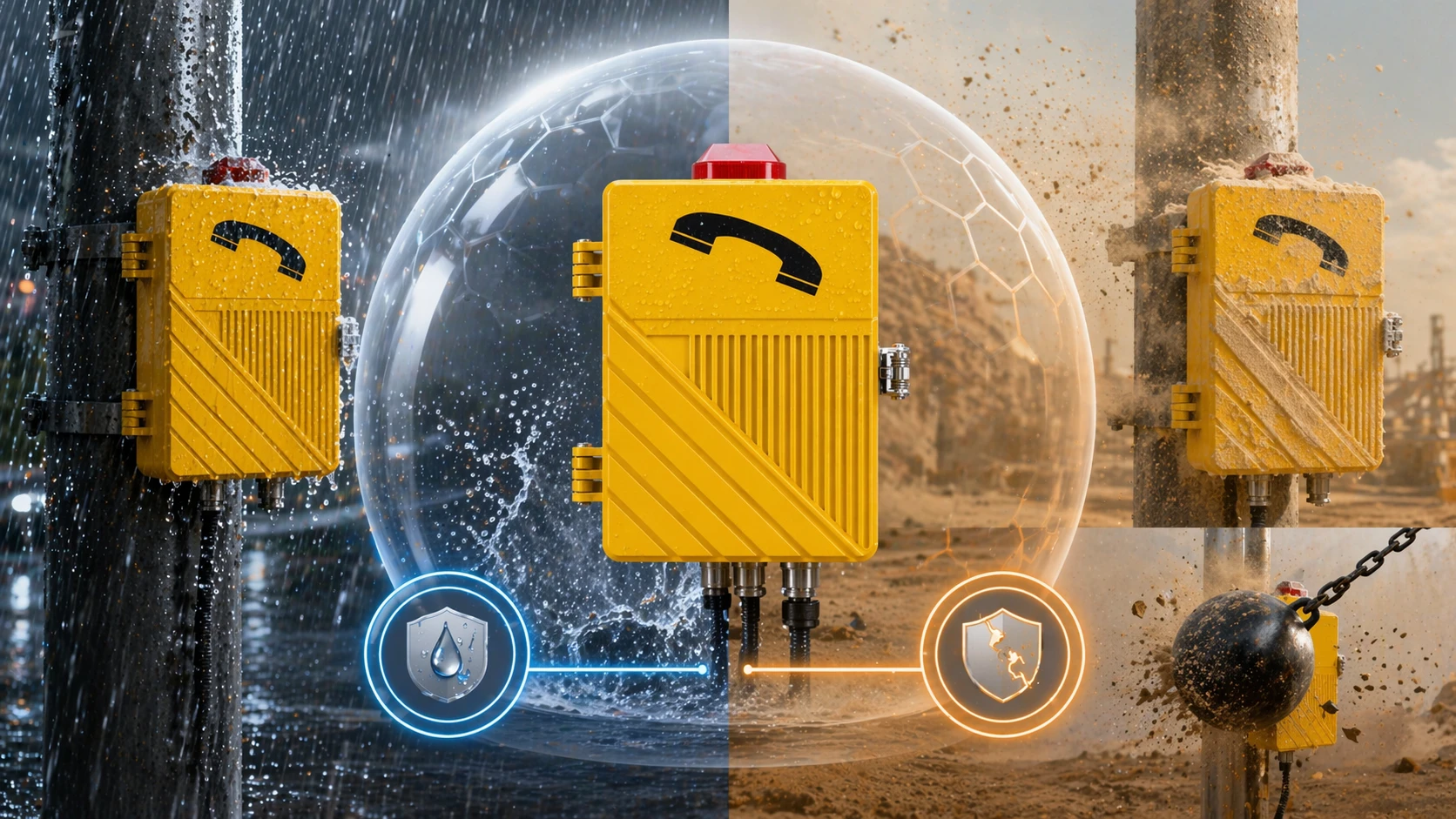
IP ratings address ingress protection, while IK ratings help evaluate how well the enclosure can withstand mechanical force in exposed installations.
Materials, Coatings, and Corrosion Resistance
A device cannot be considered truly all-weather protected if its enclosure material degrades quickly outdoors. Material choice is therefore central to environmental design. Common solutions include stainless steel, aluminum alloy, reinforced engineering plastics, anti-corrosion coatings, UV-resistant finishes, and weather-resistant gasket materials. The choice depends on cost, expected service life, and the severity of the site environment.
Corrosion resistance is especially important in marine areas, coastal zones, wastewater facilities, industrial plants, and chemical processing environments. In these locations, moisture is only part of the issue. Airborne chemicals, salt spray, industrial residue, and persistent condensation can attack metal surfaces and fasteners over time. A product that performs well in a dry commercial site may not last long in a corrosive industrial atmosphere unless its materials and surface treatment are selected appropriately.
That is why experienced buyers often evaluate enclosure material together with sealing performance. A high IP rating alone is not enough if the housing, screws, brackets, or acoustic openings are vulnerable to long-term corrosion. Good all-weather design means the enclosure system remains mechanically and environmentally stable throughout prolonged outdoor service.
Common Protection Ratings Used in Outdoor Equipment
IP54, IP55, and Entry-Level Outdoor Suitability
Lower outdoor-oriented ratings such as IP54 or IP55 may be acceptable for semi-sheltered installations where the device is not fully exposed to driving rain or severe contamination. These ratings can be suitable for covered entrances, partially protected stations, or light commercial outdoor areas where environmental stress exists but is not extreme. In such settings, the product may perform well if installation conditions are carefully controlled.
Even so, system designers should be cautious about assuming that basic outdoor suitability equals robust all-weather protection. A device in a recessed wall box or under a canopy may still encounter moisture buildup, wind-driven dust, or temperature variation. Over time, real conditions can exceed what was assumed during installation. Entry-level protection may therefore be insufficient for mission-critical communication endpoints where availability matters.
For critical communication infrastructure, lower ratings are generally selected only when the site is substantially protected by structure or when additional housing is provided. Otherwise, designers tend to move toward higher sealing levels to reduce maintenance risk and improve long-term reliability.
IP65 and IP66 for General Harsh Outdoor Use
IP65 and IP66 are among the most common ratings for serious outdoor communication equipment. These levels are often used for weatherproof telephones, industrial intercom stations, emergency call boxes, outdoor paging speakers, and network equipment enclosures. They provide a strong baseline for resisting dust ingress and rain or washdown exposure in many infrastructure and industrial applications.
In real engineering projects, IP65 or IP66 is often considered a practical balance between protection, manufacturability, cost, and field serviceability. Devices at this level can usually be deployed in outdoor exposed positions, roadside cabinets, utility areas, industrial yards, and transportation facilities, provided that installation is done correctly and the product is intended for the specific temperature and corrosion profile of the site.
The distinction between IP65 and IP66 becomes more meaningful in environments with strong water spray, cleaning procedures, or intense weather exposure. Selection should be based on actual operating conditions rather than marketing preference. A site that faces direct storm exposure, washdown, or recurring high-pressure spray may justify a more robust enclosure specification.
IP67 and Higher for More Demanding Exposure
IP67-rated equipment is designed to resist dust and temporary immersion under controlled conditions. This can be valuable for locations where equipment may face standing water, flooding risk, or unusually severe moisture conditions. Certain field devices, cable junction points, sensors, and compact outdoor units use this level of protection when the exposure profile justifies it.
Still, users should not interpret IP67 as meaning the device can be ignored in any outdoor condition. Temporary immersion testing is very different from indefinite submersion, harsh chemical exposure, or repeated environmental cycling. In communication devices, audio ports, cable glands, service access points, and mounting arrangement still need careful attention. The enclosure rating is one part of the environmental design, not the entire story.
For practical procurement, higher ratings are most useful when they align with real risk. Over-specification can increase cost unnecessarily, while under-specification can create service problems later. The best approach is to match the rating to the environment, maintenance model, and operational importance of the device.
How All-Weather Protection Is Achieved
Sealing Design and Enclosure Construction
The most visible part of all-weather protection is the enclosure, but the real performance depends on detailed construction choices. Proper gasket compression, precision cover alignment, protected hinge design, secure latching, and reliable cable sealing all matter. In communication endpoints, designers must also protect microphones, speakers, keypads, buttons, display windows, and connectors without compromising usability.
Good enclosure design also manages water behavior. Engineers consider how rain runs across the housing, where water may pool, and whether drainage or pressure equalization is needed. A product that looks sealed on paper can still develop failure points if water is allowed to sit around a cable entry or service joint for long periods. This is why enclosure geometry is often as important as the raw material itself.
In industrial or outdoor emergency communication equipment, enclosure construction is often reinforced to support both environmental and operational demands. The housing may need to resist corrosion, impact, vibration, and tampering while still allowing clear audio, easy activation, and service access for maintenance personnel.
Thermal Design, Condensation Control, and Component Stability
Outdoor reliability is not only about what stays out of the enclosure, but also about what happens inside it. Temperature shifts between day and night can create condensation, especially in humid environments. This can affect circuit boards, connectors, acoustic assemblies, and power components. A device designed for all-weather service must therefore consider thermal behavior and moisture management internally.
Manufacturers may address this through enclosure design, component spacing, membrane vents, coatings, heating strategies, or careful selection of operating temperature components. In some environments, sunlight heating is a major concern. Dark enclosures exposed to full sun can experience significant internal temperature rise, which affects electronics and accelerates material aging. In cold regions, freezing conditions create a different set of risks, especially where condensation and ice formation interact.
These internal stability issues are often overlooked by non-specialist buyers, yet they strongly influence long-term field performance. A product that passes a basic water ingress expectation may still suffer service issues if it is not thermally and electrically prepared for continuous outdoor operation.
Audio, User Interface, and Environmental Usability
In communication products, all-weather protection must be compatible with real-world usability. A rugged housing is not enough if the audio becomes unclear in wind, rain, or industrial noise, or if the keypad and call controls become difficult to use with gloves or wet hands. Environmental protection must therefore support, not undermine, communication effectiveness.
This is particularly relevant for weatherproof telephones, SIP intercoms, paging stations, and emergency help points. The acoustic path must remain functional while being protected from dust and water. Buttons must be durable and responsive. Labels and indicators should remain readable outdoors. In many industries, the equipment must also support operation by non-technical users under stress, such as passengers, workers, visitors, or emergency responders.
As a result, all-weather product design often involves trade-offs between sealing, audio quality, human factors, maintenance access, and structural strength. High-quality outdoor communication equipment succeeds because these factors are balanced as a complete system rather than treated as separate features.
The best all-weather equipment is not only hard to damage. It is also easy to use, easy to hear, and dependable when conditions are poor and communication matters most.
Typical Applications of All-Weather Protected Equipment
Industrial Plants and Process Facilities
Industrial sites such as petrochemical plants, power stations, refineries, mining operations, and manufacturing yards often require field communication devices that can operate in exposed or semi-exposed conditions. These environments may involve dust, moisture, oil mist, corrosive air, vibration, and rapid temperature change. In such cases, all-weather protection becomes a baseline requirement rather than an optional feature.
Weatherproof industrial telephones, SIP intercoms, paging speakers, and emergency call stations are commonly installed across process units, perimeter areas, loading zones, storage yards, and access points. Their role is not only routine communication but also emergency reporting, dispatch coordination, evacuation support, and maintenance response. Reliability is essential because devices may be located far from indoor support areas and may not be inspected constantly.
In higher-risk industrial sectors, environmental protection may also work alongside other design requirements such as explosion protection, high-visibility operation, noise compensation, or integration with PAGA and dispatch systems. This shows how all-weather protection often fits into a larger safety and operations framework.
Transportation and Infrastructure Networks
Road tunnels, highways, railways, metro systems, airports, ports, and bridges all rely on communication devices that can withstand changing environmental conditions. Exposure may include rain, vehicle emissions, dust, washdown procedures, wind, vibration, and public interaction. In such settings, outdoor communication endpoints are part of the operational infrastructure and may also serve life-safety functions.
Examples include roadside emergency telephones, tunnel communication stations, platform help points, outdoor broadcast speakers, and field maintenance intercoms. These devices must remain available through changing weather and heavy use. Because transportation systems often run continuously, the cost of downtime can be significant, affecting both operational coordination and emergency readiness.
All-weather protection in transport environments also supports system integration. Field devices are frequently linked with SIP networks, control rooms, video systems, alarms, and central dispatch platforms. A communication endpoint that survives outdoors but fails to deliver stable service quality is still a weak link in the broader infrastructure system.
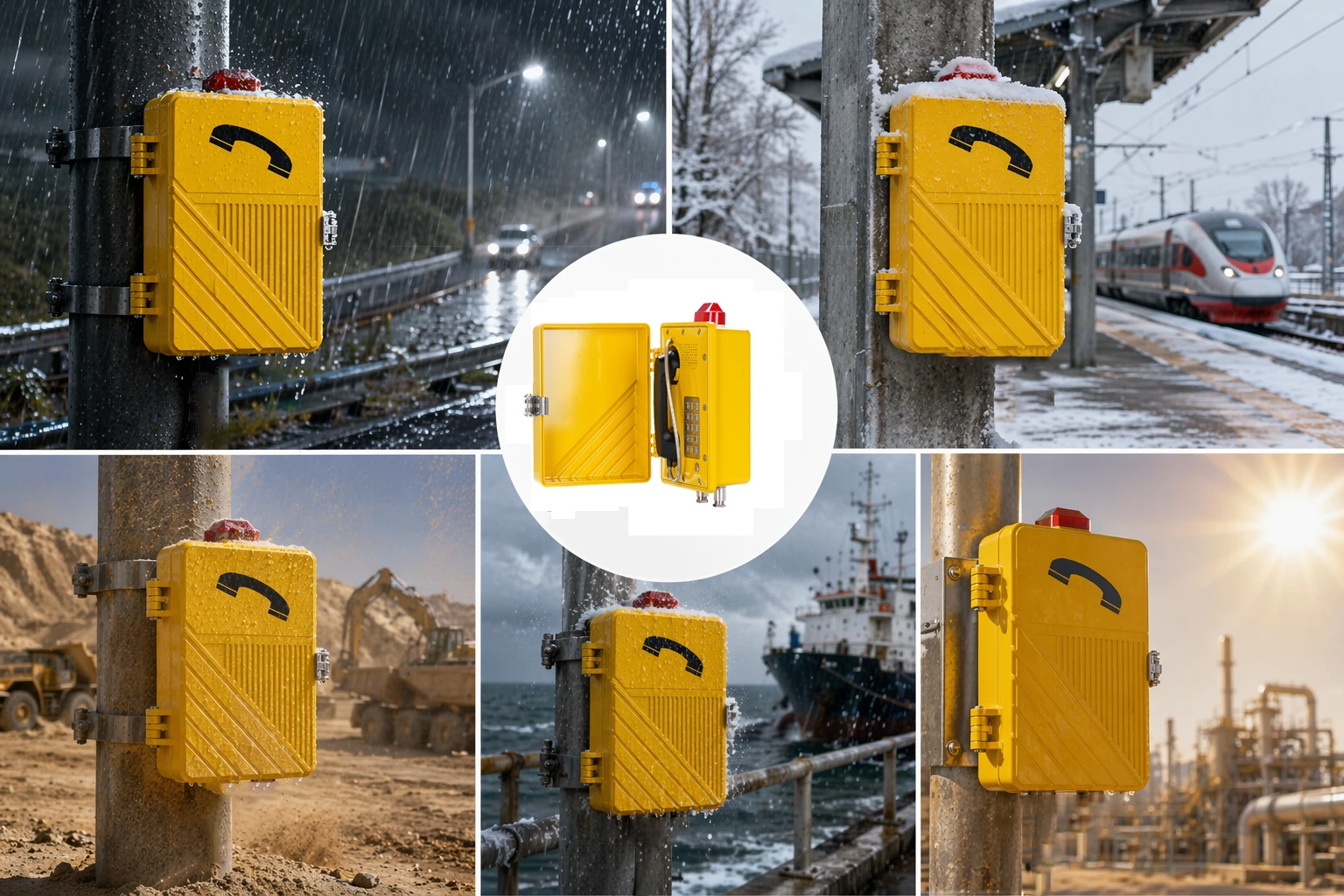
All-weather protected equipment is widely used in transport, industrial, and public-facing emergency communication systems.
Campuses, Public Areas, and Emergency Help Systems
Universities, hospitals, parking facilities, public squares, scenic areas, and large commercial campuses often deploy outdoor intercoms and help points in locations where public users may need immediate assistance. Because these devices are exposed to weather and unpredictable usage, they must combine environmental durability with simplicity of operation.
In these applications, all-weather protection supports both service continuity and user trust. A help point that appears damaged, waterlogged, or unreliable can discourage use, even if technically still online. Durable housings, clear audio performance, visible status indication, and resistance to outdoor wear all contribute to effective public communication infrastructure.
Such systems are frequently integrated with security operations centers, SIP PBX platforms, broadcasting systems, and surveillance environments. That means the field endpoint must function as part of a larger response process. Environmental protection therefore affects not only the device itself but also the reliability of the whole assistance workflow.
How to Evaluate All-Weather Protected Products
Look Beyond the Marketing Phrase
When reviewing products described as all-weather protected, buyers should ask what measurable design elements support that claim. Useful questions include the enclosure rating, impact resistance, operating temperature range, material specification, corrosion treatment, mounting method, and cable entry design. It is also worth asking whether the published rating applies to the fully assembled product in normal installation condition.
Marketing language can be helpful as an initial indicator, but procurement decisions should not rely on description alone. A serious outdoor product should be understandable in technical terms. That does not mean every application needs the highest possible specification, but it does mean the environmental claim should be backed by details relevant to the deployment environment.
This is especially true for communication devices, where failure can affect response time and operational continuity. Environmental suitability should be treated as a performance requirement, not a cosmetic product feature.
Match the Product to the Site Conditions
The right protection level depends on where and how the equipment will be used. A campus help point under partial shelter may not need the same construction as a coastal industrial telephone or a tunnel emergency station. Similarly, an outdoor SIP speaker installed in a protected overhead position may face different risks from a wall-mounted intercom at ground level in an open public area.
Site assessment should consider exposure to water, dust, sunlight, vandalism, chemical atmosphere, washdown, temperature range, and maintenance accessibility. Installation details matter as well. Even a strong enclosure can perform poorly if mounted in a position that traps water, exposes weak cable joints, or encourages impact damage.
Therefore, the most reliable procurement approach is application-led rather than spec-sheet-led. Ratings and standards are important, but they should always be interpreted in the context of the actual service environment and the operational criticality of the device.
Consider Integration, Maintenance, and Lifecycle Value
All-weather protection should also be evaluated as part of total lifecycle performance. A robust enclosure can reduce failure rates, maintenance visits, replacement costs, and service interruptions over time. This is particularly important for distributed sites where field access is difficult or expensive. In these cases, environmental reliability has direct economic value as well as operational value.
System integration matters too. Outdoor devices today are rarely isolated products. They are commonly part of SIP communication systems, paging networks, security platforms, public warning systems, and dispatch workflows. A well-protected endpoint should not only survive the environment but also integrate cleanly into the wider network architecture.
For that reason, buyers often achieve the best results when they evaluate enclosure protection together with audio performance, network compatibility, power method, installation flexibility, and long-term serviceability. A truly successful all-weather solution is dependable in the field and practical in the system.
Why All-Weather Protection Matters in Modern Communication Systems
Availability, Safety, and Operational Continuity
Modern communication systems increasingly extend beyond office buildings into outdoor and industrial spaces. As organizations deploy SIP telephony, intercom, paging, and emergency communication infrastructure across wider physical areas, environmental reliability becomes central to system design. The field endpoint is often the point where people interact with the system during a real event, which means its failure can carry immediate consequences.
In routine operations, dependable outdoor equipment improves coordination, maintenance communication, visitor assistance, and site management. During incidents, the importance becomes even greater. Workers may need to report a hazard. A traveler may need roadside help. A control room may need to issue broadcast instructions through outdoor speakers. In such cases, all-weather protection helps ensure that communication remains available when needed most.
This is why the topic continues to matter across industrial, transportation, municipal, educational, and commercial sectors. As outdoor communication networks become more connected and more critical, environmental durability is no longer secondary. It is part of the core system value.
A Practical Foundation for Outdoor SIP and IP Devices
In many modern deployments, all-weather protection supports the broader shift toward IP-based communication. SIP telephones, outdoor intercoms, network speakers, call boxes, and distributed help points are now expected to operate as part of unified communication, security, and dispatch environments. This creates new flexibility, but it also means outdoor hardware must meet both network and environmental expectations.
A poorly protected endpoint can undermine an otherwise advanced system. Strong server-side architecture, SIP integration, and intelligent control features do not solve the problem if the field device stops working in rain, dust, or heat. Durable physical design remains the practical foundation of dependable outdoor communication.
For that reason, all-weather protection should be viewed as an enabling capability. It allows networked voice devices to move confidently into real-world environments where people actually need them, not just into controlled technical spaces.
As communication systems become smarter and more connected, outdoor device protection becomes more important, not less. Network intelligence depends on physical reliability at the edge.
FAQ
Is all-weather protection the same as waterproof?
No. Waterproof usually refers mainly to resistance against water, while all-weather protection is a broader idea that includes resistance to rain, dust, humidity, sunlight, temperature change, and sometimes corrosion or mechanical exposure. A product may be water-resistant yet still not be suitable for long-term harsh outdoor use.
Which IP rating is commonly used for outdoor communication equipment?
IP65 and IP66 are very common for outdoor communication devices such as weatherproof telephones, intercoms, and paging speakers. However, the correct rating depends on the actual site conditions, installation method, and required reliability level.
Does a high IP rating guarantee long-term outdoor durability?
Not by itself. A high IP rating is important, but long-term durability also depends on enclosure material, corrosion resistance, UV stability, impact strength, cable sealing, installation quality, and maintenance practices. Real outdoor performance always involves more than one specification.
Where is all-weather protected equipment most commonly used?
It is widely used in industrial plants, transportation systems, tunnels, highways, ports, campuses, public safety installations, outdoor emergency help points, and other environments where communication devices must remain operational despite changing weather and environmental exposure.