


At a time when smartphones, SIP phones, cloud PBX platforms, and internet calling seem to dominate business communication, one traditional technology still refuses to disappear: the POTS phone.
POTS stands for Plain Old Telephone Service. It refers to the classic analog telephone service that uses copper telephone lines to transmit voice calls. For more than a century, POTS has supported homes, offices, elevators, alarm systems, emergency phones, fax machines, and many other basic communication applications.
A POTS phone may look simple, but its value comes from that simplicity. It does not need IP addressing, SIP registration, Ethernet switching, or cloud configuration. It sends voice as an analog electrical signal over a pair of copper wires, making it one of the most recognizable forms of traditional telephone communication.
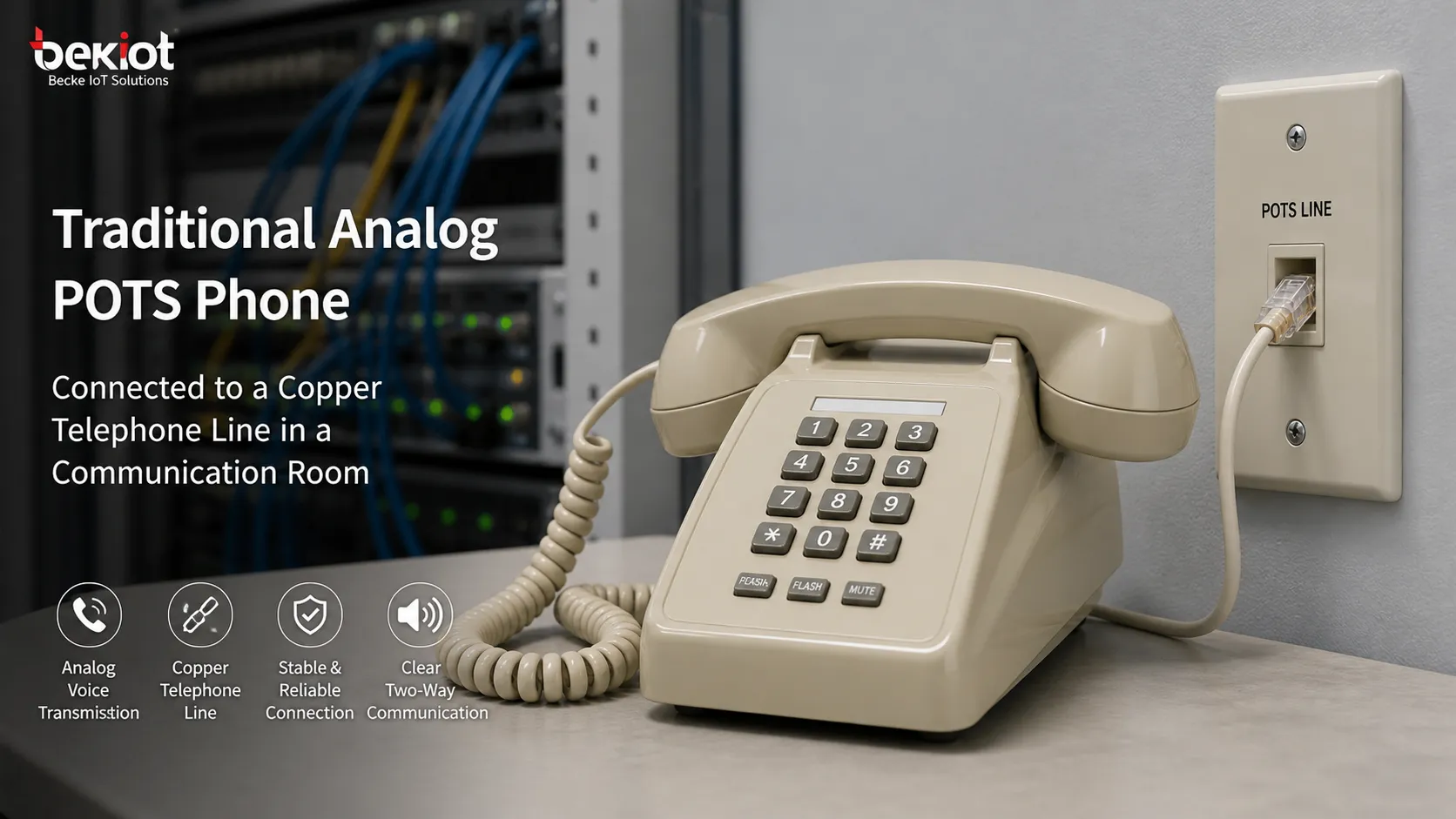
What Does POTS Phone Mean?
POTS Phone Definition
A POTS phone is a traditional analog telephone designed to work with Plain Old Telephone Service. It usually connects through an RJ11 telephone cable and communicates over a copper telephone line, analog PBX extension, or FXS gateway port.
Unlike a SIP phone or IP phone, a POTS phone does not connect directly to an IP network. It does not register to an IP PBX through SIP. Instead, it relies on analog voice signaling and traditional telephone line functions such as ringing voltage, dial tone, off-hook detection, and DTMF dialing.
Other Names for POTS Phones
POTS phones are often also called analog phones, landline phones, traditional telephones, or PSTN phones. These terms are closely related, but they are not always exactly the same.
PSTN refers to the Public Switched Telephone Network, while POTS usually refers to the basic analog telephone service that runs over traditional copper infrastructure. In practical communication projects, however, many people use POTS phone and analog phone in a similar way.
A POTS phone is not an IP phone. It is a traditional analog telephone that works through copper telephone lines, analog PBX ports, or FXS gateway interfaces.
How Does a POTS Phone Work?
Analog Voice Transmission
A POTS phone converts a person’s voice into analog electrical signals. These signals travel through copper wires to a telephone exchange, PBX system, or analog gateway. At the other end, the electrical signal is converted back into sound.
This is different from VoIP communication. In a VoIP or SIP phone system, voice is converted into digital packets and transmitted over an IP network. A POTS phone keeps the process more basic by using continuous analog signaling instead of packet-based transmission.
Line Power and Basic Operation
One reason POTS became so widely trusted is that a traditional telephone line can provide line power from the telephone exchange or central office. A basic corded POTS phone may continue working during a local power outage, depending on the network and line conditions.
When a user picks up the handset, the telephone goes off-hook and closes the circuit. The telephone exchange or PBX detects the action and provides dial tone. When the user dials a number, DTMF tones or dialing pulses tell the system where to route the call.
Why POTS Phones Still Matter
Simple and Reliable Communication
The biggest strength of a POTS phone is simplicity. It does not depend on broadband, Wi-Fi, IP configuration, software accounts, or cloud services. For many basic voice applications, this simplicity makes POTS technology easy to understand, easy to maintain, and highly predictable.
Traditional analog phones also have fewer electronic components compared with modern smart devices. In many legacy systems, a well-installed analog phone can remain in service for many years with limited maintenance.
Useful in Critical Applications
POTS phones are still found in many critical communication scenarios because they provide direct two-way voice communication. Elevator emergency phones, alarm panels, security rooms, remote buildings, and older industrial facilities may still rely on analog telephone lines or analog PBX connections.
Even where full copper line service is being reduced, many organizations still need to support existing analog devices. This is why POTS replacement, analog gateways, and VoIP migration have become important topics in modern communication planning.
Common Applications of POTS Phones
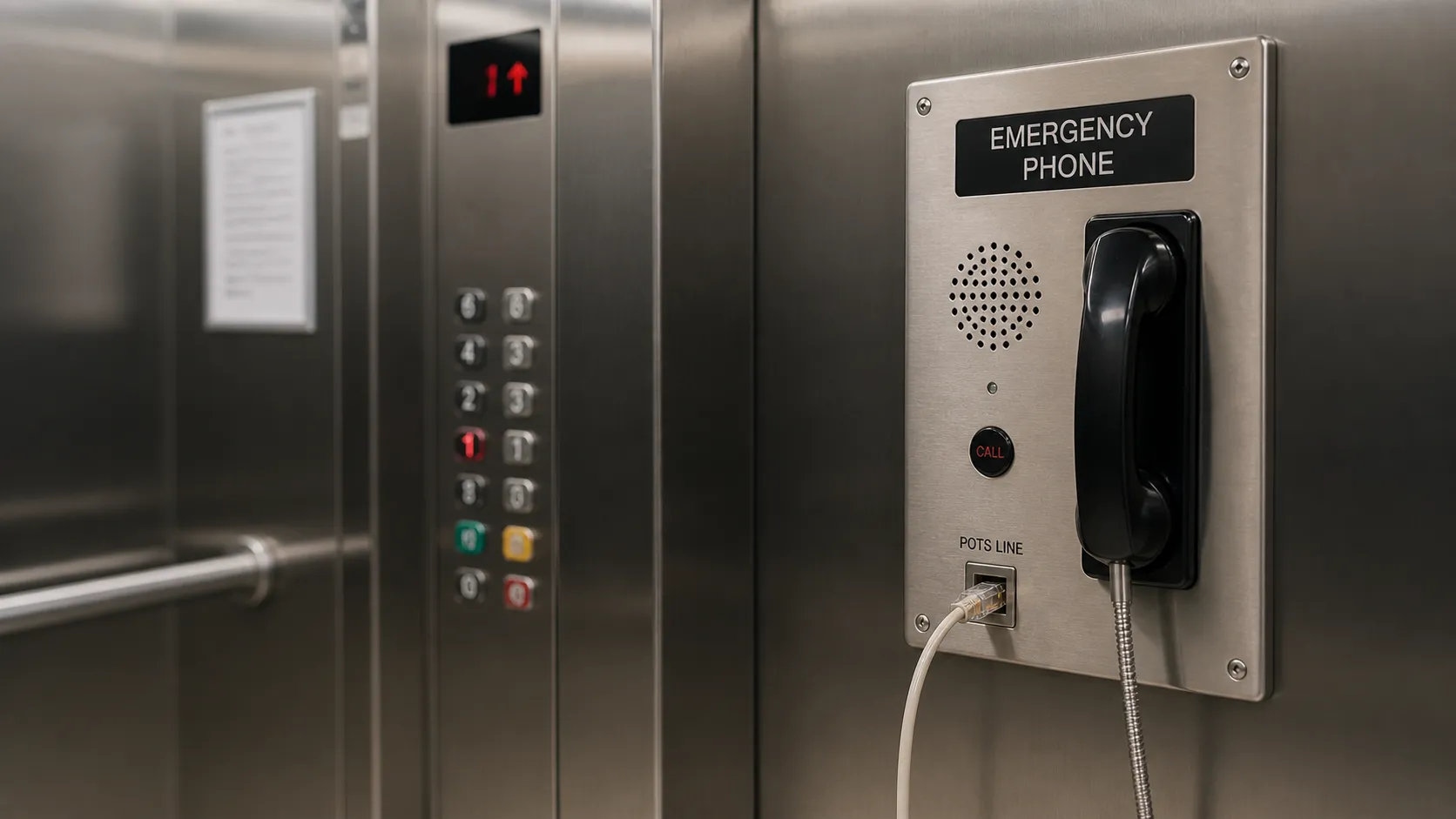
Elevator Emergency Phones
Elevator emergency phones are one of the most common places where POTS lines are still discussed. Many elevator systems require reliable two-way voice communication between trapped passengers and a monitoring center, security office, or emergency response team.
In older buildings, this connection often uses a traditional analog telephone line. In newer projects, the same function may be handled through an analog gateway, cellular adapter, VoIP service, or SIP-based emergency phone solution.
Fire Alarm, Security, and Monitoring Systems
Many fire alarm panels, security systems, and monitoring devices were originally designed to dial out through analog telephone lines. These systems may send alarms, status signals, or voice calls to a monitoring center.
As carriers reduce support for traditional copper lines, building owners and system integrators often need to evaluate whether these systems should stay on POTS, move to cellular, or connect through an IP-based gateway.
Fax Machines and Legacy Business Devices
Fax machines, credit card terminals, modems, and older point-of-sale devices have also used POTS lines for many years. Although these applications are declining, they still exist in certain industries, government departments, healthcare facilities, and legacy business environments.
For these cases, replacing the telephone line is not always as simple as unplugging the old device. Compatibility, signaling behavior, reliability, and regulatory requirements may need to be considered.
POTS Phone vs SIP Phone
Connection Method
The main difference between a POTS phone and a SIP phone is how they connect. A POTS phone connects to an analog telephone line, while a SIP phone connects to an IP network through Ethernet or Wi-Fi.
A SIP phone registers to a SIP server, IP PBX, or cloud communication platform. It uses digital signaling and voice packets to set up and transmit calls. A POTS phone does not use SIP directly unless it is connected through an analog telephone adapter or gateway.
Feature Differences
POTS phones are usually designed for basic voice communication. They can support calling, ringing, answering, dialing, and DTMF tones, but they do not naturally support advanced network-based features.
SIP phones and IP phones can support functions such as HD voice, remote provisioning, call recording, video calling, paging integration, intercom control, centralized management, and dispatch system integration. This makes SIP communication more flexible for modern enterprise and industrial environments.
| Item | POTS Phone | SIP Phone |
|---|---|---|
| Connection | Analog telephone line | IP network |
| Signal Type | Analog voice signal | Digital voice packets |
| Typical Interface | RJ11 | RJ45, Ethernet, or Wi-Fi |
| System Platform | PSTN, analog PBX, FXS port | SIP server, IP PBX, cloud PBX |
| Main Advantage | Simple and proven | Flexible and feature-rich |
| Typical Use | Legacy voice and emergency lines | Modern VoIP communication systems |
POTS Phone vs Analog Phone
Are They the Same?
In many daily conversations, POTS phone and analog phone mean almost the same thing. Both describe phones that use analog voice signals instead of IP-based voice packets.
However, the term POTS usually emphasizes the traditional telephone service and copper line infrastructure. Analog phone is a broader term. An analog phone may connect to a public POTS line, an analog PBX extension, an FXS gateway, or an analog telephone adapter.
Why the Difference Matters
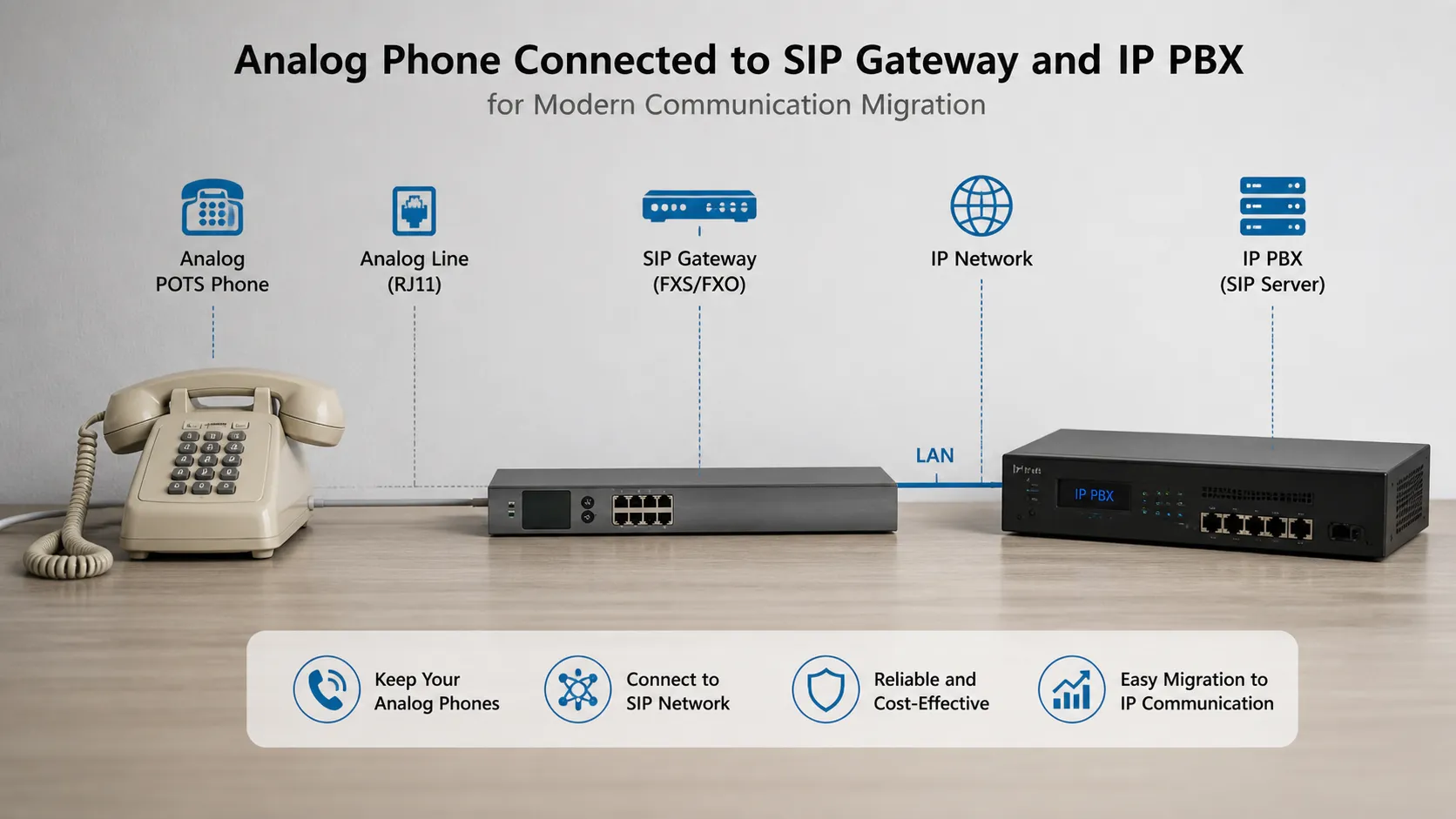
The distinction becomes important when planning a system upgrade. A company may still use analog phones, but those phones may no longer be connected to true public copper POTS lines. Instead, they may be connected to an IP PBX through a gateway.
This hybrid approach allows organizations to keep existing analog endpoints while moving the core communication system toward VoIP, SIP trunking, and centralized management.
Why Are POTS Lines Being Replaced?
Carrier Network Modernization
Many telecom carriers are gradually reducing support for traditional copper telephone infrastructure. Maintaining old copper networks can be expensive, and modern communication networks are increasingly based on fiber, IP, cellular, and cloud technologies.
As a result, organizations that still depend on POTS lines often face higher monthly costs, limited service availability, and greater uncertainty about long-term support.
Cost, Maintenance, and Scalability
Traditional POTS lines are simple, but they are not always cost-effective for large facilities, multi-site organizations, or modern safety systems. Each analog line may require separate wiring, service fees, and maintenance.
VoIP and SIP-based systems can be easier to scale across buildings, campuses, factories, tunnels, and remote sites. They also support centralized monitoring, call routing, recording, paging, emergency alerts, and integration with other systems.
POTS line replacement does not always mean removing every analog phone immediately. In many projects, gateways help bridge legacy analog devices with modern IP communication platforms.
How POTS Phones Connect to VoIP Systems
Using an FXS Gateway
An FXS gateway allows a traditional analog phone to connect to a VoIP or SIP-based system. The POTS phone plugs into the FXS port, and the gateway converts analog voice into digital VoIP traffic.
This approach is common when organizations want to keep existing analog phones, elevator phones, emergency phones, or legacy devices while upgrading the main communication platform to an IP PBX or SIP trunk.
Using an Analog Telephone Adapter
An analog telephone adapter, also called an ATA, is often used for smaller deployments. It allows one or a few analog phones to connect to an IP-based phone service.
For larger projects, a multi-port analog gateway is usually more practical. It can support many analog endpoints and connect them to a centralized VoIP platform, SIP server, or enterprise communication system.
POTS Line Replacement for Emergency Phones
Blue Light Phones and Emergency Call Stations
POTS line replacement is especially important for emergency phones, blue light phones, elevator phones, and public safety call stations. These systems must remain reliable because they are used when people need urgent assistance.
Older emergency phones may still rely on analog copper lines. When those lines become expensive or unavailable, organizations need a replacement strategy that preserves two-way voice communication, call routing, monitoring, and emergency response procedures.
Migration Options
Common POTS replacement options include SIP emergency phones, analog-to-SIP gateways, cellular adapters, IP PBX integration, and cloud-based voice services. The best choice depends on the site environment, network conditions, safety requirements, and existing equipment.
For industrial sites, transportation hubs, campuses, tunnels, and public facilities, the replacement plan should consider more than the phone line itself. It should also consider power backup, network redundancy, call supervision, dispatch center connection, paging integration, and alarm linkage.
POTS Phones in Industrial Communication Systems
Legacy Systems in Harsh Environments
Industrial facilities often keep communication systems in service for many years. Analog phones may still be installed in workshops, control rooms, substations, utility corridors, tunnels, parking areas, warehouses, and remote technical rooms.
In these environments, replacing every phone at once may not be practical. Existing wiring, installation cost, environmental conditions, and operational continuity all need to be evaluated before migration.
Hybrid Communication Architecture
A hybrid architecture can combine legacy analog phones with modern SIP devices. Analog phones can connect through gateways, while new SIP phones, industrial intercoms, emergency call stations, paging gateways, and dispatch consoles operate on the IP network.
This helps organizations modernize gradually while still protecting existing investment. It also allows the communication system to expand beyond basic calling into paging, public address, alarm notification, CCTV linkage, and control room dispatch.
Becke Telcom Perspective: From Analog Voice to SIP Emergency Communication
Supporting Gradual Migration
For industrial and public safety projects, the move from POTS phones to SIP communication is often a phased process. Some areas may continue using analog telephones, while new areas require SIP emergency phones, IP intercoms, paging devices, and centralized dispatch platforms.
Becke Telcom supports this type of communication modernization with industrial telephone, SIP intercom, paging, gateway, and dispatch communication solutions. In practical projects, analog gateways and SIP-based endpoints can work together to create a more flexible and manageable system.
Related Product Introduction:IP Phone
Building a More Integrated Communication Network
Modern emergency communication is no longer limited to one phone line and one handset. Facilities often need voice calls, public address, paging, alarm linkage, CCTV integration, and control room coordination.
By combining legacy compatibility with SIP-based architecture, organizations can reduce dependence on old copper lines while improving system visibility, scalability, and emergency response capability.
Conclusion
A POTS phone is a traditional analog telephone that works through copper telephone lines or analog interfaces. It is simple, familiar, and historically reliable, which is why it continues to appear in elevators, alarm systems, fax machines, emergency phones, and legacy business communication systems.
However, as telecom networks move toward IP, fiber, cellular, and cloud-based infrastructure, many organizations are reviewing their dependence on POTS lines. For some sites, direct replacement with SIP phones is the best option. For others, analog gateways provide a practical bridge between old and new systems.
The future of communication is increasingly IP-based, but understanding POTS phones remains important. They represent the foundation of traditional voice communication and continue to influence how modern emergency, industrial, and public safety systems are designed.
FAQ
What does POTS phone stand for?
POTS phone stands for Plain Old Telephone Service phone. It refers to a traditional analog telephone that works through copper telephone lines or analog telephone interfaces.
Is a POTS phone the same as a landline phone?
In many cases, yes. A POTS phone is commonly known as a landline phone. However, landline is a general term, while POTS specifically refers to traditional analog telephone service.
Is a POTS phone the same as an analog phone?
They are closely related. A POTS phone is a type of analog phone, but an analog phone may also connect to an analog PBX port, FXS gateway, or analog telephone adapter instead of a public copper POTS line.
Can a POTS phone work with VoIP?
Yes. A POTS phone can work with a VoIP system through an FXS gateway, analog telephone adapter, or analog gateway. These devices convert analog voice signals into VoIP traffic.
Why are POTS lines being replaced?
POTS lines are being replaced because many carriers are modernizing their networks, maintaining copper lines can be expensive, and IP-based communication systems offer better scalability, management, and integration.
Are POTS phones still used today?
Yes. POTS phones are still used in elevator emergency phones, alarm systems, fax machines, security rooms, rural areas, industrial sites, and legacy PBX systems.
What is the best replacement for a POTS phone?
The best replacement depends on the application. Options include SIP phones, SIP emergency phones, analog-to-SIP gateways, cellular adapters, cloud phone services, or IP PBX systems.
Do POTS phones work during power outages?
A basic corded POTS phone may continue working during a local power outage if the telephone line and central office power remain active. However, performance depends on the carrier network and site conditions.







