A Key Performance Indicator, usually shortened to KPI, is a measurable value used to track how effectively a person, team, department, process, or organization is achieving a specific objective. In practical terms, a KPI helps answer an important management question: are we making progress in the direction that actually matters? Instead of relying on intuition alone, organizations use KPIs to turn goals into visible, trackable signals that support decision-making and performance control.
The term is widely used in business, operations, sales, customer service, manufacturing, logistics, healthcare, education, IT, and public administration. In each of these environments, managers need a way to connect targets with real outcomes. Revenue growth, call response speed, project completion rate, downtime reduction, customer retention, quality improvement, and safety compliance can all be evaluated more clearly when a suitable KPI framework is in place. The KPI itself is not the goal. It is the indicator that shows whether the organization is moving toward the goal in a measurable way.
Although the idea sounds simple, KPI design is often more important than KPI quantity. A useful KPI must reflect what is truly important, not merely what is easy to count. If an organization chooses the wrong indicators, it may produce impressive-looking reports while still missing the actual objective. This is why good KPI practice is not just about measurement. It is about selecting the right measurement logic, aligning it with strategy, reviewing it consistently, and using it to guide action rather than just generate dashboards.
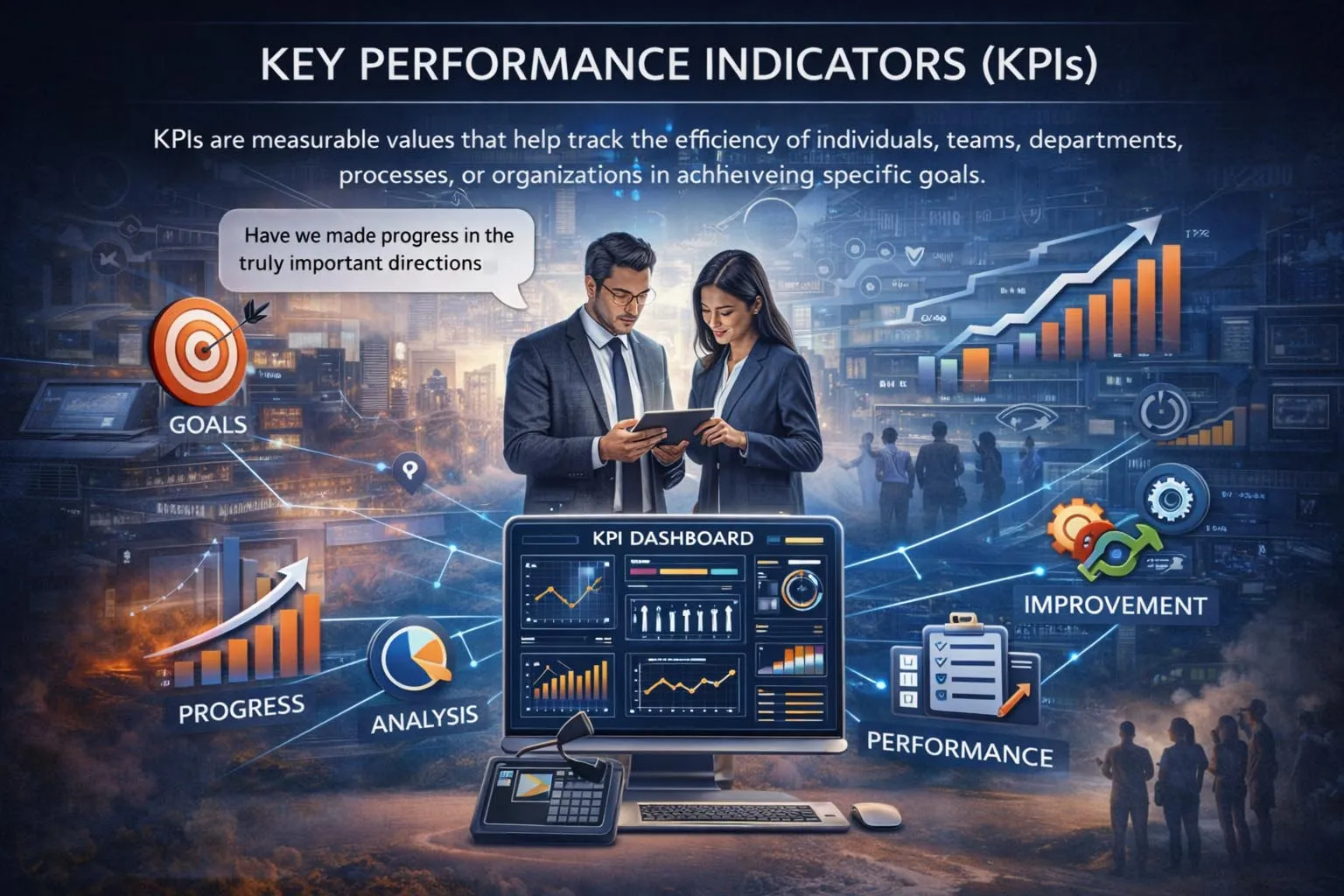
KPIs help organizations translate goals into measurable signals that support tracking, analysis, and performance improvement.
What a KPI Means in Practice
A Metric That Connects Performance with Objectives
At the most basic level, a KPI is a performance metric tied to an important objective. This connection to a meaningful objective is what makes it “key.” Organizations collect many kinds of data, but not every number is a KPI. For example, a company may track website visits, internal emails sent, or the number of meetings held, but those figures are not automatically key performance indicators unless they directly help evaluate progress toward a defined strategic or operational goal.
For this reason, KPIs are usually more selective than general metrics. A customer support department may monitor many details, but only a smaller number of them may be chosen as KPIs, such as average response time, resolution time, customer satisfaction score, or first-contact resolution rate. A factory may track many production figures, but its KPIs may focus on yield, defect rate, equipment uptime, or safety incident frequency because those measures reflect the outcomes that matter most.
In other words, a KPI is not important because it is numeric. It is important because it helps reveal whether the organization is succeeding in a specific area of performance. That is why KPI design begins with the question, “What outcome are we really trying to achieve?” rather than “What data do we already have?”
Different from Ordinary Data or Raw Activity Counts
Many organizations gather large volumes of operational data, but without thoughtful interpretation, data alone does not improve performance. A KPI differs from raw activity counts because it is intended to support evaluation, not just description. Counting the number of customer calls received may provide useful information, but it does not necessarily indicate performance by itself. Measuring the percentage of calls answered within a target time is often a better KPI because it reflects service responsiveness rather than simple volume.
This distinction matters because organizations sometimes confuse busy activity with effective performance. A team can appear productive by generating many tasks, reports, or interactions, while still missing the actual business objective. KPIs help prevent this by focusing attention on results, quality, efficiency, consistency, or impact instead of mere output count.
That is why mature KPI practice usually combines context and interpretation. A number on its own has limited value. A KPI becomes useful when it is linked to a target, reviewed over time, compared with expectations, and used to trigger action if the performance is drifting away from plan.
A KPI is not just something that can be measured. It is something worth measuring because it reveals whether the organization is moving toward an important objective.
How KPI Works
From Goal to Indicator
KPI systems begin with goals. A business may want to increase customer retention, reduce production defects, improve cash flow, shorten support response time, raise employee productivity, or strengthen project delivery discipline. Once the goal is clear, the next step is to identify a measurable indicator that reflects whether progress is being made. That indicator becomes useful only if it can be observed consistently and linked to the desired outcome.
For example, if the goal is to improve customer service quality, a company may define a KPI such as average resolution time, complaint recurrence rate, or customer satisfaction score after interaction. If the goal is to improve production reliability, the KPI may focus on equipment availability, unplanned downtime, or defect percentage. In project environments, the KPI may measure milestone completion, budget adherence, or schedule variance. In each case, the KPI works by turning an abstract goal into a practical measurement point.
This process matters because organizations often struggle not with a lack of ambition but with a lack of clarity. A KPI framework creates a line between intention and evidence. It helps answer whether performance is improving, declining, or remaining flat in relation to a defined objective.
Targets, Thresholds, and Review Cycles
A KPI becomes more useful when it is paired with a target or expected threshold. Without a target, the number may be interesting but not actionable. For example, an average response time of six minutes means little until the organization knows whether its standard is two minutes, five minutes, or ten minutes. The target provides context, and the context determines whether the KPI reflects success, concern, or failure.
Many KPI systems therefore include benchmark levels, red-amber-green status logic, periodic review schedules, and exception reporting. Management teams may review KPIs daily, weekly, monthly, or quarterly depending on the nature of the activity. Operational KPIs are often reviewed more frequently, while strategic KPIs may be reviewed over longer cycles because the underlying outcomes move more slowly.
Regular review is essential because KPIs are meant to support action. If performance is off track, managers should be able to investigate why, identify the cause, and adjust resources, processes, or priorities accordingly. Without review discipline, a KPI dashboard becomes a passive display rather than a management tool.
Measurement, Analysis, and Response
The real working logic of KPI management is not only measurement, but measurement followed by analysis and response. First, the data is captured. Then the organization interprets what the result means in relation to the target. Finally, it decides whether action is needed. If customer churn is rising, the business may review service quality or pricing. If production defects increase, the team may inspect training, raw materials, or maintenance. If revenue per region declines, leadership may revisit sales coverage or product mix.
This action loop is what gives KPI systems their managerial value. The number itself does not solve problems. It helps reveal where attention is required. Used properly, KPIs support continuous improvement, accountability, and faster response to changing conditions. Used poorly, they can become static charts that create the illusion of control without producing improvement.
For this reason, KPI systems work best when measurement is closely tied to ownership. Someone must be responsible not only for reporting the indicator, but also for responding when it moves in the wrong direction.
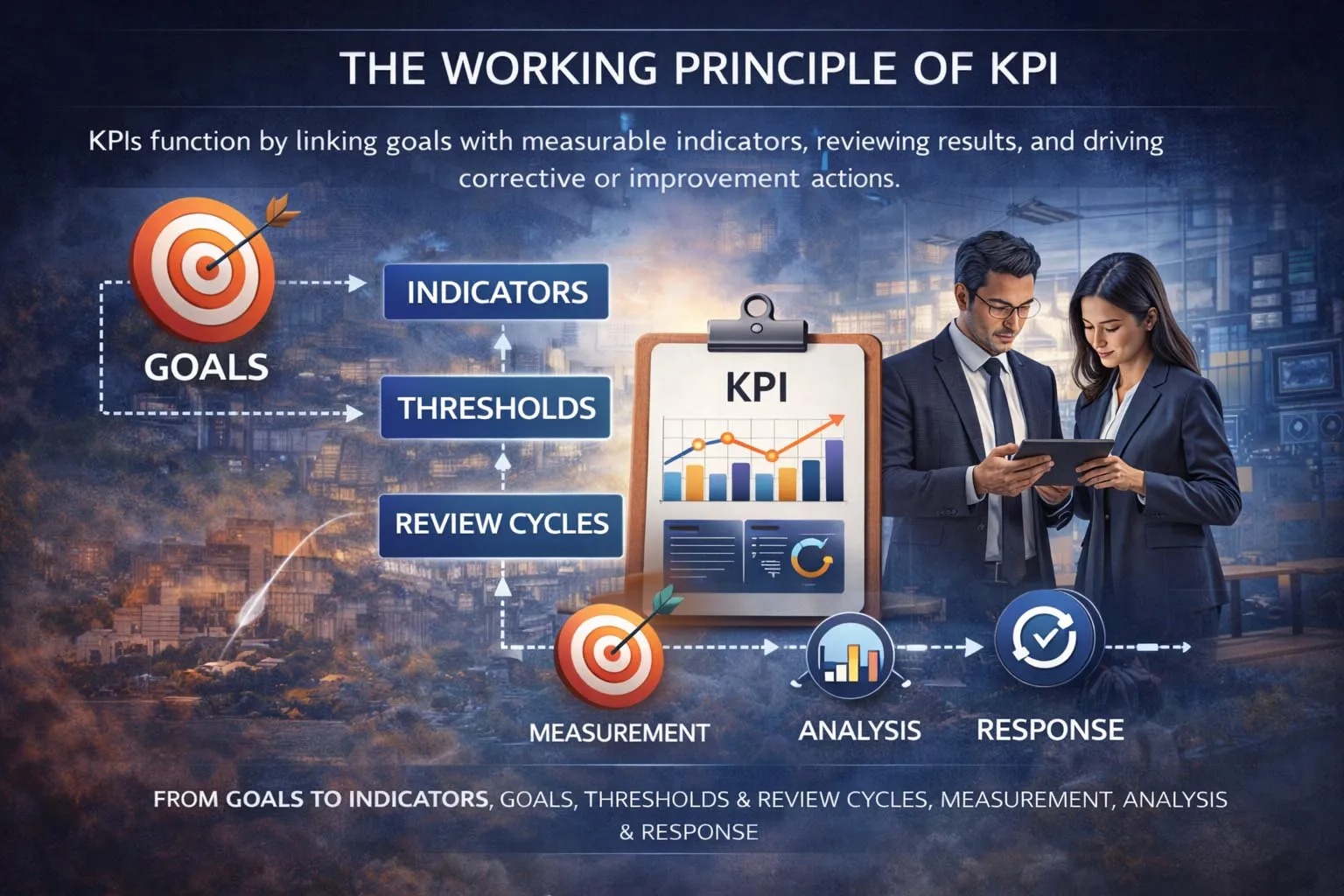
A KPI works by linking objectives with measurable indicators, reviewing results, and driving corrective or improvement action.
Main Characteristics of a Good KPI
Relevant to Strategic or Operational Priorities
A good KPI must reflect something that genuinely matters. Relevance is the first condition of usefulness. If the indicator does not connect clearly to a business goal, team objective, or operational priority, it may create reporting effort without generating meaningful insight. This is one of the most common reasons KPI programs fail. Organizations sometimes fill dashboards with numbers that are easy to extract but weakly connected to the real drivers of performance.
Relevance also depends on level. A board-level KPI is different from a front-line operational KPI. Senior leadership may care about profitability, service growth, or customer retention. A warehouse supervisor may care more about order accuracy, throughput, picking time, or incident rate. Both levels can use KPIs, but the indicators must fit the decision context of the people who use them.
That is why KPI selection is usually strongest when it begins with business purpose and role clarity. The right KPI for one function may be the wrong KPI for another, even within the same organization.
Measurable, Clear, and Consistent
A KPI should be defined in a way that different people can understand and interpret consistently. If the formula, data source, or scope changes from one reporting cycle to another, comparisons lose meaning. Clarity is therefore essential. The organization should know what is being measured, how it is calculated, what time period it covers, what data sources it uses, and which owner is responsible for reviewing it.
Consistency matters because one of the main strengths of KPIs is trend visibility over time. If a sales KPI suddenly uses a different calculation method, it becomes harder to judge whether performance truly changed or whether only the reporting logic changed. The same is true for service, quality, safety, and operational metrics. Stable definition supports more reliable management decisions.
This is why organizations often document KPI definitions formally, especially when multiple departments or reporting systems are involved. Clear definitions reduce confusion and improve trust in the results.
Actionable Rather Than Decorative
A useful KPI should help decision-makers do something. If the indicator moves, the organization should have some idea of what type of review, intervention, or adjustment might follow. This does not mean every KPI has a simple fix, but it should at least point toward meaningful management attention. An indicator that looks impressive but does not influence behavior adds little practical value.
Actionability is one reason why balanced KPI design is so important. If a team is measured only on speed, it may sacrifice quality. If it is measured only on output, it may ignore cost. If it is measured only on revenue, it may neglect retention or service experience. Good KPI systems often combine multiple viewpoints so that performance is not driven in a distorted direction.
As a result, the best KPIs are not just technically measurable. They are managerially useful.
Benefits of KPI
Improved Visibility into Performance
One of the biggest benefits of KPI use is visibility. Without KPIs, many organizations operate with incomplete understanding of what is improving and what is slipping. Teams may feel busy and managers may feel informed, but performance may still be unclear. KPI frameworks reduce that ambiguity by creating common reference points that show how the organization is performing against important objectives.
This visibility is especially valuable in larger or more complex environments where performance cannot be judged by observation alone. A company with multiple branches, teams, or workflows needs ways to compare outcomes, identify trends, and understand variation across the organization. KPIs support this by turning performance into something that can be reviewed systematically rather than guessed informally.
Better visibility also supports communication. Leadership can explain goals more clearly when the organization knows which indicators matter and why they are being tracked.
Stronger Accountability and Focus
KPIs help create accountability because they make expectations more explicit. When a team knows which outcomes are being monitored and what targets apply, responsibility becomes easier to define. This can improve focus at both management and operational levels. People are more likely to align their behavior with the organization’s priorities when those priorities are reflected in meaningful indicators.
This does not mean KPI use should become punitive. In healthy organizations, KPIs are used to support clarity, learning, and improvement rather than simply blame. Still, accountability is an important benefit because performance discussions become more concrete. Instead of relying on vague impressions, teams can review actual results and discuss what they mean.
Used well, this helps shift management from subjective argument toward evidence-based performance conversation.
Better Decision-Making and Continuous Improvement
KPI systems also improve decision-making by helping organizations identify where intervention is needed. If a process is slowing down, if service quality is falling, if costs are rising, or if conversion is weakening, a KPI framework can reveal the pattern early enough for corrective action. This is particularly valuable in competitive or high-pressure environments where small trends become larger problems if ignored.
In addition, KPI review encourages continuous improvement. Teams can experiment with process changes, technology upgrades, training programs, or resource shifts, then observe how those changes affect the chosen indicators over time. This creates a more disciplined improvement loop in which the organization learns not only from intuition, but from evidence.
Because of this, KPIs are often central to performance management, quality management, and operational excellence frameworks.
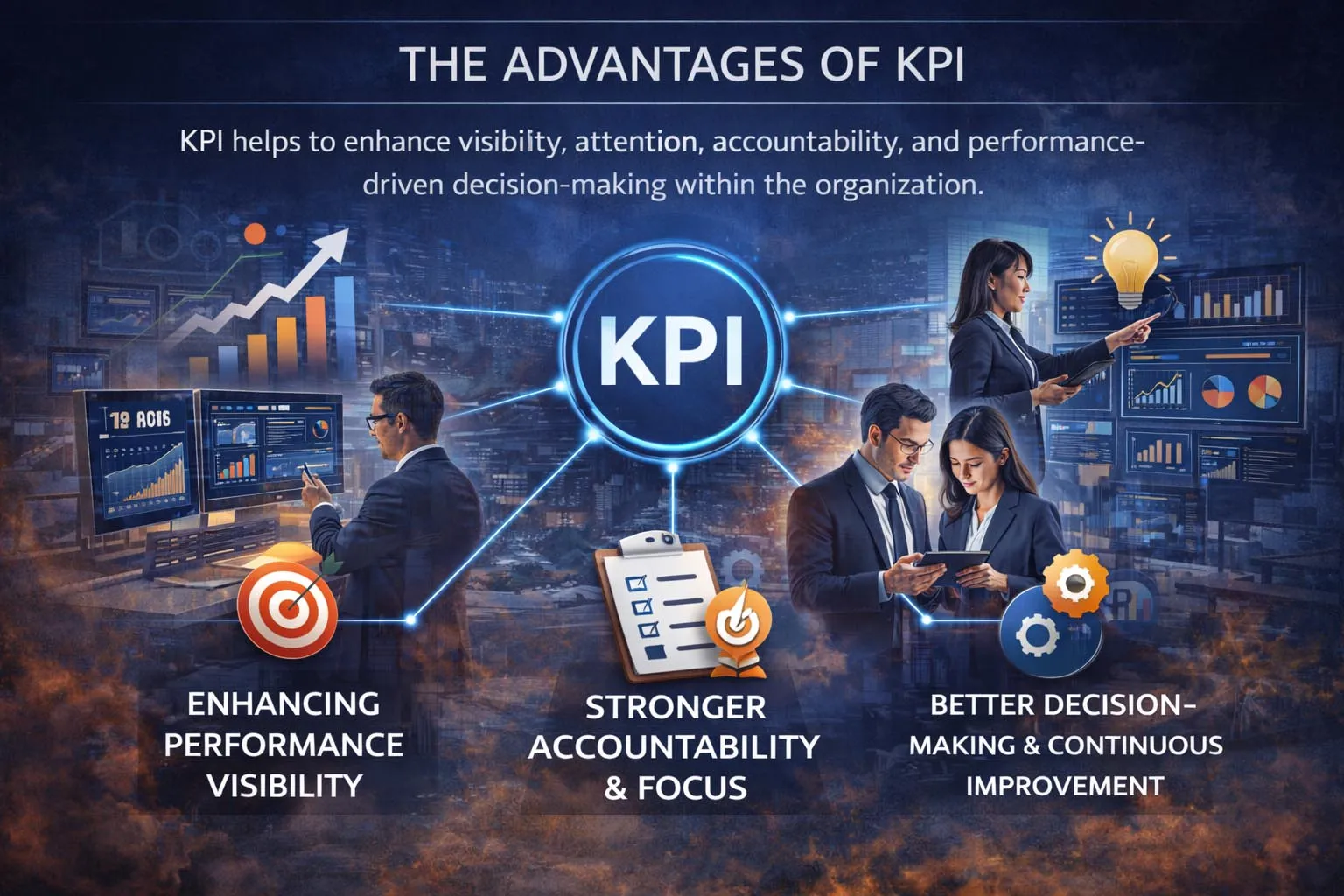
KPIs help improve visibility, focus, accountability, and performance-driven decision-making across the organization.
Common Types of KPI
Strategic KPIs
Strategic KPIs are used to evaluate long-term organizational objectives. These indicators are usually reviewed by leadership teams, senior managers, or business owners because they reflect the broader direction of the business. Examples may include revenue growth, operating margin, customer retention, market share, productivity improvement, or overall service availability. Strategic KPIs do not usually change hour by hour. They are intended to show whether the organization is progressing toward its major goals over time.
Because strategic KPIs operate at a higher level, they often need supporting operational indicators underneath them. For example, customer retention may be strategic, while support response time and complaint resolution may be operational contributors. Strategic KPIs therefore work best when linked to lower-level indicators that explain what is driving the result.
This connection between levels helps prevent leadership from seeing the outcome without understanding the mechanism behind it.
Operational KPIs
Operational KPIs focus on day-to-day performance and process efficiency. These are often used by front-line managers, supervisors, and team leaders because they reflect activities that need frequent attention. Examples include first-call resolution, order fulfillment speed, machine uptime, average handling time, incident response time, or on-time delivery rate. These indicators help organizations maintain control over active workflows.
Operational KPIs are especially valuable because they are often more actionable in the short term than strategic measures. A supervisor can work to reduce downtime this week. A support manager can target faster ticket resolution this month. A production lead can review defect trends this shift. In this way, operational KPIs help drive immediate improvement and support stability in routine execution.
They are often the part of the KPI system that users engage with most directly, because they influence daily management behavior.
Leading and Lagging Indicators
Another useful distinction is between leading and lagging indicators. A lagging KPI measures an outcome that has already occurred, such as monthly revenue, churn rate, or annual defect percentage. These indicators are important because they show the final result. However, by the time they move significantly, the problem or improvement may already be well underway.
A leading KPI, by contrast, gives earlier signals about what may happen next. Examples might include sales pipeline quality, maintenance completion rate, training completion, inquiry conversion rate, or open support backlog. These indicators do not guarantee a future result, but they help organizations detect risk or opportunity sooner.
Strong KPI systems often combine both types. Lagging indicators show what happened. Leading indicators help influence what happens next.
Applications of KPI
Business Management and Executive Reporting
One of the most common applications of KPIs is executive and management reporting. Leadership teams use KPIs to understand how the business is performing across finance, growth, operations, customer outcomes, and risk. Instead of reviewing large amounts of raw data, they rely on selected indicators that summarize the state of the organization in a manageable and decision-oriented format.
This is particularly useful in multi-branch, multi-product, or multi-department organizations where no single manager can directly observe everything happening. KPI reporting creates a structured overview that helps leadership identify where attention is required. It also helps align teams around common objectives by making performance expectations visible at an organizational level.
In this application, KPI dashboards often become part of monthly reviews, quarterly planning, and strategic progress discussions.
Sales, Marketing, and Customer Operations
Sales and customer-facing functions use KPIs extensively because performance in these areas depends on measurable movement through pipelines, service interactions, and customer behavior. Sales teams may track lead conversion rate, average deal size, win rate, and revenue attainment. Marketing teams may use campaign response, acquisition cost, engagement rate, or qualified lead volume. Customer service teams may focus on response time, resolution rate, satisfaction score, and churn-related indicators.
These functions benefit from KPI use because they are both dynamic and performance-sensitive. Small changes in conversion efficiency, response quality, or retention can have a strong effect on overall business outcome. KPIs make these shifts more visible and allow managers to adjust tactics more quickly.
In service-oriented organizations, KPI frameworks also help balance speed with quality, ensuring that teams are not rewarded for volume alone.
Manufacturing, Logistics, and Operational Control
Manufacturing and logistics environments also rely heavily on KPIs because they involve repeatable processes, measurable throughput, and tight performance dependencies. Common indicators may include defect rate, output volume, cycle time, uptime, delivery accuracy, stock turnover, order completion rate, and incident frequency. These KPIs support process control, cost management, quality assurance, and capacity planning.
In such environments, KPI systems often sit close to the operation itself. Supervisors and planners may review them daily or even shift by shift. This makes the indicators highly practical rather than purely administrative. They help identify bottlenecks, resource constraints, and quality issues before the impact becomes too large.
For organizations that depend on consistent execution, KPIs are one of the main tools for maintaining operational discipline.
Projects, IT, and Service Delivery
Project teams and IT functions use KPIs to measure schedule control, resource use, service reliability, and support effectiveness. Project KPIs may include milestone completion, budget variance, issue closure rate, and delivery timeliness. IT teams may track uptime, incident response time, change success rate, system availability, and user satisfaction. Managed service environments often combine technical performance indicators with service-level indicators.
These KPIs are important because they help technical teams connect their work to business expectations. A project is not only about activity. It is about delivering the right outcome on time and within acceptable limits. An IT system is not only about technical functionality. It is also about service reliability and business continuity.
This shows how KPI frameworks help translate specialized technical work into measurable performance language that management can understand and act upon.
Challenges and Good Practice in KPI Use
Avoid Measuring Too Much or Measuring the Wrong Thing
One of the biggest mistakes in KPI management is trying to measure everything. When dashboards become crowded with too many indicators, focus is lost. Teams may spend more time reporting than improving, and leadership may struggle to distinguish what is truly important from what is merely available. A smaller number of well-chosen KPIs is often more effective than a large collection of weak indicators.
Another common problem is choosing indicators that reward the wrong behavior. If a call center tracks speed only, quality may decline. If a sales team is judged only by volume, margin or customer fit may suffer. If a project team is measured only on schedule, hidden quality problems may increase. Good KPI design therefore requires balance and reflection, not just data extraction.
This is why KPI systems should be reviewed periodically. A KPI that once mattered may become less relevant as the business changes, and a missing KPI may need to be added when new risks or priorities emerge.
Use KPIs as Management Tools, Not Decoration
KPIs create value only when they are used. That means they should influence meetings, reviews, decisions, and improvement actions. A dashboard that is rarely discussed or never linked to follow-up activity has limited practical impact. Organizations often gain the most value when KPI ownership, review rhythm, and response expectations are clearly defined.
Culture also matters. If KPIs are used only to punish underperformance, people may begin to manipulate the numbers, avoid transparency, or focus narrowly on short-term reporting success. If KPIs are used to support analysis and improvement, they are more likely to drive honest engagement and better decision-making. The purpose should be disciplined performance management, not metric theater.
In strong organizations, KPIs support conversation, learning, and accountability at the same time.
The best KPI systems do not merely report performance. They shape attention, guide decisions, and encourage better operational behavior over time.
FAQ
What is the difference between a KPI and a normal metric?
A normal metric measures something, while a KPI measures something that is directly tied to an important objective or performance outcome. All KPIs are metrics, but not all metrics are KPIs.
Why are KPIs important in business?
They help organizations track progress, improve visibility, strengthen accountability, and make better decisions based on measurable results rather than assumptions alone.
Can KPI frameworks be used outside business?
Yes. KPIs are also widely used in healthcare, education, manufacturing, logistics, government, project management, IT services, and many other operational environments.
How many KPIs should a team have?
There is no single fixed number, but in most cases a smaller set of relevant and actionable KPIs is better than a large dashboard full of weak or distracting indicators.