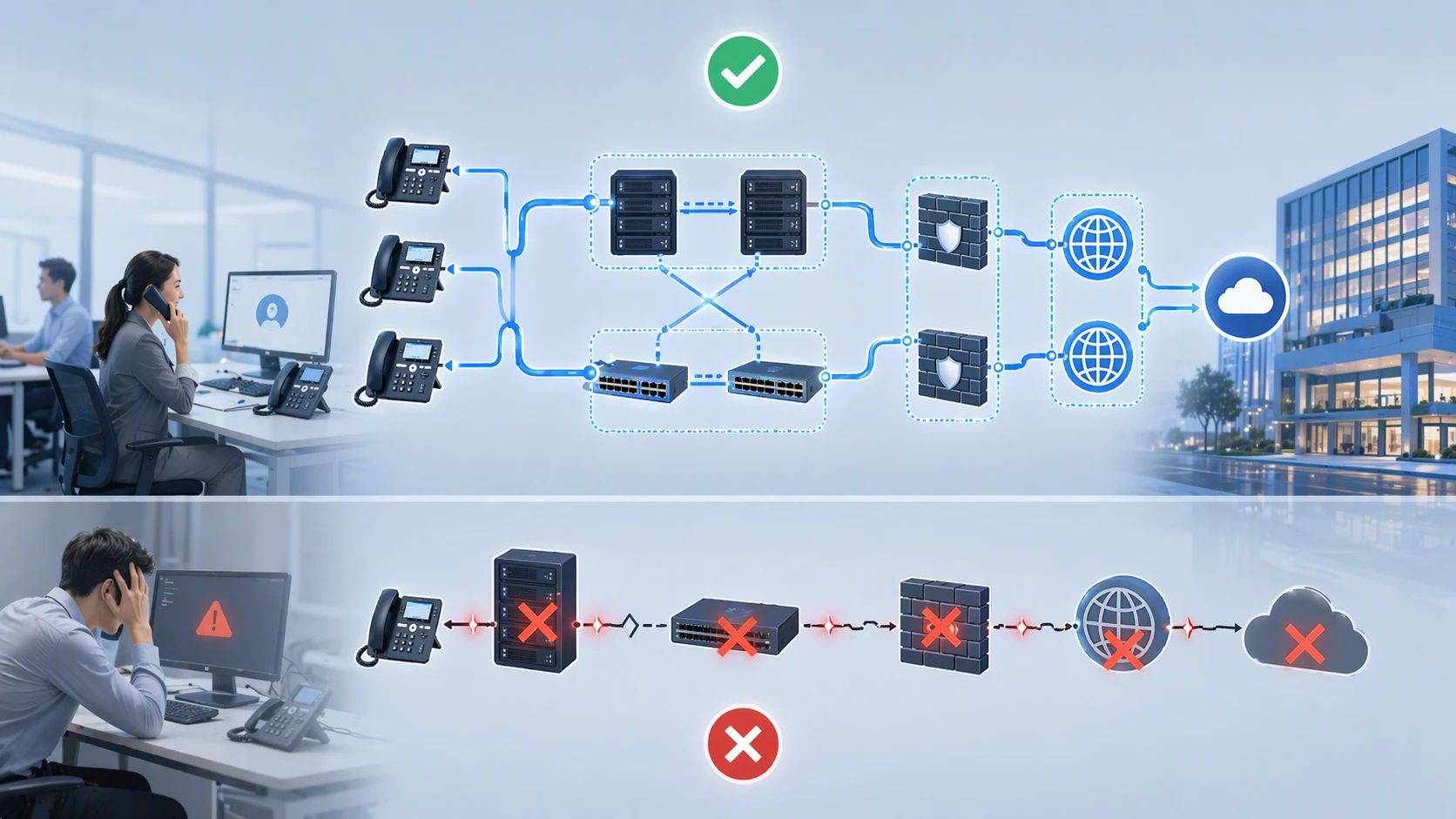
SIP INFO DTMF is a method used in IP telephony to send keypad digits during an active call through SIP signaling messages rather than relying on the ordinary voice audio stream. In practical terms, when a user presses a key such as 0–9, *, or # on an IP phone, softphone, ATA-connected analog phone, or gateway-based endpoint, the system can transmit that digit to the far end using a SIP INFO request instead of embedding the tone only inside the audio path. This matters because DTMF is still essential in modern communication systems for IVR navigation, voicemail access, conference bridge control, PIN entry, queue selection, self-service menus, and many kinds of automated interaction.
In real deployments, SIP INFO DTMF is often discussed alongside other DTMF transport methods such as in-band DTMF and RFC 2833 style RTP telephone events, which in current standards language are more closely associated with RFC 4733. These methods all aim to achieve the same operational goal, which is to carry user-entered digits from one side of a call to the other. However, they do so in different ways and with different implications for codec behavior, interworking, call signaling, media handling, service provider compatibility, and platform design.
SIP INFO DTMF remains important because it gives VoIP systems another way to carry digit information that does not depend on audio tone preservation. It is especially relevant in mixed environments where endpoints, gateways, PBXs, SBCs, or applications may need signaling-layer control over digit transport. At the same time, it is not always the default or preferred choice across every SIP trunk or service provider environment. To use it well, engineers and system integrators need to understand both its strengths and its boundaries.
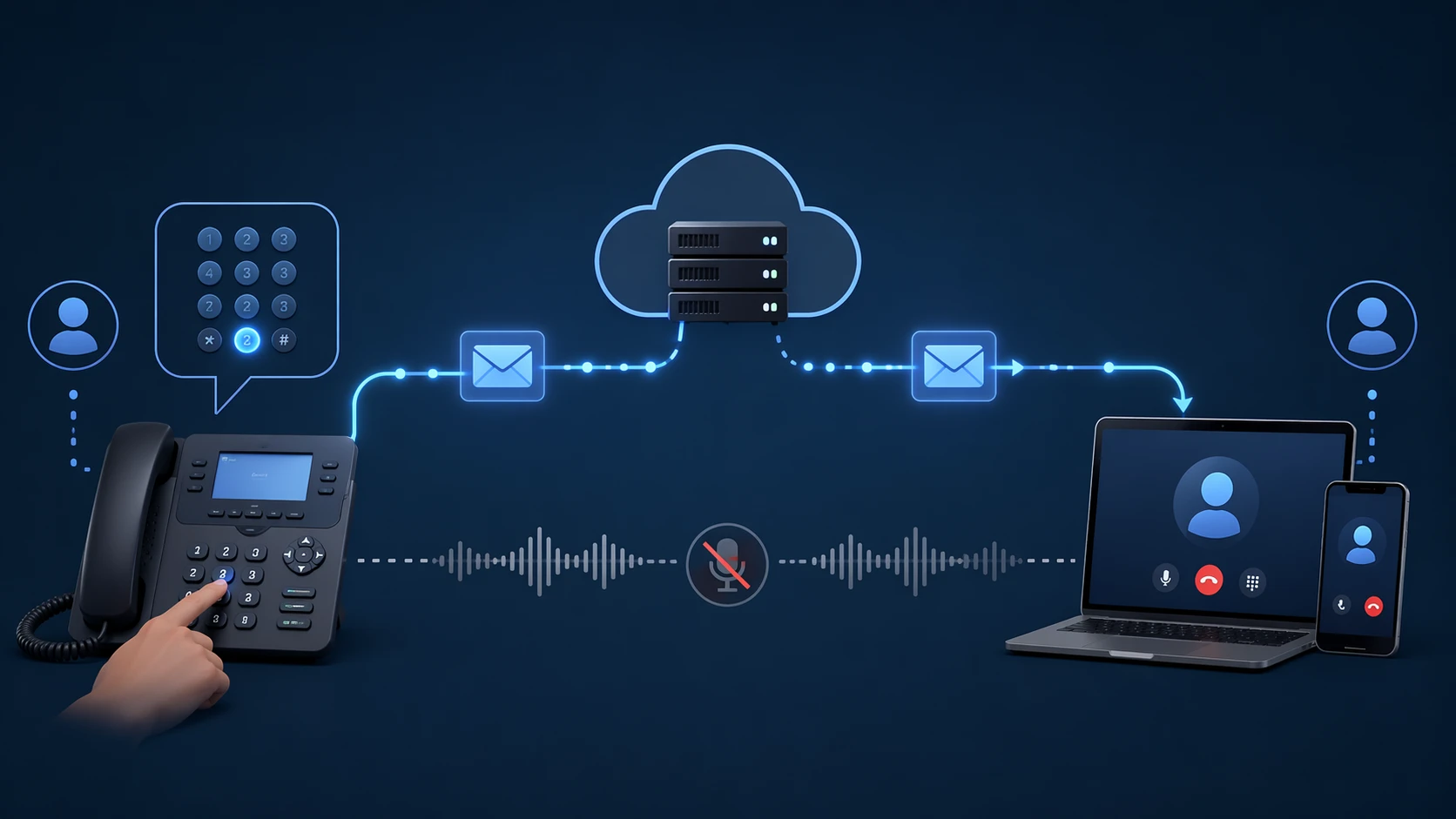
SIP INFO DTMF sends keypad information through SIP signaling during an active session instead of relying only on the media audio path.
What Is SIP INFO DTMF?
Basic definition
SIP INFO DTMF is a method of transmitting DTMF digits during an established SIP session by sending them in SIP INFO messages along the signaling path of the call. Instead of asking the receiving side to detect the audio waveform of the tone inside the RTP media stream, the sender conveys the digit as signaling information at the SIP level. This makes SIP INFO a signaling-plane approach to DTMF delivery rather than a media-plane telephone-event method.
In other words, the pressed key is communicated as session-related information carried in SIP signaling after the call has already been established. The goal is not to make the tone sound better to the human listener. The goal is to ensure that the remote system knows which digit was pressed and can act on it correctly.
Why it is called SIP INFO
The name comes from the SIP INFO method, originally defined in RFC 2976 and later replaced by RFC 6086. The INFO method was created to carry mid-session signaling information along the SIP signaling path. That general capability made it possible for implementations to use INFO messages for DTMF-related data during active calls. In day-to-day telecom language, this usage is often simply called “SIP INFO DTMF.”
This is why many PBX menus, IP phones, ATAs, SBCs, and gateways include DTMF mode options such as In-band, RFC2833, SIP INFO, or Auto. Each option represents a different way of transporting the same keypad intent.
SIP INFO DTMF does not send the keypad digit as a telephone-event RTP payload. It sends digit information through SIP signaling during the call.
How SIP INFO DTMF Works
Digit generation at the endpoint
When a user presses a key on a supported endpoint, the device first identifies the intended DTMF digit. In a SIP INFO workflow, the endpoint does not need to depend solely on the far end hearing and decoding the actual audio tone. Instead, it can construct a SIP INFO request containing information that represents the pressed key and send that request through the signaling path of the existing SIP session.
This can happen on many kinds of devices, including IP desk phones, softphones, media gateways, session border controllers, analog telephone adapters, and other SIP-capable communication endpoints. Depending on the system design, the device may generate both a local tone for the user and a signaling message for the network, but the core transport of the digit itself is handled through SIP signaling.
Sending the INFO message during the active call
Once the call is established, the SIP dialog already exists between the participating SIP entities. When a digit is pressed, the sending side creates an INFO request and sends it along the SIP signaling path associated with that call. The receiving side acknowledges the INFO request using normal SIP response behavior and then interprets the DTMF-related content carried within that message.
This is why SIP INFO is considered a mid-session signaling method. It is neither a call setup message like INVITE nor a pure RTP media event like RFC 4733 telephone-event handling. It occupies a signaling role while the conversation is already in progress.
Interpreting the DTMF content
After the SIP INFO message reaches the far end, the receiving endpoint, server, application, gateway, or PBX processes the content and determines which digit was sent. That digit can then be passed to an IVR, voicemail platform, conference bridge, application server, call routing script, or other logic that depends on keypad input.
In practical deployment terms, this means the success of SIP INFO DTMF depends on both sides of the call supporting the chosen message format and agreeing on how to interpret it. A call may be perfectly healthy at the audio level but still fail to pass usable DTMF if the SIP INFO handling is inconsistent across devices or trunks.
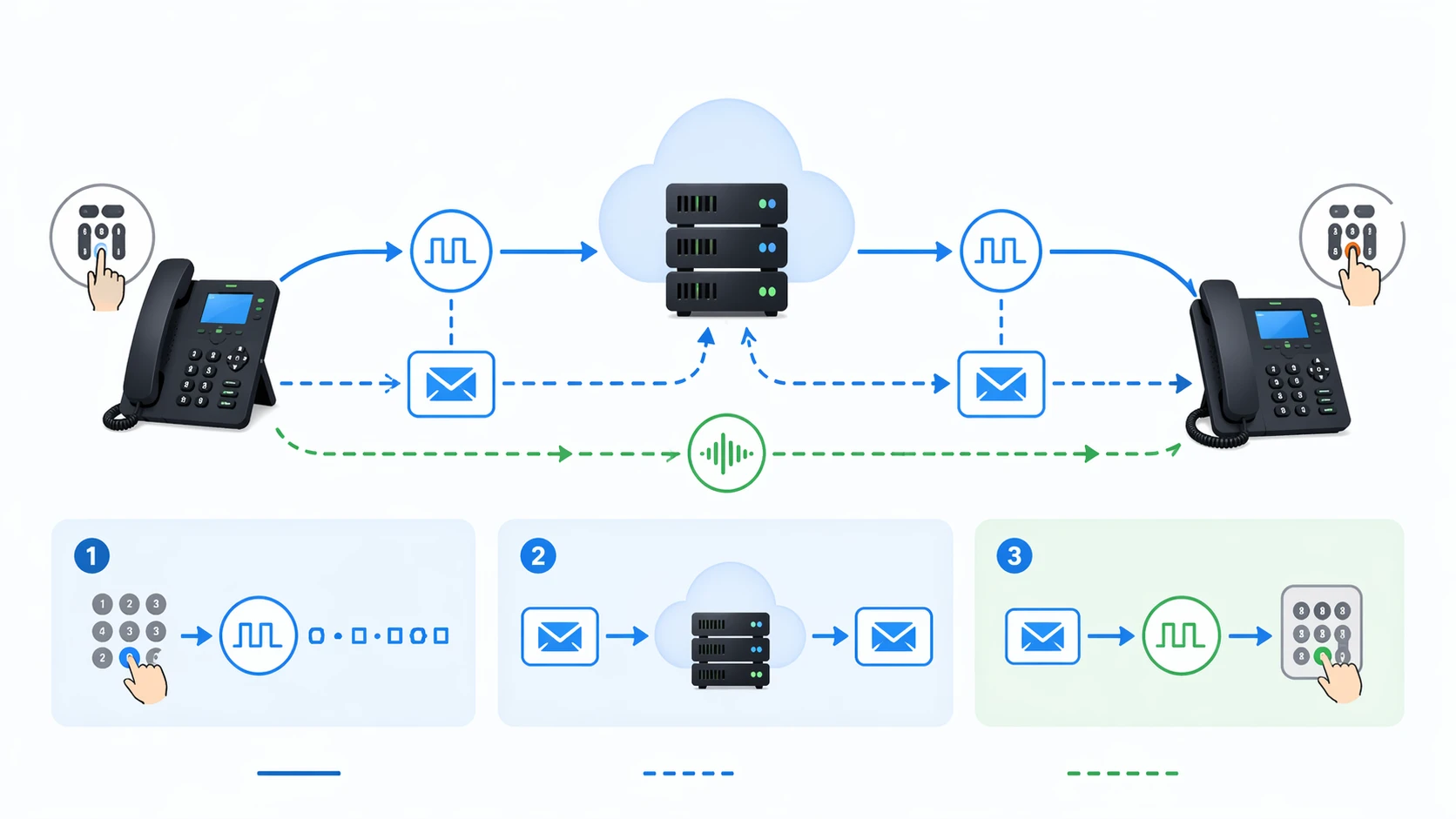
In a SIP INFO DTMF workflow, digit information is carried through SIP signaling messages associated with the active session.
Audio Benefits of SIP INFO DTMF
Reduced dependence on audio tone preservation
One of the biggest practical advantages of SIP INFO DTMF is that it does not rely on the audio codec preserving the exact shape of the DTMF tones. This is important in VoIP environments because compressed codecs, transcoding, packet loss concealment, echo processing, or other media treatments can distort in-band tones. If the far-end equipment must reconstruct the digit only by analyzing the sound, those media effects can cause failures.
With SIP INFO, the digit is not dependent on the far end “hearing” a perfect tone inside the audio. Instead, the pressed key is conveyed explicitly through signaling. That can make machine interpretation more predictable in certain designs.
Codec independence in many scenarios
Because the digit information is sent in SIP signaling rather than encoded inside the audio stream, SIP INFO can be attractive in situations where the media codec is heavily compressed or where multiple codec changes occur during the call. The digit itself is not expected to survive through voice compression in the same way it would need to in an in-band method.
This is one reason some integrators prefer SIP INFO in controlled enterprise environments, especially where endpoints and PBXs are known to support it reliably and where audio compression would otherwise be a concern for in-band DTMF recognition.
Clear separation between user speech and machine signaling
Another benefit is conceptual clarity. The user’s voice remains in the RTP media stream, while keypad commands are handled through signaling. This separation can make application behavior easier to manage in some platform designs, especially when the DTMF is intended primarily for automation systems rather than for human listening.
For example, an IVR or voicemail system does not care whether the tone sounded natural to the caller. It cares whether digit 5 was received as digit 5. SIP INFO supports that objective by passing the digit as application-relevant signaling rather than as a sound that must be reinterpreted later.
The audio benefit of SIP INFO DTMF is not improved voice sound quality. It is reduced reliance on the voice path to preserve DTMF tones accurately enough for machine recognition.
Technical Features of SIP INFO DTMF
Signaling-plane digit transport
The defining technical feature of SIP INFO DTMF is that it operates in the signaling plane rather than the RTP media plane. The digit is carried in a SIP INFO request within the existing session signaling context. This makes the method fundamentally different from RFC 4733 telephone-event transport, which uses RTP payloads associated with the media session.
This signaling-plane nature affects how the method behaves with proxies, SBCs, B2BUAs, PBXs, and applications that inspect or transform SIP dialogs. It also affects how troubleshooting is performed, because engineers may need to inspect SIP traces rather than only RTP packet captures.
Mid-session transport behavior
SIP INFO is designed for mid-session information transfer, which means the call is already established when the DTMF information is sent. The signaling path of the SIP dialog remains active, and INFO requests can be exchanged during the session as needed. This is why SIP INFO can be convenient in architectures where application signaling during a call is expected or centrally managed.
However, the fact that it rides on the SIP signaling path also means it is influenced by SIP routing behavior, dialog state, intermediary support, and policy controls in ways that RTP telephone-events are not.
Interoperability depends on implementation details
A practical technical reality is that SIP INFO DTMF is not always implemented in exactly the same way across all products and providers. Different systems may use different content types, formatting conventions, or expectations about how the INFO body is interpreted. As a result, two products may both claim SIP INFO support but still require testing or profile tuning for reliable interoperability.
This is one reason SIP INFO can work very well inside a known enterprise or vendor ecosystem while being less predictable across heterogeneous trunks and multi-vendor carrier environments.
Useful in gateway and PBX control scenarios
SIP INFO is often relevant where gateways, PBXs, application servers, or SBCs need signaling-layer awareness of digits. In these environments, the DTMF is not treated as just another media event. It becomes a session-control input that can be parsed, logged, transformed, or used to trigger application logic in a signaling-oriented architecture.
That can be especially useful in enterprise telephony, legacy interworking, and certain controlled service designs where platform behavior is managed more tightly than in open public trunk interconnection.
SIP INFO DTMF vs RFC 4733 vs In-Band DTMF
VoIP systems commonly use three broad methods for DTMF transport: in-band DTMF, SIP INFO, and RTP telephone-events often still referred to in everyday language as RFC2833, even though RFC 4733 is the current standards reference that obsoleted RFC 2833. Each method has a different operating model, and understanding the difference is essential for deployment and troubleshooting.
| Method | Transport path | Main strength | Main limitation |
|---|
| In-band | Audible tones inside the voice audio stream | Simple in some pure audio paths | Vulnerable to codec compression and media processing |
| SIP INFO | SIP signaling messages during the active call | Does not depend on tone preservation in the audio stream | May have interoperability limits across some trunks or platforms |
| RFC 4733 telephone-event | RTP media-plane event packets | Widely used and broadly supported in VoIP systems | Requires proper RTP negotiation and interworking |
In many enterprise and provider environments, RFC 4733 telephone-event transport is the most commonly preferred option because it combines broad support with media-associated event handling. SIP INFO remains useful, but it is often chosen for particular interoperability cases, PBX policies, application architectures, or vendor ecosystems rather than as the universal default everywhere.
SIP INFO and RFC 4733 solve a similar business problem, but they do not do it in the same way. One is signaling-based, and the other is media-event based.
Where SIP INFO DTMF Is Commonly Used
Enterprise PBX environments
Enterprise SIP PBXs and unified communication systems often support SIP INFO DTMF as a configurable option. In these environments, administrators may choose the DTMF mode that best matches phones, gateways, trunks, and application servers already in use. SIP INFO can work well when the endpoints and call control platform are designed to handle it consistently.
This is especially true in closed or semi-controlled deployments where the same vendor family or certified interworking profiles define how digits should be transported across the environment.
Voicemail and IVR integration
Some voicemail systems, IVR platforms, and application servers can work with SIP INFO DTMF when their signaling logic is aligned with the PBX or gateway that fronts the call. In those cases, the digit is delivered to the automation platform through a signaling-aware flow rather than through reconstructed audio analysis alone.
This can be useful in tightly integrated business systems where the signaling layer is already central to feature control and application behavior.
Gateway and legacy interworking projects
Media gateways and ATAs sometimes use SIP INFO DTMF when bridging between legacy telephony environments and SIP-based systems. For example, a gateway may detect DTMF from an analog or TDM side and relay it into the SIP network using INFO messages when the far side expects that behavior. This can help preserve legacy service workflows while adapting them to IP call control.
However, such deployments need careful configuration, because gateway interworking rules can also map between in-band, SIP INFO, and RFC 4733 depending on the destination requirement.
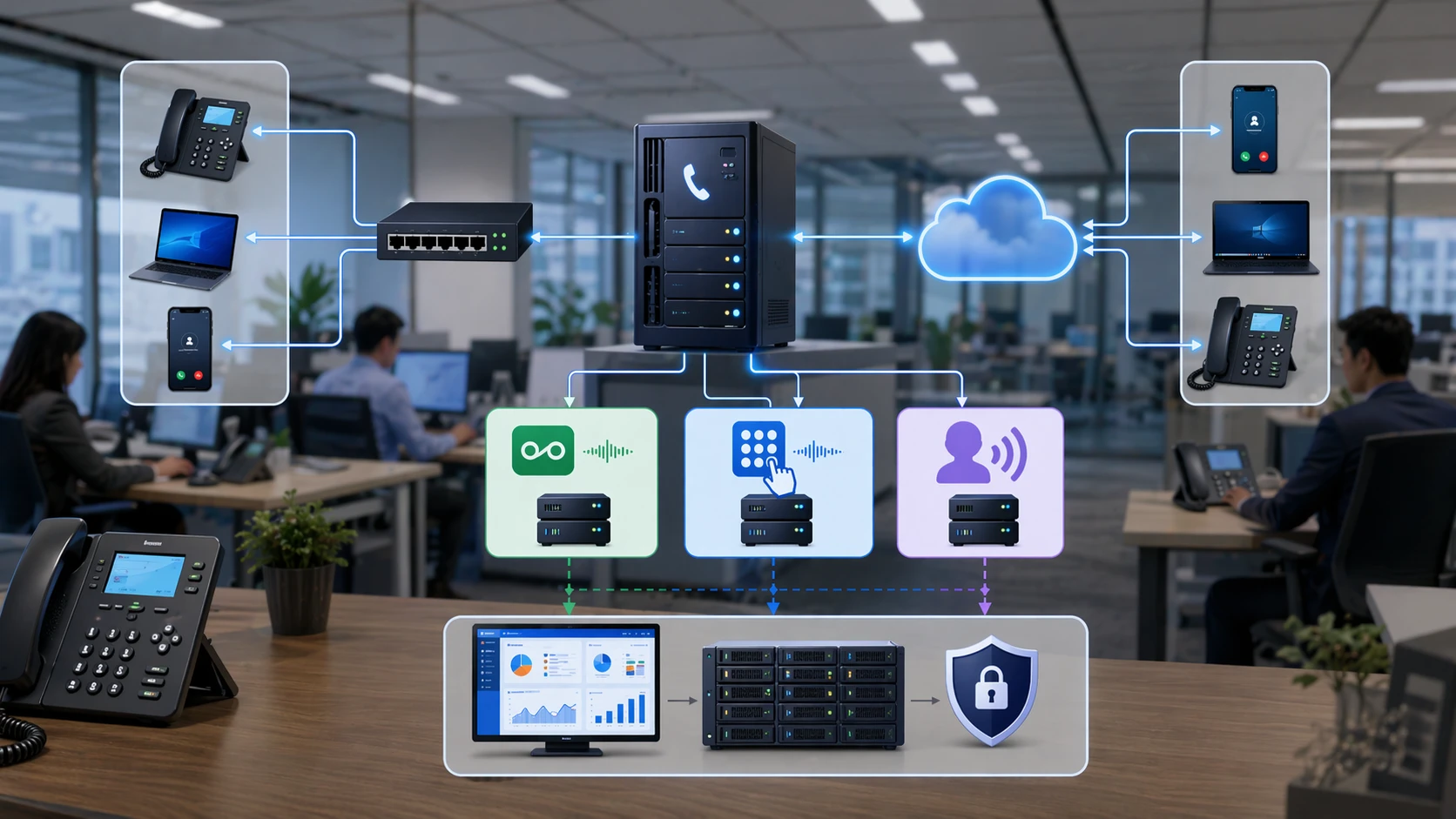
SIP INFO DTMF is often used in PBX, IVR, voicemail, gateway, and controlled enterprise VoIP environments.
Controlled SIP application platforms
Some SIP application environments prefer SIP INFO because the DTMF becomes visible within the signaling path used by the application stack. This can be useful when application behavior, workflow triggering, or transaction control is tied closely to SIP signaling logic rather than only to media handling logic.
In such platforms, SIP INFO can fit naturally into the application design philosophy even if it is not the most widely preferred method for all external trunking scenarios.
Main Advantages of SIP INFO DTMF
Independent of voice codec accuracy
A major advantage is that the far end does not need to decode the DTMF tone waveform from compressed speech audio. This reduces the risk of digit corruption caused by low-bitrate codecs, transcoding, silence suppression, or other voice-path treatment that can damage in-band DTMF.
For systems that have struggled with in-band recognition, that benefit can be immediately meaningful.
Clear session signaling visibility
Another advantage is that the digit becomes visible in the SIP signaling exchange. This can help with application logic, platform integration, policy control, logging, or troubleshooting in environments where SIP traces are already central to operations and support workflows.
In those cases, SIP INFO can provide operational transparency that is harder to obtain when DTMF exists only as a tone in the RTP stream.
Useful in controlled multi-vendor integration
Where integrators know the behavior of the PBX, endpoint, gateway, and application server, SIP INFO can be a practical choice that works consistently. It may also be useful when a specific trunk or application explicitly prefers signaling-based digit transport or when a gateway needs to interwork between different DTMF worlds.
This makes SIP INFO valuable as part of the engineer’s toolkit even when it is not always the first recommendation for every open interconnection case.
Limitations and Common Challenges
Not always preferred by service providers
One of the most important practical limitations is that some SIP trunks, carriers, or hosted voice services do not prefer SIP INFO as the main DTMF method for end-to-end interconnection. Many providers lean more heavily toward RFC 4733 telephone-event handling because it is widely established for DTMF transport associated with RTP media sessions.
This means SIP INFO may work very well inside an enterprise domain yet become less ideal once the call crosses provider boundaries or mixed vendor intermediaries.
Intermediary handling can affect results
Because SIP INFO travels through the signaling path, B2BUAs, SBCs, proxies, application servers, and PBXs can all influence how the message is routed, normalized, transformed, or terminated. If an intermediary does not pass the INFO request correctly, does not understand the expected content, or applies restrictive policy, DTMF may fail even while the voice call continues normally.
This is a different failure mode from classic in-band DTMF problems, but it can be just as disruptive in practical deployments.
Implementation format differences
Another challenge is variation in implementation. Different products may support SIP INFO DTMF with slightly different formatting details or expectations. This is why lab testing and interop validation remain important when integrating different vendors, especially in applications that depend heavily on accurate DTMF input.
In other words, support for SIP INFO on a datasheet does not always guarantee frictionless interoperability in the field.
Can increase signaling dependency
Because the method relies on SIP signaling during the session, it ties successful DTMF delivery to the health and behavior of the signaling path. In many systems that is completely acceptable, but in others it may be seen as less elegant than a media-associated event method that stays closer to the RTP session. This is one reason some engineers still prefer RTP telephone-events where supported end to end.
The best choice depends on the exact architecture, not on a one-size-fits-all rule.
If voice works but digits fail, the issue may not be audio quality at all. In SIP INFO deployments, the real problem is often signaling compatibility, intermediary behavior, or mismatched DTMF expectations between call legs.
When to Choose SIP INFO DTMF
When the application explicitly expects it
SIP INFO is a strong candidate when the PBX, application server, voicemail platform, or gateway ecosystem explicitly expects signaling-based DTMF and has known support for that approach. In such cases, choosing SIP INFO can simplify interworking and reduce dependency on audio tone preservation.
This is especially true in enterprise environments where the platform vendor or certified interop guide recommends SIP INFO for certain features or integrations.
When in-band DTMF is unreliable
If compressed voice codecs or media processing have created repeated problems with in-band DTMF, SIP INFO may provide a cleaner alternative. It allows the digit to travel as signaling information rather than as a sound that must survive codec treatment intact.
However, this should still be balanced against trunk support and end-to-end compatibility. Replacing one failure mode with another is not helpful if the far end does not want SIP INFO.
When troubleshooting or signaling visibility matters
In some deployments, the ability to inspect DTMF at the SIP signaling level is valuable in itself. Support teams may prefer the visibility that SIP INFO provides in SIP trace analysis, especially when diagnosing automation issues in PBXs or call applications.
That operational visibility can make problem isolation easier in the right environment.
Conclusion
SIP INFO DTMF is a signaling-based method of transporting keypad digits during an active SIP call. Instead of relying on audible tones inside the RTP voice stream, it delivers DTMF information through SIP INFO messages along the session signaling path. This gives it a clear practical advantage in situations where audio compression, transcoding, or media processing may interfere with in-band tone recognition.
Its strengths are most visible in controlled VoIP environments such as enterprise PBXs, gateways, voicemail platforms, IVR integrations, and signaling-aware applications. At the same time, it is not automatically the best answer for every trunk or provider environment. Its success depends heavily on SIP-side interoperability, endpoint behavior, intermediary handling, and the expectations of the far-end platform.
In short, SIP INFO DTMF is an important VoIP tool for signaling-layer digit transport. It is especially useful when engineers want DTMF to be carried as explicit session information rather than as a tone hidden inside the media path. When chosen thoughtfully, it can improve reliability, visibility, and application control in the right communication architecture.
FAQ
What is SIP INFO DTMF?
SIP INFO DTMF is a method of sending keypad digits during a SIP call through SIP INFO signaling messages instead of relying only on tones inside the audio stream.
Is SIP INFO the same as RFC2833 or RFC4733?
No. SIP INFO sends digit information in SIP signaling, while RFC 4733 telephone-event transport sends DTMF as RTP media events. They solve similar problems with different transport methods.
What is the main benefit of SIP INFO DTMF?
The main benefit is that it reduces dependence on the audio path preserving DTMF tones accurately, which can help in environments affected by compression or media processing.
Does SIP INFO DTMF improve voice quality?
Not directly. Its benefit is better digit transport behavior for machines and applications, not better sounding speech for human users.
Where is SIP INFO DTMF commonly used?
It is commonly used in enterprise PBXs, gateways, voicemail systems, IVR applications, controlled VoIP platforms, and some legacy interworking scenarios.
Why can SIP INFO DTMF fail even when the call audio is fine?
Because the digits depend on SIP signaling compatibility. Problems with SBCs, PBXs, provider trunks, INFO formatting, or call-leg expectation mismatches can break DTMF while leaving voice audio unaffected.
When should SIP INFO DTMF be chosen?
It is a good choice when the application or PBX explicitly supports it, when in-band tones are unreliable, or when signaling-layer visibility and control are important in the deployment.