Session persistence is a load-balancing behavior that keeps requests from the same client or user session directed to the same backend server for a defined period of time. It is also widely called sticky sessions or session affinity. In practical terms, instead of distributing every new request independently across all available servers, the load balancer remembers an earlier routing decision and continues to send that client back to the same destination while the persistence rule remains valid.
This behavior matters because not all applications are fully stateless. Some web applications, login flows, shopping carts, chat sessions, multi-step forms, and in-memory workflows still keep temporary session data on one application instance. If a later request from the same user is sent to a different backend that does not have the same local state, the session can break, force a new login, lose temporary data, or behave inconsistently.
Session persistence is therefore best understood as a coordination mechanism between the load balancer and the application session model. It is not always required, and many modern distributed applications are designed specifically to avoid depending on it. But where application state still lives on a particular backend instance, session persistence can be a practical and sometimes necessary solution.

Session persistence keeps a client tied to one backend for a period of time so stateful interactions remain consistent across multiple requests.
What Session Persistence Means
A Consistent Backend Path for One Client Session
At its core, session persistence means that a client is routed to the same backend server repeatedly instead of being rebalanced freely on every request. In a normal load-balanced environment, each request may be sent to whichever backend is most appropriate according to the load-balancing algorithm. With persistence enabled, the load balancer gives priority to continuity for that client and sends follow-up requests to the same backend server whenever the persistence record is still valid.
This is why session persistence is often associated with stateful web interactions. The goal is not simply routing convenience. The goal is to preserve application continuity when state has not been externalized cleanly into a shared session store or stateless token model.
In practical architecture discussions, session persistence is less about the user noticing the feature and more about the application remaining stable while several related requests are handled over time.
Also Known as Sticky Sessions or Session Affinity
The terms session persistence, sticky sessions, and session affinity are often used very closely together in load-balancing discussions. Different vendors may prefer slightly different wording, but the underlying idea is the same: the load balancer deliberately preserves the client-to-backend relationship for some period of time.
This is helpful when evaluating documentation from different platforms, because the technical concept usually remains aligned even if the naming differs. In web operations, cloud platforms, and ingress systems, these terms are often treated as near-equivalents.
Session persistence does not make an application stateful by itself. It simply helps a stateful application behave consistently by keeping a user tied to the same backend for part of the session lifecycle.
How Session Persistence Works
The Load Balancer Makes an Initial Routing Decision
Most persistence workflows begin with a normal load-balancing choice. On the first request, the load balancer selects a backend according to its configured algorithm, such as round robin, least connections, weighted routing, or another method. Once that initial target is chosen, the persistence mechanism records enough information to recognize the same client later.
This is an important detail because persistence usually does not replace load balancing entirely. Instead, it modifies what happens after the first routing decision has already been made. The balancing algorithm still matters, especially for the first request and for reassignment after failure or expiry.
In other words, the first request is often load balanced, while later requests may become affinity-based.
The System Stores an Affinity Key
After the first request is assigned, the platform needs a way to recognize later requests from the same client. Different persistence methods use different keys for this purpose. Some use cookies, some use source IP address or hashing logic, and some use more application-aware or custom data.
Once that key exists, later requests can be matched to the same backend server as long as the persistence record remains valid and the backend is still eligible. This makes the affinity mechanism central to correct session behavior.
The quality of the persistence outcome depends heavily on whether the chosen key accurately represents one user session in the real network and application context.
Subsequent Requests Reuse the Same Backend
When the same client returns, the load balancer checks the persistence record. If it finds a valid match, it routes the request to the same backend rather than making a fresh balancing decision. This reuse continues until the persistence timer expires, the backend becomes unavailable, the persistence data changes, or the platform’s policy says the affinity should be recalculated.
This behavior is what keeps login state, shopping carts, or multi-step workflows stable when the application expects continuity on one node. Without persistence, those later requests could land on another backend that does not know the session state.
That is why session persistence is often discussed alongside session timeout policy, failure handling, and load-balancer health checks rather than only as a checkbox feature.
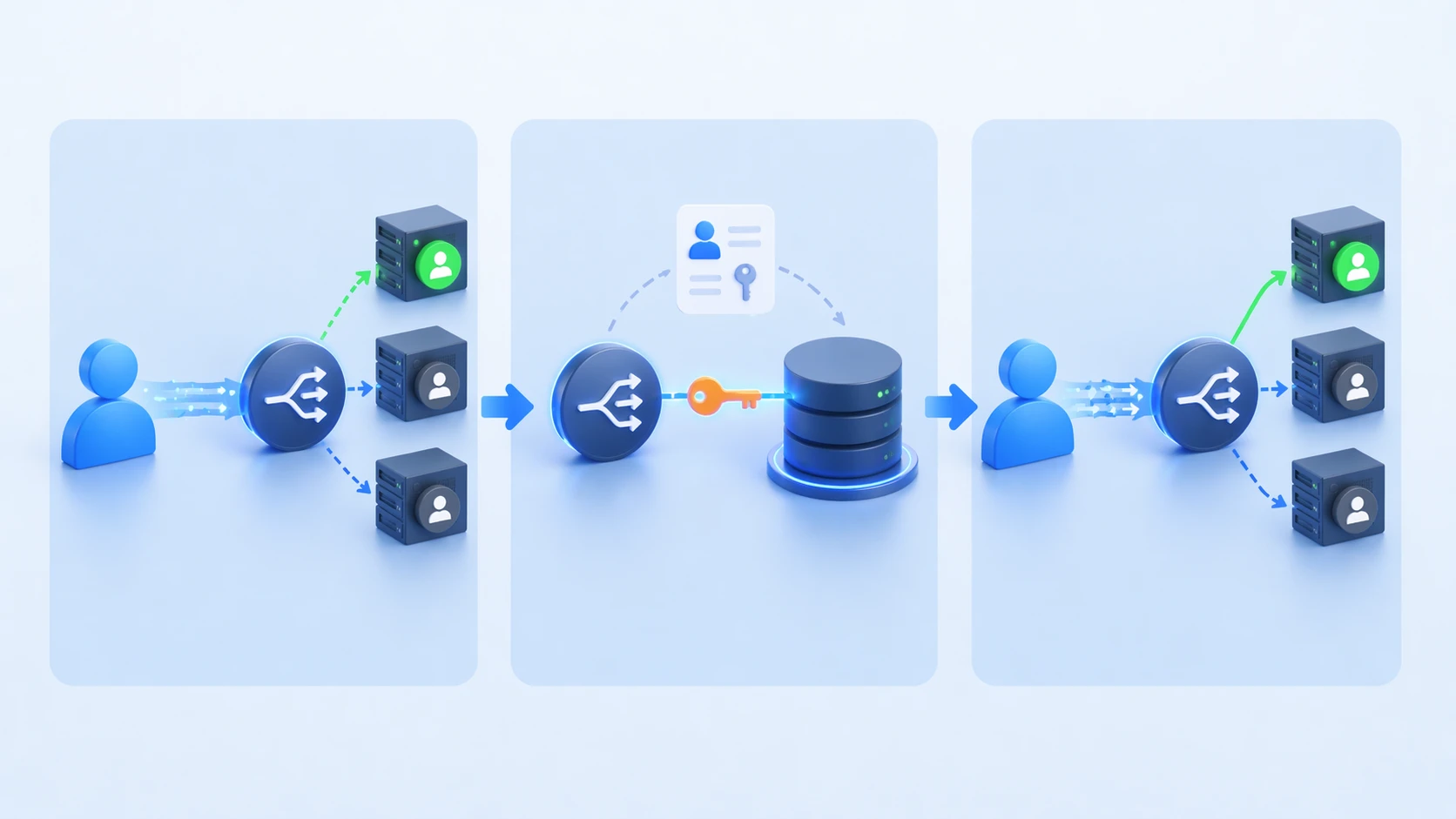
Session persistence works by creating an affinity record after the first request and then reusing that backend selection for later requests from the same client.
Common Session Persistence Methods
Cookie-Based Persistence
Cookie-based persistence is one of the most common approaches in HTTP and web application environments. The load balancer or application sets a cookie that identifies the session-to-backend relationship. Later requests carrying that cookie are routed back to the same backend server for the configured duration.
This method works well in browser-based workflows and is widely used in shopping, authentication, and portal-style applications because cookies naturally fit repeated user interactions over HTTP and HTTPS. It can also be more precise than simpler network-level methods in shared public internet environments.
Cookie-based persistence is often a strong default for classic web application session continuity, especially when browser participation is central to the workflow.
Source IP or Hash-Based Persistence
Another common method is persistence based on the client’s source IP address or on a hash of some request attribute. This method can be easy to deploy because it does not require application cookies, but it also has limitations. Users behind shared NAT gateways may be grouped together unintentionally, and mobile or roaming users may lose persistence if their visible IP changes.
For that reason, source-IP persistence is often best suited to controlled environments rather than unpredictable internet-scale client populations. It can still be effective in managed enterprise networks, internal applications, or certain infrastructure scenarios.
The simplicity of the method is attractive, but the real usefulness depends on how stable and unique the input attribute remains over the life of the session.
Application-Aware or Custom Persistence
Some platforms support more advanced persistence methods that use application data, protocol fields, or custom matching logic rather than only simple cookies or IP addresses. This kind of persistence is valuable when the application has a more complex session identity model or when standard cookie-based methods are not enough.
It also shows that session persistence can be tuned to the application layer rather than treated as a single fixed feature. In large or specialized environments, this may produce more reliable affinity behavior than generic approaches.
However, advanced persistence usually requires more careful design, testing, and operational understanding than standard cookie-based stickiness.
The best persistence method depends on how the application identifies a user session, not just on what the load balancer happens to support.
Benefits of Session Persistence
Session Continuity for Stateful Applications
The clearest benefit of session persistence is continuity. If the application stores temporary session data locally on one backend instance, persistence allows the user to continue interacting with that same instance instead of bouncing unpredictably between nodes.
This reduces broken sessions, repeated logins, partial form loss, and inconsistent application behavior. For older applications or quickly deployed web workloads, it can be the simplest way to preserve a stable user experience.
In some environments, persistence is not just helpful. It is the difference between a usable session-based application and one that behaves unreliably under load balancing.
Simpler Application Architecture in Some Cases
Persistence can also simplify application design when the alternative would require moving all session state into a distributed shared store immediately. Teams can scale horizontally while still relying on local session state, at least during a transitional stage of architecture maturity.
That does not mean persistence is always the ideal long-term design, but it can be practical. It allows teams to support continuity without redesigning every session-dependent feature at once.
This is one reason sticky sessions often appear in real production systems even when engineers ultimately prefer more stateless models.
Potential Performance Benefits
There can also be performance benefits. If the same backend keeps a user’s temporary state or cache warm locally, repeat requests may avoid repeated state reconstruction or unnecessary synchronization across nodes. In workloads with repeated short-term user interactions, this can make the application feel more responsive even if the main reason for persistence is correctness rather than speed.
These gains are especially noticeable when the application keeps hot session data in local memory and would otherwise need extra shared-store lookups or state rebuilding on every request.
As a result, persistence can improve both user continuity and backend efficiency in the right workload profile.

Session persistence is most valuable where repeated user requests depend on temporary state that is still tied to a particular backend instance.
Trade-Offs and Limitations
Less Even Load Distribution
The main trade-off of session persistence is that it reduces pure load-balancing flexibility. If users must return to the same backend, the platform cannot rebalance every request freely according to current load. This can lead to uneven traffic distribution if some persistent sessions are much heavier than others or remain active for long periods.
In practice, that means administrators need to think about both per-session behavior and total node utilization. Sticky sessions can improve continuity while still creating hot spots if session populations are not balanced well.
This trade-off is one of the main reasons persistence should be enabled deliberately rather than by default.
Failover Complexity
Persistence can also complicate failover. If a backend server becomes unavailable, the persistence record may no longer point to a valid destination. The platform must then break stickiness, reassign the session, or let the user reestablish state. This is one reason persistence works best when the application can tolerate reassignment or when some external session recovery mechanism still exists.
In other words, persistence helps continuity, but it should not be mistaken for a substitute for resilient application state management. If the bound node fails and the state exists nowhere else, some user disruption is still likely.
Good session architecture therefore balances persistence convenience with graceful failure handling.
Not Ideal for Fully Stateless Architectures
Many modern cloud-native architectures deliberately avoid dependence on sticky sessions. They externalize session state into shared data stores, tokens, caches, or distributed identity layers so any healthy backend can serve any request. In those architectures, persistence may be unnecessary or even undesirable because it limits balancing flexibility without adding needed value.
This is why session persistence should be treated as a design choice, not an automatic default. It is useful when the application model calls for it, but not every application should depend on it.
For modern platform design, a helpful rule is simple: use persistence where it solves a real state problem, and avoid it where stateless patterns already solve that problem better.
Session persistence is often a practical solution, but it is not a universal best practice. Its value depends on whether the application still relies on backend-local session state.
Applications of Session Persistence
Web Applications with Login State
One of the most common applications is login-oriented web applications where authentication state, user workflow, or temporary context is still maintained on one backend instance. Persistence helps ensure that later authenticated requests continue to reach the same server.
This is especially relevant in older web platforms, customized enterprise portals, or mixed modernization environments where session state has not yet been fully externalized.
For these applications, persistence often serves as an operational bridge between legacy session handling and modern load-balanced infrastructure.
Shopping Carts and E-Commerce Flows
E-commerce systems often use session persistence when cart contents, temporary pricing logic, or checkout state is kept locally on an application instance. In these workflows, persistence helps avoid broken checkout experiences and repeated re-creation of temporary session data.
This application is a classic example because customers typically perform a sequence of related actions over a short period of time, and the business impact of losing session continuity can be immediate.
Where cart and checkout state remain node-local, session persistence can be highly valuable.
Multi-Step Forms and Transaction Workflows
Applications that use multi-step forms, guided onboarding, or staged transaction flows can also benefit from persistence when each step depends on temporary in-memory state from earlier steps. By keeping the user on the same backend during the flow, the load balancer reduces the risk of losing continuity midway through the process.
This can be useful in registration systems, internal business portals, claims processes, support portals, and administrative workflows where the session is not only authenticated but also procedural.
These workflows often expose session inconsistency very clearly, which is why persistence is frequently adopted there first.
Chat, Realtime Web Sessions, and API Gateways
Persistence is also useful in some chat applications, realtime stateful interactions, and API gateway scenarios where upstream services expect continuity on the same node. In API environments, persistence may be used selectively when backend-local caches or transaction context make repeat routing beneficial, though many API platforms prefer stateless design wherever possible.
For realtime or conversational services, keeping the same interaction on one node can reduce state reconstruction and improve continuity, especially in transitional architectures.
As always, the decision depends on where session or conversation state actually lives.
Kubernetes and Ingress Environments
Cloud-native and Kubernetes deployments also use session persistence in selected workloads. This is especially useful during migration phases, for stateful web workloads, or when not every service in the cluster has been redesigned to be fully stateless yet.
In these environments, ingress or gateway-level persistence can help maintain stable routing to pods or upstream services while the platform continues to benefit from shared frontend access and scalable deployment patterns.
It is a common practical compromise in real production clusters that host a mix of old and new application designs.
Best Practices for Deployment
Use Persistence Only Where It Solves a Real Problem
The first best practice is to enable session persistence only when the application actually depends on per-node continuity. If the workload is already stateless, adding stickiness may reduce balancing flexibility without meaningful benefit. Persistence should be driven by application behavior, not enabled automatically by habit.
This also helps keep the architecture cleaner over time. Teams can use persistence where required while still moving other services toward more resilient shared-state or stateless models.
That selective approach tends to produce healthier long-term platform design.
Choose the Persistence Method Deliberately
Cookie-based persistence is often the best fit for browser and web application sessions, while source-IP or hash-based methods may fit controlled environments better. More advanced application-aware methods may be needed in specialized cases. The method should match how the application identifies session continuity and how clients actually behave in the network.
Choosing the wrong persistence method can create weak affinity, false grouping, or unnecessary complexity. A simple method is not always the right method.
Method selection should therefore be treated as an application-design decision as much as an infrastructure decision.
Set Timeouts and Failover Behavior Carefully
Persistence duration should be long enough to support the user’s workflow, but not so long that stale affinity remains unnecessarily. Administrators should also test what happens when the bound backend becomes unavailable. A good deployment acknowledges that persistence improves continuity but does not eliminate the need for proper failover planning.
That balance between continuity and resilience is one of the most important design considerations in any sticky-session architecture.
When persistence is configured well, it supports stability without locking the platform into rigid or fragile behavior.
FAQ
What is session persistence in simple terms?
Session persistence is a load-balancing feature that keeps a user’s requests going to the same backend server for part of the session instead of redistributing every request independently.
Is session persistence the same as sticky sessions?
Yes. Sticky sessions and session affinity are common alternative names for session persistence in load-balancing environments.
Why do some applications need session persistence?
Some applications keep temporary session data on one backend instance, such as login state, shopping carts, chat context, or multi-step workflow data. Persistence helps later requests return to the same instance.
What are the main ways to implement session persistence?
Common methods include load balancer cookies, application cookies, source IP or hash-based affinity, and more advanced application-aware persistence methods.
Is session persistence always a good idea?
No. It is useful for stateful applications, but fully stateless architectures often do not need it and may benefit from more flexible load distribution instead.