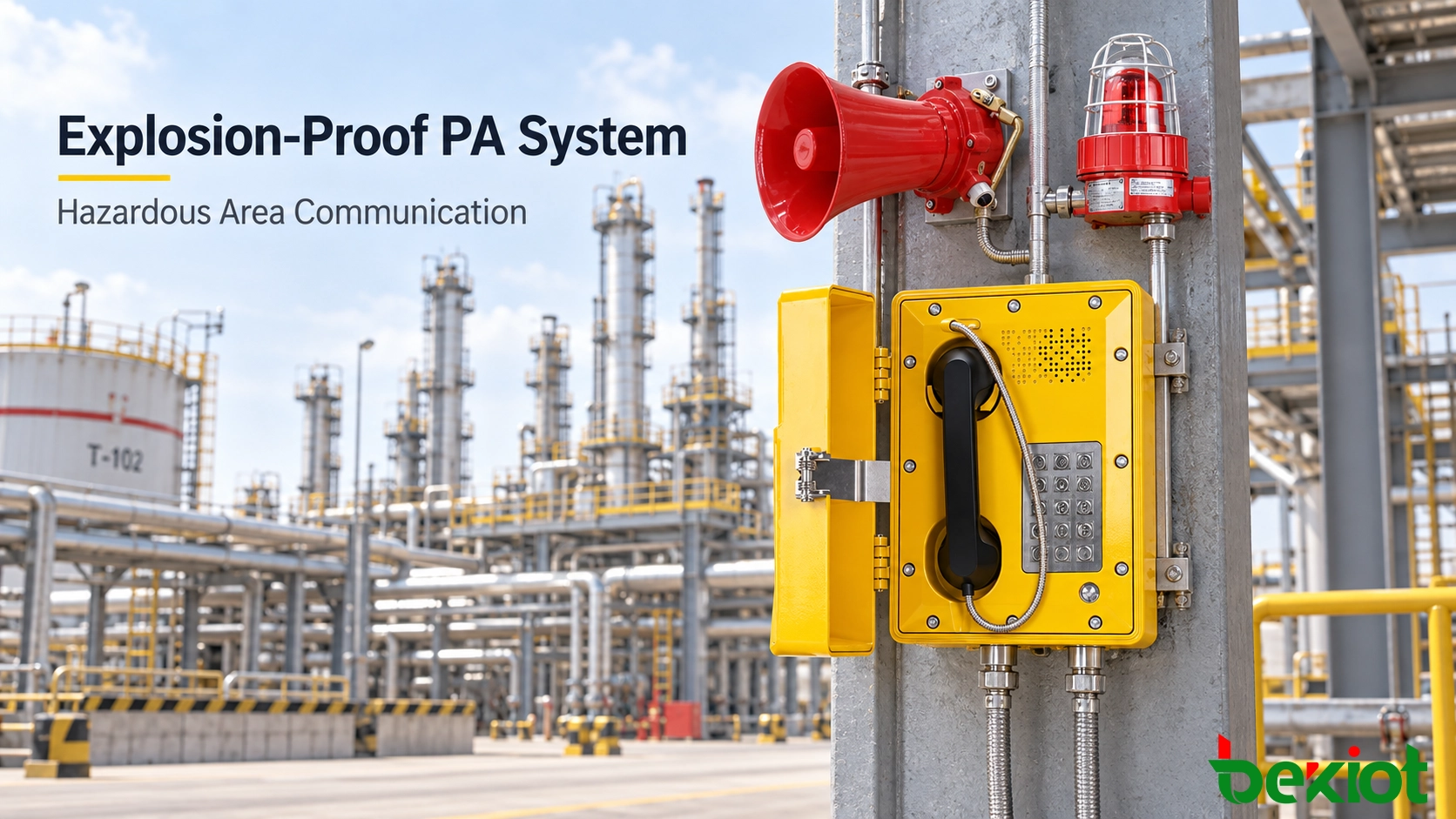
In hazardous industrial environments, communication is closely tied to safety, coordination, and operational continuity. Oil and gas plants, petrochemical facilities, offshore platforms, chemical processing sites, tank farms, mining areas, and other high-risk industrial locations often face a combination of explosive atmospheres, high ambient noise, wide-area coverage requirements, and harsh environmental exposure. In these settings, ordinary communication equipment is often not enough. What operators need is a communication system designed specifically for hazardous areas, one that supports dependable voice contact, rapid paging, emergency broadcasting, and structured dispatch coordination under demanding field conditions.
At Becke Telcom, we approach this requirement as both a communication challenge and a site-safety challenge. An explosion-proof paging and intercom system should not be viewed as a single endpoint or a simple loudspeaker network. It should function as an integrated industrial communication solution that connects control rooms, field personnel, maintenance teams, safety supervisors, and emergency response workflows across critical areas. When properly designed, the system improves daily operations while also strengthening incident response readiness.
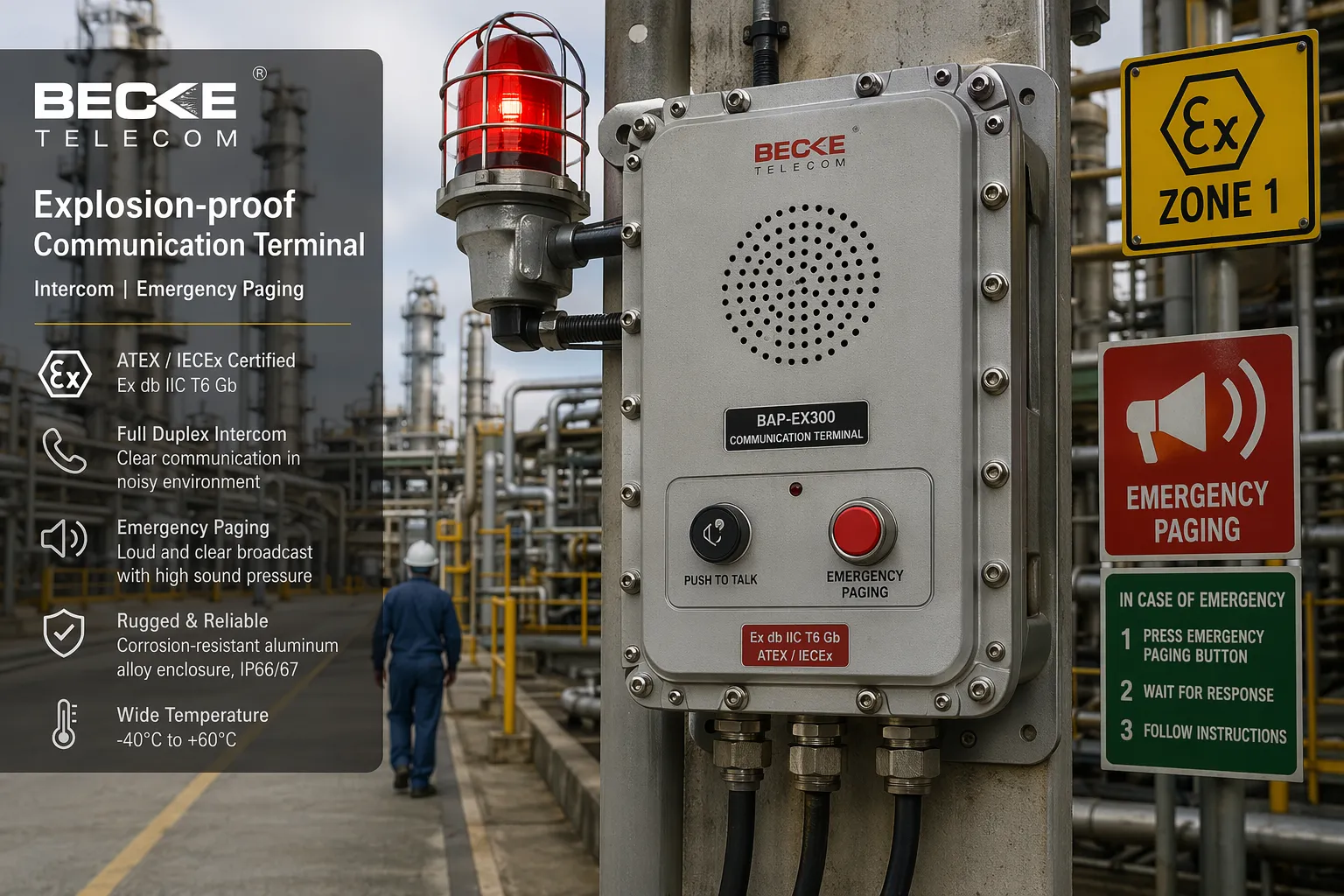
Why Hazardous Industrial Areas Require a Specialized Communication System
Communication Conditions Are More Demanding Than in Ordinary Facilities
Hazardous industrial areas are fundamentally different from offices, commercial buildings, and conventional production floors. These sites may contain flammable gases, volatile vapors, combustible dust, corrosive substances, or high-risk process equipment. They may also span large outdoor sections, elevated steel structures, enclosed process units, utility corridors, loading zones, and remote operational points. As a result, communication systems must support more than basic calling. They must remain available, understandable, and safe under real industrial conditions.
In many high-risk facilities, the communication problem is not caused by one factor alone. Noise from pumps, turbines, compressors, transport lines, or heavy machinery can reduce speech clarity. Distance between work points and the control center can delay coordination. Restricted areas may make it difficult for workers to move quickly when help is needed. Environmental exposure such as rain, salt spray, dust, heat, and vibration can also affect equipment performance. A hazardous-area communication system must therefore be engineered to maintain reliable operation in settings where failure or delay can have serious consequences.
For this reason, the choice of communication equipment in hazardous zones is closely connected to plant safety management, field efficiency, and emergency response capability. It is not only about connecting calls. It is about creating a dependable communication structure that supports people, processes, and protection measures every day.
Explosion Protection Is Only One Part of the Requirement
Many buyers begin their evaluation by focusing on explosion-proof certification, which is essential, but certification alone does not define system value. A truly practical explosion-proof paging and intercom solution must also address usability, network compatibility, call management, paging control, zone coverage, and lifecycle maintainability. If the system is difficult to operate, poorly integrated, or weak in acoustic performance, it may still underperform even if it meets hazardous-area equipment requirements.
At Becke Telcom, we believe industrial communication design must reflect how the site actually works. Field users need devices that are easy to activate and hear. Supervisors need structured call and paging control. Operators in the control room need the ability to reach specific zones, groups, or individuals without delay. Maintenance teams need straightforward deployment and support. This is why our system thinking goes beyond enclosure safety and extends into overall communication workflow design.
In hazardous industrial areas, a communication system should not simply survive the environment. It should actively support safer actions, clearer coordination, and faster response.
What Is an Explosion-Proof Paging and Intercom System
A Combined Voice, Paging, and Emergency Communication Solution
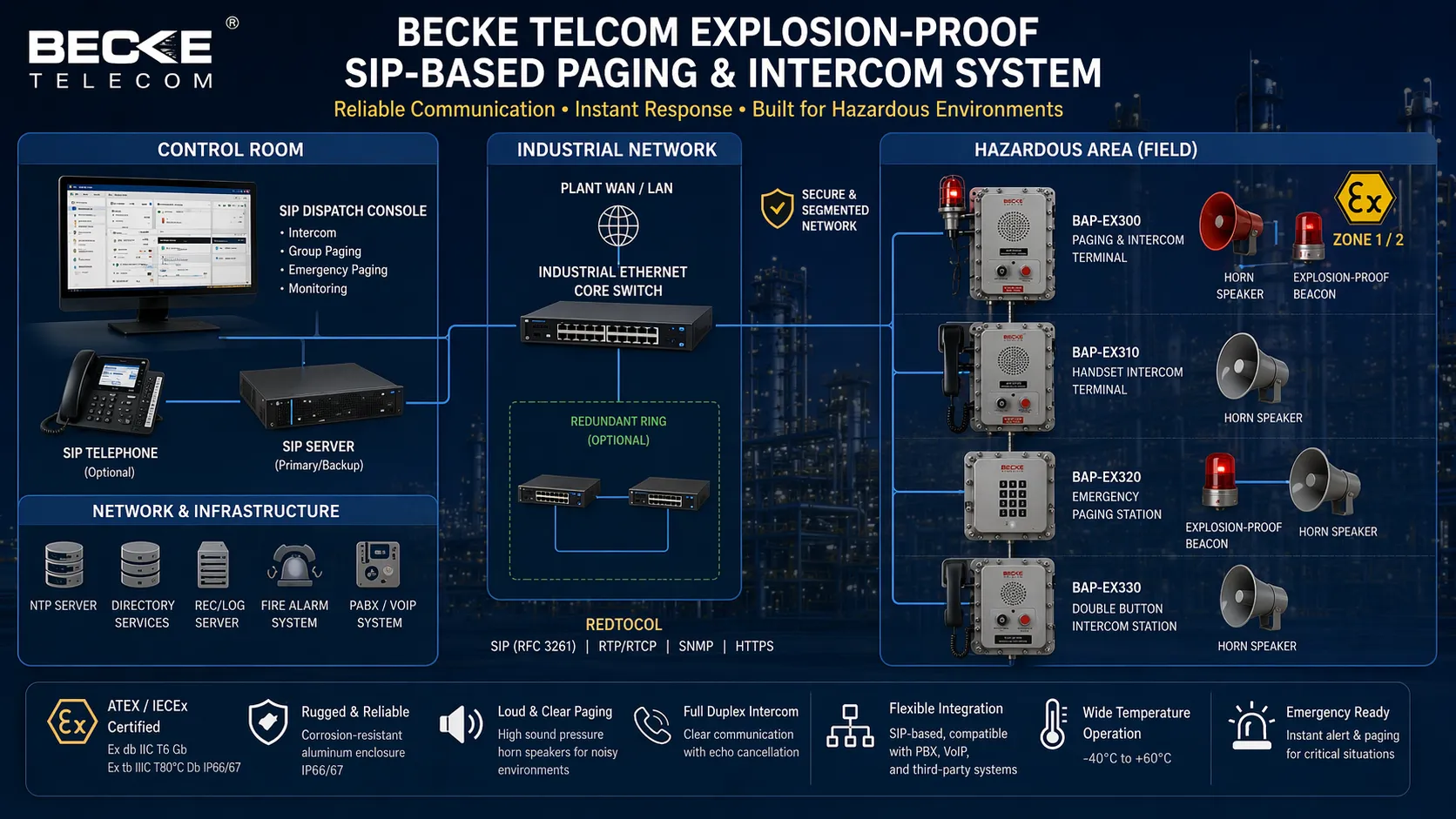
An explosion-proof paging and intercom system is an industrial communication solution designed to provide safe two-way voice communication and controlled audio broadcasting in hazardous environments. It usually combines explosion-proof telephones or intercom stations, industrial paging terminals, horn speakers or loudspeakers, amplifiers, SIP communication platforms, dispatch interfaces, and network infrastructure into one coordinated system.
Its function is much broader than that of a traditional standalone phone or a simple broadcast endpoint. In daily operation, it can support routine field communication, production coordination, maintenance assistance, and area paging. In abnormal or emergency situations, it can support warning announcements, emergency instructions, incident coordination, evacuation communication, and rapid contact between exposed field positions and a central control room.
This combined structure is especially valuable in hazardous industrial sites because operational communication and emergency communication often overlap. A worker may need to report a fault, request isolation support, alert nearby teams, and coordinate with supervision in quick succession. A system that unifies intercom and paging functions helps reduce communication fragmentation during such moments.
A System That Can Be Built Around Modern SIP and IP Architecture
Modern hazardous-area communication systems increasingly use SIP and IP architecture instead of remaining limited to isolated analog deployment. This allows explosion-proof endpoints and paging devices to connect with IP PBX platforms, SIP servers, dispatch consoles, recording systems, visual communication platforms, and centralized management tools.
For industrial users, this creates important long-term advantages. It supports easier expansion across multiple buildings or process zones, better central administration, more flexible call routing, and stronger integration with broader communication or security systems. It also helps align the hazardous-area communication layer with modern enterprise and industrial digital infrastructure rather than leaving it as a disconnected subsystem.
How Becke Telcom Builds This Type of Industrial Communication Solution
Field Communication Terminals for Hazardous Locations
At the field level, the system can include explosion-proof telephones, rugged intercom stations, and industrial communication terminals installed in key operating positions. These may be placed near process units, tank areas, loading stations, perimeter work points, marine access sections, tunnels, utility areas, or remote maintenance locations. The purpose is to ensure that personnel have immediate access to reliable communication without depending on consumer-grade devices or unsafe alternatives.
These terminals are typically selected according to the actual environment, required installation method, operating workflow, and communication priority. Some locations require a dedicated emergency call point. Others need a regularly used intercom station for process coordination. In broader system design, endpoint deployment should reflect where communication demand is highest and where incident communication must remain available under pressure.
Becke Telcom focuses on matching endpoint design with industrial usage logic. We do not treat every location the same. Areas with high noise, exposed weather, limited operator mobility, or elevated process risk may require a different communication interface or deployment emphasis from secondary work zones.
Paging and Broadcast Coverage for Operational and Emergency Use
Paging capability is a core part of the system. In hazardous sites, operators often need to deliver live voice announcements, routine notices, warning messages, or emergency instructions to one area or multiple areas at once. Depending on project scope, the system can support zone paging, group paging, all-call broadcasting, scheduled playback, or event-triggered announcements.
This ability is important because industrial sites are rarely managed as one undivided acoustic space. Production units, storage areas, pipe racks, workshops, utility corridors, docks, and service areas each have their own operating patterns. A practical system should allow messages to be directed to the right destination instead of sending every announcement everywhere. This improves clarity, reduces unnecessary disturbance, and supports more disciplined communication procedures.
From the Becke Telcom perspective, paging is not only an alert function. It is also a management tool that helps maintain safer operational order across a complex industrial environment.
Control Room Coordination and Dispatch Integration
The control room is often the communication center of a hazardous industrial facility. This is where operators monitor events, coordinate resources, and respond to abnormal conditions. A well-designed explosion-proof paging and intercom system should therefore give the control room more than simple call-answering capability. It should provide structured communication control, visibility into available endpoints or zones, and the ability to initiate coordinated paging or intercom actions efficiently.
Becke Telcom solutions can be built to work with SIP-based control platforms, IP PBX systems, and industrial dispatch environments, allowing supervisors or operators to manage field communications more effectively. This is especially useful in larger sites where field teams, contractors, maintenance personnel, and safety units may all need to communicate through one organized framework.
When integrated well, the communication system becomes part of plant operations rather than an isolated utility. That improves the speed and consistency of communication during both normal work and urgent response scenarios.
Main Features and Functional Advantages
Reliable Two-Way Communication Between Field and Control Room
Two-way communication is one of the most important capabilities in hazardous industrial areas. A worker who identifies a leak, notices equipment abnormality, requests maintenance support, or encounters a safety concern must be able to speak with the appropriate team immediately. Delays caused by distance, noise, or device limitations can increase operational risk.
An explosion-proof intercom and telephone system helps solve this by creating dependable voice paths between critical field positions and centralized management points. In practical use, this supports faster escalation, clearer instruction, and stronger control over developing situations. The ability to speak directly with a real person, rather than relying only on alarm signals, often improves decision-making during uncertain events.
Zone-Based Paging for More Accurate Communication
Industrial communication becomes more effective when it is targeted. Zone-based paging allows messages to be sent to the exact process area, building section, or work group that needs the information. This is useful not only during emergencies but also during maintenance planning, operational coordination, permit control, and restricted-area management.
For example, a message to maintenance personnel in a loading zone does not necessarily need to be heard across the entire plant. Likewise, an emergency instruction in one process block may need to remain local while supervisors assess the broader situation. Proper zoning helps maintain communication order and reduces confusion in multi-area facilities.
Emergency Broadcasting and Site Warning Support
In emergency conditions, audio communication must be immediate, intelligible, and centrally controlled. A hazardous-area paging and intercom system can support live emergency announcements, pre-recorded warning messages, evacuation instructions, and incident communication procedures aligned with site safety plans. This gives the operator a practical method for reaching exposed personnel quickly.
Because voice instructions can provide context, direction, and reassurance, they often play a valuable role alongside alarms and visual indicators. In many facilities, the ability to broadcast area-specific instructions can help manage movement, reduce uncertainty, and support more orderly response actions.
SIP Integration for Scalable Industrial Communication
SIP integration allows hazardous-area endpoints and paging resources to become part of a larger communication platform. This can include call servers, IP PBX systems, unified communication platforms, dispatch consoles, soft clients, recording platforms, and remote management tools. From a design perspective, SIP support helps the system scale beyond a limited local function.
For industrial buyers, this means better flexibility for future expansion. New process zones, service buildings, or remote operational points can be added more easily. It also makes it more practical to link field communication with headquarters, multi-site operations, or specialized emergency command functions when required.
Compatibility with Broader Safety and Operational Systems
A modern industrial communication platform is more useful when it can cooperate with other systems already in the facility. Depending on project needs, paging and intercom functions may be linked with CCTV, alarm systems, access control, industrial networking, visual dispatch platforms, or plant management procedures. These integrations can help create a more responsive and informative communication environment.
Becke Telcom places strong value on integration because industrial communication increasingly sits at the intersection of voice, monitoring, event handling, and command workflow. The more effectively these functions interact, the more practical the final solution becomes for the operator.
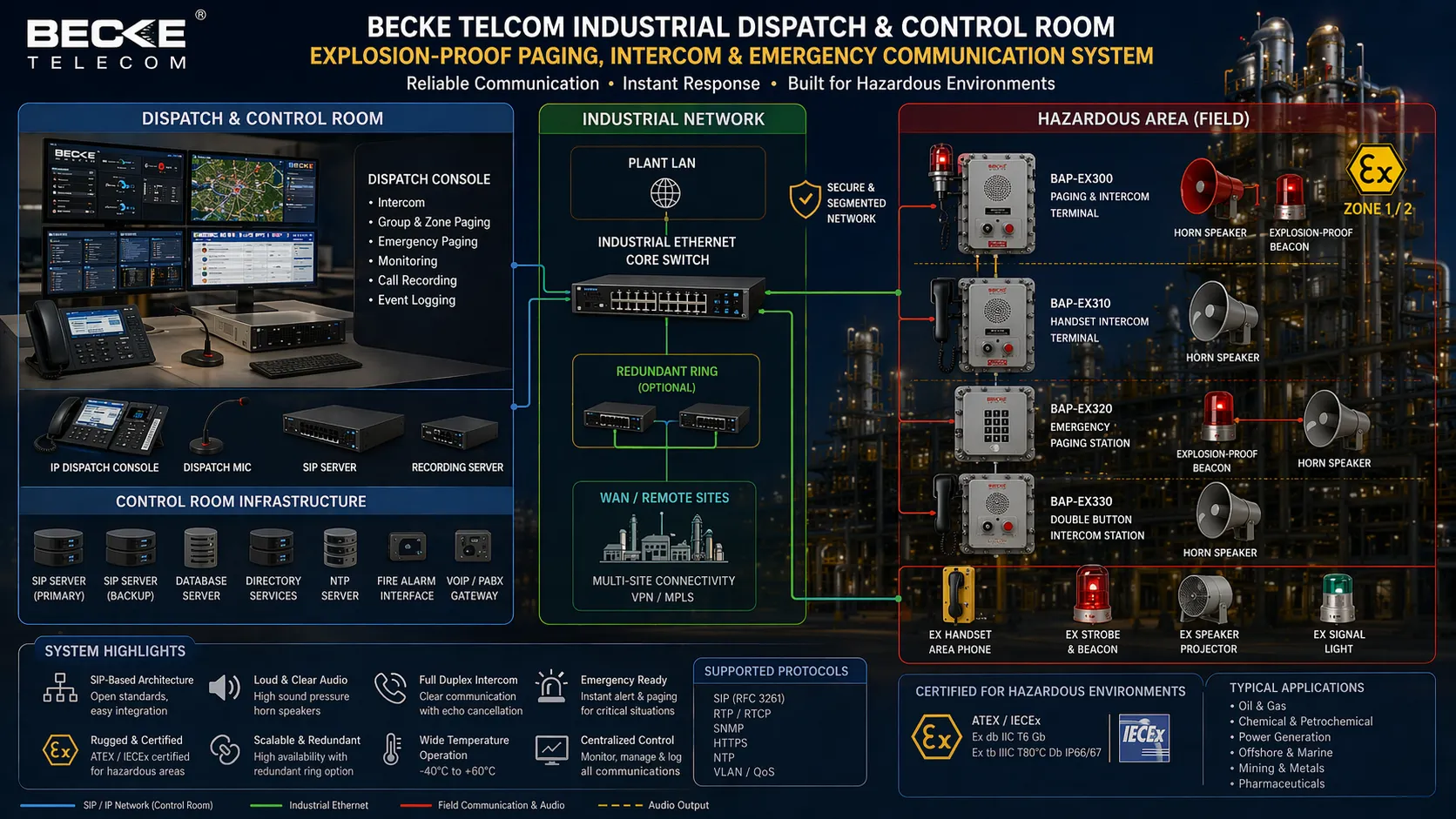
Typical System Architecture for Hazardous Industrial Areas
Core Platform Layer
At the center of the system is usually a SIP server, IP PBX, or industrial communication platform responsible for call control, user and endpoint management, paging permissions, and communication logic. In projects with higher coordination needs, this layer may also include dispatch software, recording, event linkage functions, and visual operator interfaces.
This central layer determines how communication resources are organized and controlled. It is where groups, zones, priorities, and operational policies are usually defined. Good platform design is essential because it affects not only communication performance but also manageability and future growth.
Network and Transmission Layer
The transmission layer connects the control platform with field endpoints and paging devices. In IP-based deployment, this may include industrial Ethernet switches, optical transmission, protected network segments, or other structured industrial networking methods suited to the site. In larger or more critical installations, redundancy may also be considered to reduce the impact of failures on essential communication paths.
At Becke Telcom, network design is treated as part of solution reliability. Even the best endpoint hardware cannot perform well if the transmission path is poorly planned. For that reason, communication topology, distance, environmental constraints, and operational priorities should all be considered during solution design.
Field Device and Broadcast Layer
The field layer includes explosion-proof telephones, industrial intercom stations, paging terminals, horn speakers, amplifiers, and other devices placed in work areas that require communication access or broadcast coverage. Their deployment should be guided by real site behavior: where personnel operate, where hazards are concentrated, where warning communication is most important, and where direct control-room access is needed.
This is also the layer where acoustic conditions matter most. Device placement, speaker direction, ambient noise, and coverage strategy all influence practical performance. A successful design therefore balances technical architecture with real environmental behavior instead of treating deployment as a purely schematic exercise.
Typical Application Scenarios
Oil and Gas Processing Facilities
Oil and gas sites often combine hazardous process units, outdoor structures, loading areas, rotating equipment, and centralized supervision. These conditions make explosion-proof voice communication especially important. Paging and intercom systems help connect field workers with the control room while also supporting operational announcements and emergency communication across process areas.
Petrochemical and Chemical Plants
Petrochemical and chemical environments often require disciplined communication across multiple zones with different process characteristics. Personnel may need to report abnormal equipment conditions, coordinate isolation tasks, request maintenance, or respond to area warnings. A zoned explosion-proof system provides a more controlled way to manage these interactions than informal or fragmented communication methods.
Offshore Platforms and Marine Energy Sites
Offshore projects demand communication equipment that can handle exposure, operational complexity, and safety-sensitive workflows. Explosion-proof paging and intercom systems support coordination between deck areas, process sections, technical rooms, and control centers while helping maintain readiness for incident communication in isolated environments.
Hazardous Storage and Tank Farm Areas
Tank farms and hazardous storage sites often cover broad outdoor areas where rapid voice contact and warning capability are both important. Communication points near transfer areas, valve stations, access points, and supervisory posts can improve daily coordination and create more immediate communication access during abnormal events.
Mining, Utility, and Industrial Infrastructure Projects
Although project conditions vary, many mining and industrial infrastructure sites also require rugged communication with controlled broadcast capability. In these environments, a Becke Telcom solution can be adapted to support remote work areas, exposed field conditions, emergency call needs, and centralized coordination requirements.
The best hazardous-area communication systems are designed around actual operating behavior: who needs to talk, where they need to talk from, how fast they need support, and what must happen when conditions change suddenly.
What Buyers Should Consider When Selecting a Solution
Hazardous-Area Suitability and Environmental Durability
Explosion-proof suitability is a basic requirement, but buyers should also assess enclosure strength, weather resistance, corrosion resistance, installation method, and long-term durability in the specific environment. A coastal offshore installation, for example, may present different demands from an inland chemical plant or a covered process workshop.
Audio Practicality in Real Industrial Conditions
Clear communication in a quiet test environment is not the same as usable communication near operating machinery or in exposed outdoor locations. Buyers should consider whether the system is designed to maintain intelligibility and practical usability in the acoustic conditions that actually exist on site.
Architecture Flexibility and Integration Potential
A system that works only as a standalone product may offer limited long-term value. Buyers should consider whether the solution can integrate with SIP platforms, IP PBX systems, control room workflows, and existing plant communication or safety infrastructure. This affects both immediate project value and future expansion flexibility.
Operational Simplicity and Maintenance Logic
Industrial communication systems should support the people who operate and maintain them. Endpoint usability, central management logic, maintenance accessibility, and fault handling simplicity all influence how well the system performs over time. A solution that looks strong on paper but is difficult to manage can create long-term inefficiency.
Why Becke Telcom
Industrial Communication Thinking, Not Just Endpoint Supply
Becke Telcom focuses on industrial and emergency communication products and solutions for demanding environments. Our approach is not limited to supplying a single device. We pay attention to how telephones, intercoms, paging devices, broadcast resources, SIP platforms, and dispatch functions work together as a complete industrial communication structure.
This is especially important in hazardous industrial areas where system design quality has a direct influence on usability and response effectiveness. We aim to help customers build communication solutions that are practical in the field, manageable from the control room, and scalable for future operational needs.
Designed for Integration and Real Project Use
Whether the requirement involves explosion-proof field telephony, zoned paging, SIP intercom deployment, or broader communication platform integration, Becke Telcom emphasizes application-oriented system value. We understand that industrial customers need communication systems that support real workflows, not just product features listed in isolation.
For hazardous-area projects that require reliable communication, controlled broadcasting, and a stronger connection between field operations and central coordination, Becke Telcom provides solution support aligned with industrial realities.
FAQ
What is the main purpose of an explosion-proof paging and intercom system?
Its main purpose is to provide safe, reliable two-way communication and controlled audio broadcasting in hazardous industrial environments where ordinary communication equipment may not be suitable. It supports both daily operations and emergency response.
Can this type of system be integrated with SIP or IP PBX platforms?
Yes. Many modern solutions, including Becke Telcom system designs, can be built on SIP and IP architecture, allowing integration with IP PBX platforms, dispatch systems, recording, and broader industrial communication networks.
Is the system only for emergency use?
No. It is valuable for both daily communication and emergency situations. In normal operation, it supports field coordination, maintenance communication, and routine announcements. In emergencies, it supports warnings, instructions, and centralized incident communication.
Which industries commonly use explosion-proof paging and intercom systems?
They are commonly used in oil and gas, petrochemical, chemical processing, offshore energy, hazardous storage, mining, power, marine terminals, and other industrial environments where safety and communication reliability are essential.